What Does a Tokenomics Expert Do? A Founder's Guide to Hiring One
A tokenomics expert designs, documents, and strategizes your token model so it holds up to investor and regulatory scrutiny. What they do and when to hire one.


A tokenomics expert designs, documents, and stress-tests the economic model behind a token so it holds up to investor diligence, exchange listing review, and regulatory scrutiny. The role spans three deliverables: mechanism design, investor-grade documentation, and launch and liquidity strategy tied to a business that already generates revenue.
A tokenomics expert is the person who designs, documents, and stress-tests the economic model behind a token so it holds up when investors, exchanges, and regulators look under the hood. The role covers three things: designing the mechanics, meaning allocation, vesting, supply, and utility; documenting them at investor-grade quality; and building the launch and liquidity strategy around them. A good one ties every decision back to a single question: how does the underlying business actually make money?
The stakes are not abstract. A token model that looks clever in a spreadsheet can still create concentrated sell pressure, fail an exchange listing review, or draw regulatory questions the founder never anticipated. Most tokens that fail, fail on economics, not technology. That is the gap a tokenomics expert is hired to close.
This guide is for founders building onchain who know they need help but cannot yet define the role. Pre-raise, pre-TGE, or mid-design, the questions are the same: what does this person actually deliver, what should they know, and when do you bring them in? One frame runs through all of it. A token is infrastructure that amplifies a real business. It does not replace one. A tokenomics expert who forgets that is designing a countdown timer.
tokenomics expert: a specialist who designs, documents, and stress-tests a token's economic model, covering allocation, vesting, supply, and utility, so it withstands investor, exchange, and regulatory review.
#What a tokenomics expert actually does
A tokenomics expert works across three pillars: design, documentation, and strategy. Each pillar produces concrete deliverables, not abstractions. If you cannot point to an artifact at the end of an engagement, the work was not done.
Most founders picture a tokenomics expert as the person who invents a clever mechanism. That is the smallest part of the job. The harder work is making sure the mechanism survives contact with a legal review, a treasury model, and a market that does not care how elegant the design looked in a pitch deck. Clever and fragile is common. Sustainable beats aggressive every time.
The point of all three pillars is to enable the people around you. Legal gets compliance-ready documents. Your developers get specs precise enough to build against. Marketing gets a position it can defend. Finance gets projections it can plan against. We've advised 100+ projects through $100MM+ in combined raises, and the pattern is consistent: the model only creates value when every stakeholder can act on it.
#The three pillars: design, documentation, and strategy
Design is the mechanism work. Token utility, allocation tables, vesting schedules, unlock cliffs, emission curves, and the supply logic that governs how many tokens exist and when they enter circulation. This is where a tokenomics expert decides whether the model creates real demand or just prints sell pressure on a schedule. Revenue-first design starts here, with the question of what the token does for a business that already makes money.
Documentation turns those decisions into investor-grade artifacts. A token model that lives only in the founder's head is worthless in a diligence process. The expert produces the written record: mechanism rationale, supply and demand projections, Monte Carlo stress tests, and the compliance-ready documents your legal team needs to do its job. Get your house in order here, before an investor asks for it, not after.
Strategy is the launch and liquidity layer. When does the token generation event happen? How deep does initial liquidity need to be? What does the exchange budget look like, and how do vesting unlocks interact with treasury runway? A tokenomics expert sequences these so the launch does not fall apart in month three. As a concrete example, a four-year linear vest with a twelve-month cliff for the team reads very differently to an investor than a schedule that unlocks half the supply in year one. The expert models both against your runway and shows you what each does to sell pressure.
#The skills a real tokenomics expert has
Titles vary. Some people call themselves a tokenomics specialist, others a token economist or a token designer. The label matters less than four fluencies. If someone claims the role without them, keep looking. The crypto market is full of people who can talk fluently about tokenomics and far fewer who can build a model that holds up under review. A confident vocabulary is not a skill set.
#Token-standard and contract fluency
A tokenomics expert should know the token standards cold, from the baseline ERC-20 mechanics documented at ethereum.org to security-token standards like ERC-1400 and ERC-3643 that embed transfer restrictions and identity verification directly in the smart contract (Source: ethereum.org). The standard you choose shapes what compliance you can enforce later. Choosing wrong means a costly migration, and that migration is a project-level disruption, not a quick fix.
They do not need to be a Solidity auditor. They should read audited contract patterns and know where audit firms fit. Familiarity with widely reviewed libraries like the ones documented at docs.openzeppelin.com is a reasonable proxy for whether someone understands what production-grade token contracts actually look like (Source: docs.openzeppelin.com). A candidate who has never opened an audited contract is guessing about the code your token will run on.
#On-chain data and regulatory fluency
A real tokenomics expert reads the market instead of guessing about it. Circulating supply versus fully diluted supply, unlock schedules, liquidity depth, and fully diluted valuation are all observable. Public dashboards like defillama.com track total value locked, unlock calendars, and protocol revenue across the market (Source: defillama.com). If a candidate cannot tell you where they get their data, treat that as a signal. The difference between someone who says "liquidity looks fine" and someone who says "circulating supply triples at the six-month unlock while liquidity depth stays flat" is the difference between an opinion and an analysis.
Regulatory fluency is the fourth. Token classification questions sit close to securities law, and the analysis is fact-specific and jurisdiction-specific. A tokenomics expert should understand the Howey-test-adjacent questions that shape whether a token looks like a security, and the SEC publishes its framework and enforcement actions at sec.gov (Source: sec.gov). Note the posture. The expert helps you understand the questions. They do not tell you a design "is compliant" or "is not a security." That is your legal team's call, and in our view, anyone who promises otherwise has told you something useful about how they work.
#When to hire a tokenomics expert
There is no universal right moment, but there are clear signals. Four situations tend to send founders looking for help.
Pre-raise. Investors will ask hard questions about allocation, vesting, and supply. If you cannot answer them with documentation, the conversation ends. This is where getting your house in order pays for itself, before you walk into the room, not after you have lost it.
Pre-TGE. The token generation event forces decisions you cannot easily reverse: initial liquidity depth, exchange budget, the first unlock schedule. These compound. Getting them wrong tends to surface months later as sell pressure or a broken market.
Mid-design pivot. Sometimes the utility is not working. Holders have no reason to keep the token, velocity is high, and the model is not capturing value. This is the moment to bring in a tokenomics expert who can diagnose why and restructure before launch locks the mistake in.
Post-launch review. Governance is stalling, or concentrated wallets are creating sell pressure you did not model. A tokenomics expert can read what actually happened onchain and tell you which mechanics to adjust and which to leave alone.
Here's what most founders get wrong on timing: they wait until the model is nearly locked, then ask a tokenomics expert to bless it. By then the expensive decisions are already made. The most useful engagements start while the design is still a set of open questions, not a finished spreadsheet defended by sunk cost.
If you recognize your project in any of these, that is usually the point to hire a tokenomics expert rather than keep improvising your way through decisions where any one of them can be hard to undo.
Ready to bring in help? See what our tokenomics consulting service covers before you compare titles below.
#Tokenomics expert vs. tokenomics consultant vs. tokenomics advisor
Founders search these three terms as if they name different things. In practice they overlap, and the title tells you less than the scope.
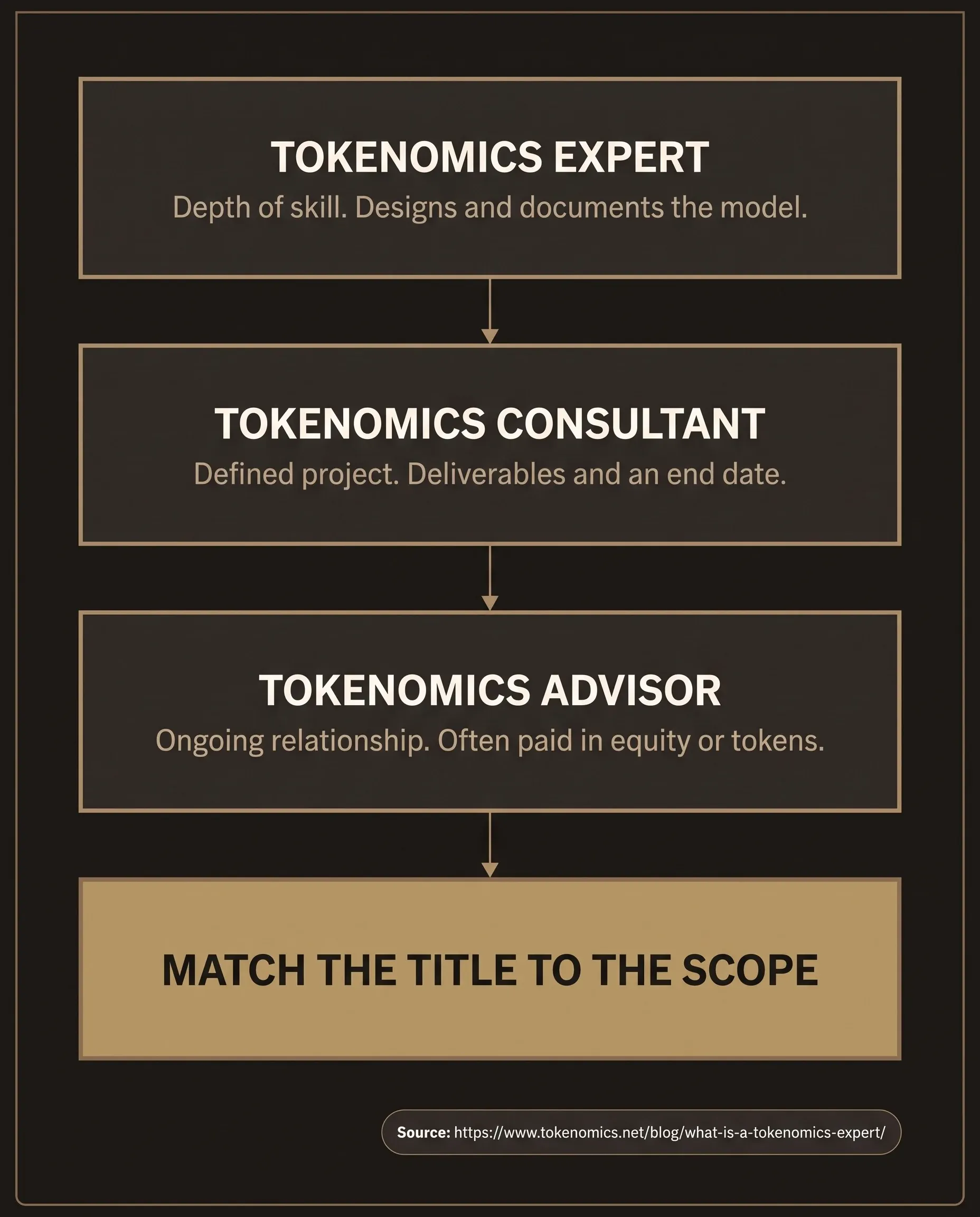
A tokenomics expert usually describes someone hired for depth of skill: they design and document the model itself. A tokenomics consultant describes an engagement model more than a skill set, typically a defined project with deliverables and an end date. A tokenomics advisor describes an ongoing relationship, someone who stays close to the project across quarters, often compensated in equity or tokens rather than a fixed project fee.
Be honest about the overlap. The same person may hold all three labels depending on the contract. What matters is not the word on the invoice. It is the scope and whether the deliverables are complete.
The practical read is simple. If you are pre-launch and need the model built, you are hiring for expertise. If you have a model and need a fresh set of eyes, you are hiring a consultant for a defined review. If you want someone in the room as the project evolves over the next year, you want an advisor. Founders often need the first, think they want the third, and discover a consultant-shaped project is what actually fits.
We go deeper on the engagement side in our guide to tokenomics consulting, which walks through how a defined project is structured and priced.
Read the full tokenomics consulting guide for more detail.
#How to evaluate a tokenomics expert before you hire one
Once you decide to hire a tokenomics expert, the harder problem is telling a real one from professionally packaged noise. Use a short checklist, and treat each question as a filter.
Ask for real deliverable samples, not a wall of logos. A portfolio of client names proves nothing about the work. Redacted model samples, sample documentation, an actual vesting schedule they built: that is evidence you can inspect.
Ask how they handle stakeholder handoffs. The output has to move to legal, developers, marketing, and finance. If they cannot describe that handoff clearly, the documentation behind it probably does not exist.
Ask what happens when the model says something will not work. A tokenomics expert who only validates your existing plan is not advising you. The value sits in the honest "this breaks in month nine" conversation, not in agreement.
Ask how they frame regulatory questions. The right answer is narrow and jurisdiction-aware. Anyone who tells you a design "is compliant" or is definitively "not a security" is overselling a call that belongs to your lawyers. The confident version of that claim is the red flag.
Ask who reviews the numbers. A model that no one has stress-tested is a hypothesis. Ask whether the projections ran through Monte Carlo simulation or a second reviewer, and what the worst case looked like. A tokenomics expert who only shows you the base case is showing you half the picture.
The worst outcome is not paying for help. It is paying for professionally packaged work with a fundamental flaw you discover after launch. If the design is already partway built, a third-party tokenomics audit is a cheaper way to catch that flaw than a failed raise.
See what our tokenomics audit service covers and how it differs from a full design engagement.