What Is a DAO Treasury? A Founder's Guide
What a DAO treasury actually is, what sits inside it, who really controls it, and where treasury governance design fails founders in practice today.


A DAO treasury is a wallet or a set of on-chain contracts holding a protocol's assets, controlled by rules instead of a single signer. That is the plain mechanism. What actually matters to a founder is the sentence that follows it: a treasury is working capital for a real product, not a trophy balance sitting on a dashboard.
Too much writing on this topic treats a DAO treasury as a closed system, a pile of tokens governed by a voting process worth studying for its own sake. That framing misses the point. The treasury exists to fund the thing your protocol actually does, engineering, contributor pay, liquidity incentives, audits, the operating cost of running a real business on-chain. If the governance layer around it does not connect back to that underlying business, you have built an elaborate way to argue about money rather than a way to deploy it.
This post works through DAO treasury governance end to end: what actually sits inside a treasury, who actually holds the keys, how a spend decision moves from idea to executed transaction, and where the design of all of that tends to fail founders in practice.
#What actually sits inside a DAO treasury
Most treasuries are not one asset. They are a mix, and the mix matters more than the headline dollar figure reported on a dashboard.
The largest line item by count is usually the protocol's own native token. It is also, in practice, the least liquid and the most correlated with the protocol's own fortunes, since selling a meaningful amount of it into the market tends to move the price that made the treasury look large in the first place.
Alongside native token, most treasuries hold stablecoins set aside specifically for runway, the part of treasury management meant to cover operating costs regardless of what the market does to the token price. A growing number also hold tokenized real-world assets, treasury bills or similar instruments wrapped on-chain, used as a yield-bearing reserve layer that behaves independently of crypto market cycles.
Name the tension directly: a treasury that is overwhelmingly its own native token is not diversified, it is exposed. That is a description of a structural pattern, not a directive to hold, sell, or reweight any particular asset. What a founder should take from it is a question worth asking about their own treasury: how much of it could actually be spent tomorrow without moving the market against you?
#Who actually controls a DAO treasury
The DAO framing suggests pure on-chain voting decides everything. In practice, most treasuries are controlled by a multisig, a defined set of signers, often five to nine wallets, who must approve a transaction before funds move anywhere. That signer threshold is the real treasury multisig control layer, whatever the governance marketing says.
Token-weighted or delegated voting sits on top of the multisig, not instead of it. A vote can signal that the community supports a spend, but the multisig signers are the ones who execute it, and the gap between those two things is where a lot of governance design either holds up or falls apart.
A timelock sits between the two. It is the delay between a proposal passing and the funds actually moving, and its length is itself a design choice, not a technical afterthought. A short timelock gives an attacker or a captured signer set less time to be caught before funds move. A long timelock protects against exactly that, at the cost of slowing down every legitimate spend too. Neither setting is inherently right; the choice should match how much trust the structure is actually willing to place in a small group of signers.
governance model comparison for DAOs
#How a treasury allocation decision actually gets made
A funding request has a pipeline, and understanding it is the practical answer to "how do I get the DAO to fund something."
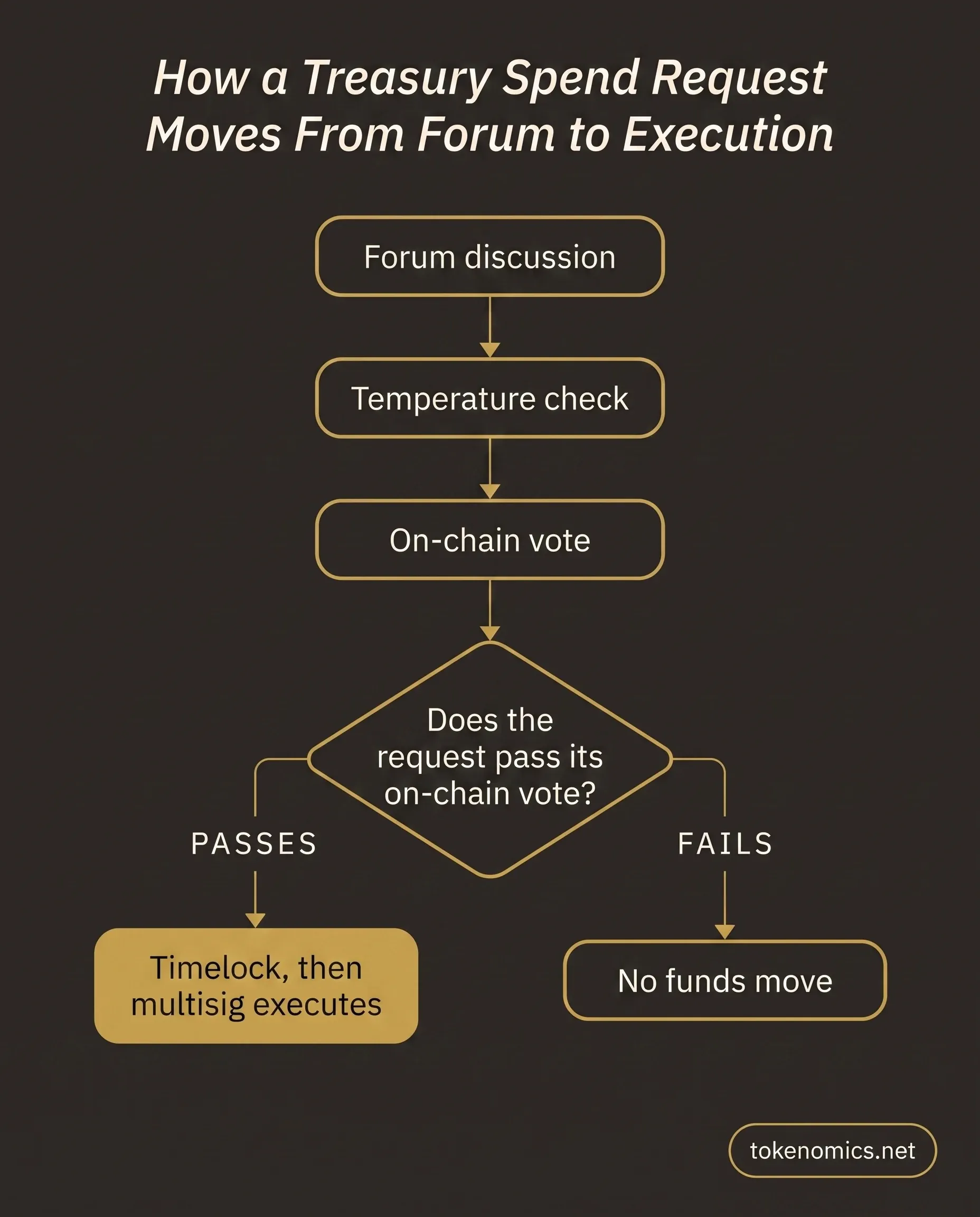
It typically starts as a post in a governance forum, laying out what the request is for and why. That moves to an informal temperature check, a lightweight signal of whether the community is receptive before anyone commits to a formal process. If the temperature check holds up, the request goes to a formal on-chain vote, where token-weighted or delegated votes actually count. A pass triggers the timelock, and once that delay clears, the multisig executes.
Not every request travels the full pipeline the same way. Recurring operational spend, contributor pay, infrastructure costs, the things a protocol needs every month regardless of what else is happening, usually clears a lower approval bar than a one-off discretionary request for a new initiative. Confusing the two, treating a routine budget line like it needs the same scrutiny as a new six-figure grant, is a common way governance slows a protocol down for no real safety benefit.
#Treasury runway and diversification, from an operator's seat
The number that matters is not the treasury's total dollar value. It is runway: how many months of operating expense the non-native-token portion of the treasury actually covers, at current spend, if the native token price went to zero tomorrow.
That reframing changes how you look at a treasury. A large headline figure built mostly on the protocol's own token can look impressive on a dashboard and still leave a protocol with a few months of real runway if the token drops hard. This concentration pattern shows up often enough in the treasuries we review that it is worth naming directly: teams that built up a large treasury during a strong market, denominated almost entirely in their own token, and found themselves with far less actual spending power than the headline number suggested once conditions turned.
None of this is a case for a specific allocation target. It is a case for asking the runway question explicitly, on a schedule, rather than only checking the headline balance. A treasury that cannot survive a native-token drawdown is not a market event when it happens. It is a governance design choice that was never stress-tested.
#Where treasury governance design fails founders in practice
Two failure patterns show up more than any others.
The first is governance capture in the practical sense: a signer set small enough, or a delegate concentration tight enough, that a small group can move treasury funds without needing the broader token holder base to actually agree. The vote can look decentralized on a dashboard while the real decision sits with a handful of wallets, because voting weight and execution power are not the same thing, and a structure that only decentralizes the first one has not actually solved the problem.
The second is a gap between the marketing and the structure. Calling a treasury decentralized because it technically has a governance token is a claim about branding, not about the signer count, the delegate concentration, or the timelock length that would actually back that claim up. Neither "decentralized" nor "compliant" is a label a governance structure earns by having a vote button. It earns it, if it earns it at all, from the specific thresholds underneath the button, and those are worth checking directly rather than taking on faith.
If you are designing or inheriting a treasury governance structure and want a second read on where the signer thresholds, vote weighting, and timelock actually sit, that is a conversation worth having before the structure is locked in, not after.
**Note for the orchestrator:** zero external links injected , legitimate zero, not a failure. None of the 10 active `authority-sources` entities (BENJI, Ondo, RWA.xyz, CryptoRank, SEC, Tornado Cash, Coinbase, Centrifuge, Maple, [Howey test](/glossary/howey-test/)) appear anywhere in this post, and the body doesn't name any other specific protocol, regulator action, or study for Pass B to attach to , it's written generically about DAO treasury mechanics. Flagging for the composer/outline stage: if future DAO-treasury-cluster posts want external authority links, they need a named real-world example (a specific protocol's multisig setup, a cited incident, etc.) baked into the outline.