Hyperliquid Unlocks: How to Read HYPE Token Unlock Events
Hyperliquid unlocks explained: what each HYPE allocation bucket is, how to verify unlocks from primary sources, and how they net against the buyback.


Hyperliquid unlocks are the moments when a restricted allocation of HYPE becomes transferable to the people who hold it. A headline announces one, and it is hard to tell whether the event is routine or a problem. The answer depends on which allocation is unlocking and what offsets it.
That second part is the business question. In token designs where an underlying exchange earns fees, that revenue can fund a buyback that acts as a counterweight, and this post uses that general model to show how to net an unlock against it. Check the specifics for HYPE against Hyperliquid's own documentation. The token is infrastructure. The exchange is the engine. This post teaches a method for reading Hyperliquid unlocks. It describes mechanisms and is not advice to buy, sell, or hold.
#What a Hyperliquid unlock actually is
A Hyperliquid unlock is the point at which a previously restricted HYPE allocation becomes transferable by its holder. It changes what the holder is permitted to do. It does not move tokens to an exchange, it does not mean they are sold, and it does not by itself change what a tracker labels circulating supply.
#Locked, unlocked, and circulating are three different states
Locked means the holder cannot transfer the tokens yet. Unlocked means they can. Circulating is a tracker's classification, and trackers draw that line differently. Treat the three as separate columns, never as one number.
#Why an unlock is a permission event, not a sale
Nothing happens onchain at the moment of unlocking except a change in what is allowed. Whether a recipient holds, stakes, or transfers is a separate decision, made later, that the schedule cannot show you.
#Where the unlocked HYPE comes from: the allocation buckets
In most token designs, only some buckets generate scheduled unlock events. That is why alarm about unlocks usually applies to a subset of supply, not the whole. The table below is a general way to classify buckets, not a statement of Hyperliquid's exact schedule. Confirm each row against Hyperliquid's published tokenomics documentation before relying on it.
| Bucket | Who receives it | Scheduled unlock event? |
|---|---|---|
| Genesis community allocation | Users at launch | Typically no, if already liquid |
| Core contributor allocation | Team and contributors | Typically yes, vesting-controlled |
| Future emissions and community rewards | Community participants | Ongoing by design |
| Hyper Foundation budget | The foundation | Governance-dependent |
For scale, CoinGecko lists roughly 222.4 million HYPE as circulating against roughly 955.3 million in total supply and a 1 billion maximum supply, as of September 21, 2026. Those supply figures move as vesting unlocks proceed, and they do not break supply down by bucket. Take each bucket's share of total supply from Hyperliquid's published tokenomics documentation, not from a tracker.
#Genesis community allocation (already liquid)
A launch distribution to users is generally already liquid, so it produces no future unlock event. Check Hyperliquid's documentation to confirm how this bucket was released.
#Core contributor allocation (the vesting bucket)
In token designs generally, this is the bucket most unlock headlines are about. Vesting-controlled allocations release under rules set in advance. Hyperliquid's own documentation is where this bucket's actual terms should be read.
#Future emissions, community rewards, and foundation budget
These buckets release through programs and governance, not a single date.
#The three kinds of unlock event and what each one signals
Classify an event before reacting to it.
#Cliff and linear release (team and contributor vesting)
A cliff holds an allocation fully locked until a set date, then releases it in regular installments. This is a scheduled design choice known in advance, so informed participants have already accounted for it. The useful question is what the schedule says about incentive alignment, not when the date falls.
#Community reward and emission distributions
Emissions are ongoing by design. Tokens flow out gradually under rules set in advance, so there is no single moment to react to. Read the rate, not the date.
#Foundation budget releases
A foundation release depends on governance and disclosure, so it is only as legible as the foundation's own posts. In general, public documentation on exact cadence can be incomplete for releases of this kind, and schedules can change at the discretion of the parties who control them. Treat any cadence as provisional until a primary source confirms it.
#How to verify an unlock yourself: the primary sources
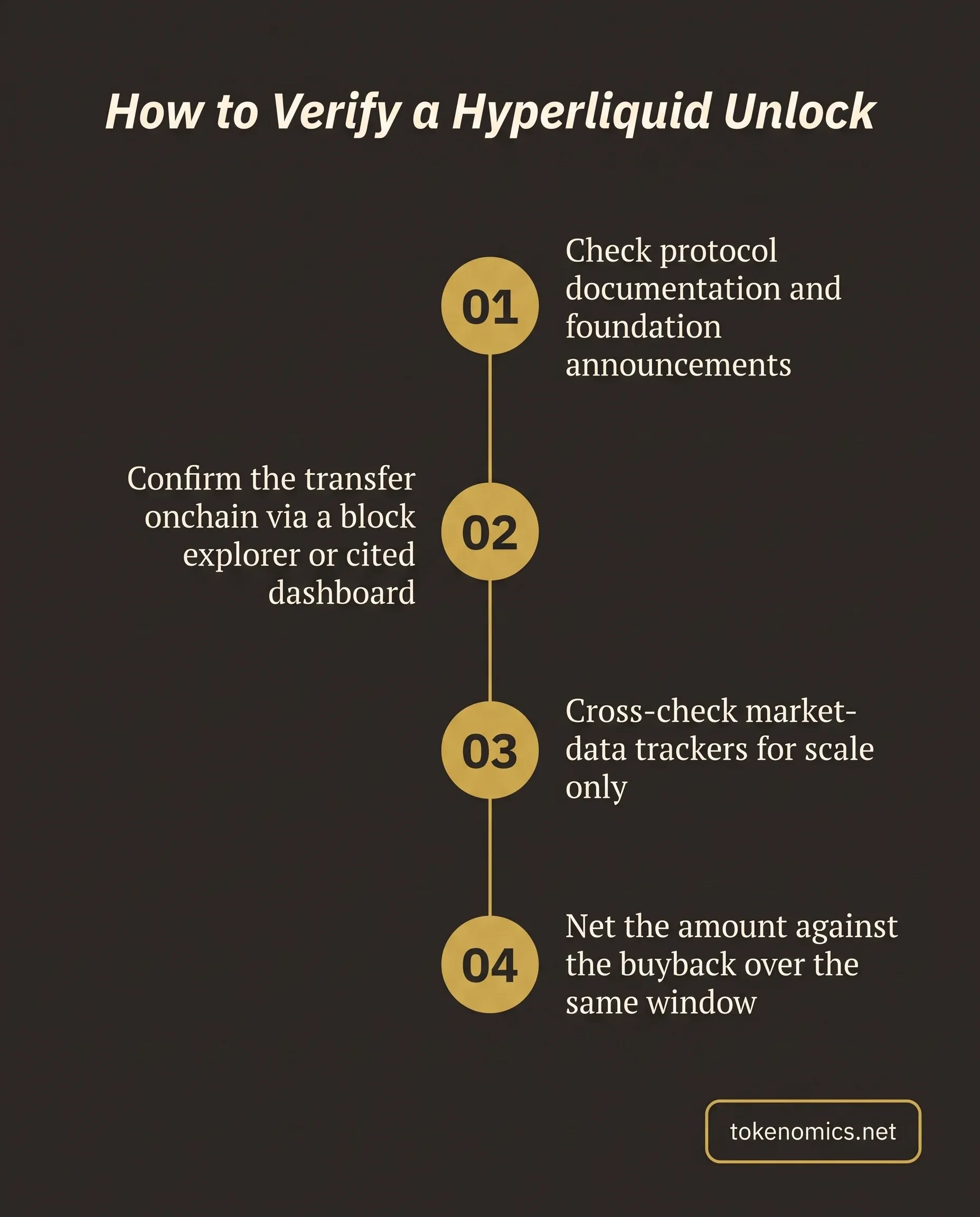
Verification is an order of operations. Skip a step and a secondary source quietly becomes your only source.
#Protocol documentation and foundation announcements first
Start with Hyperliquid's own documentation and Hyper Foundation posts. They are where allocation and release terms would be stated, when they are published at all.
#Onchain data second
Confirm the transfers themselves from the relevant addresses, using the Hyperliquid block explorer or a Dune dashboard cited by query ID. Record the addresses and the explorer or query you used, so anyone can repeat the check.
#Market-data trackers for scale reference only
Trackers such as CryptoRank give a rough sense of scale. They are a secondary source and cannot be the sole basis for any claim. The dated cadence lives in our Hyperliquid unlock schedule guide, so this post does not repeat it.
#Unlocks versus the Assistance Fund buyback: netting the float
#The two-sided supply equation
As a general model for fee-funded buyback designs, supply enters circulation through unlocks and leaves through buyback purchases funded by protocol fees. You can net the two over the same window. That is a mechanism exercise, not a forecast. Confirm Hyperliquid's own buyback terms in its documentation before applying the model to HYPE.
#A worked example with clearly labeled illustrative numbers
Illustrative numbers only, not HYPE data: suppose 100 units unlock in a month and the buyback purchases 40 units in that same month. The net new float from those two flows is 60 units. If fee revenue falls, the same process buys fewer units at a given price, and the offset shrinks.
The buyback is a counterweight only while fee revenue holds. It depends on the exchange earning fees, which returns the argument to the business underneath the token. For the fee-to-buyback mechanics, see our Hyperliquid tokenomics breakdown.
#What an unlock does not tell you
#Recipient behavior is not observable from the schedule
An unlock date says nothing about whether recipients hold, stake, or transfer. Two identical unlocks can lead to different behavior.
#Liquidity depth, custody, and staking change the outcome
The same unlock size lands differently against different order-book and spot liquidity depth. Where tokens sit matters too, since custody arrangements and staking can change what can move. History can show how a mechanism behaved in the past. It does not tell you where anything goes next.
The schedule is an input to analysis, not a signal.
#What founders can borrow from Hyperliquid's unlock design
#Disclosure, cadence, and a real revenue counterweight
A predictable, publicly documented cadence lowers the uncertainty premium around Hyperliquid unlocks and any similar event. That part transfers to almost any token. The counterweight is different.
#What does not transfer to a token without fee revenue
A buyback works only when an underlying business earns the fees that fund it. Copy the unlock design without the revenue engine and you copy the risk, not the counterweight. Across 80+ projects, the design questions that matter most are about what the token depends on. Start there, then decide how to structure release. For a lower-commitment way to pressure-test a vesting design, a tokenomics audit is the natural first step.
If you are benchmarking a token design against Hyperliquid and want a second read on how release and revenue fit together, book a strategy call.