Inflation Control Mechanisms: The Token Designer's Toolkit
Inflation control mechanisms are the lever set that prevents token supply from eroding value. Learn the five core mechanisms and how to layer them correctly.


Inflation control mechanisms are the set of protocol-level tools that govern how much token supply enters circulation and at what pace. They sit between the emission schedule, which determines issuance, and the demand-side mechanics that determine absorption. A token model without deliberate inflation controls is a countdown timer. This post covers the five core mechanisms, how they interact, and the sequencing mistakes that most founders get backwards.
#What Inflation Means in a Token Context
Token inflation is not the same as consumer price index inflation. In a token economy, inflation means new supply entering circulation faster than demand absorbs it. The result is a fall in real purchasing power of the token, which undermines every incentive the protocol built on top of that token.
Inflation control mechanisms: the protocol-level tools used to regulate the rate at which new token supply enters circulating markets, including burn mechanisms, staking locks, emission schedule design, buyback programs, and velocity reduction structures.
Two types of inflation create problems. Scheduled inflation is expected. It is the natural output of an emission curve, and it is manageable when the curve is designed around realistic absorption assumptions. Uncontrolled inflation is the failure mode. It shows up when emission schedules were set optimistically, when staking incentives require emissions that outpace demand, or when burn mechanisms fail to activate because on-chain revenue never materialized.
The three failure modes are consistent across the projects we have advised. Price depression compounds investor concern, which reduces liquidity, which accelerates sell pressure. Incentive collapse follows when the tokens allocated to liquidity mining, ecosystem grants, or node operator rewards are worth less than anticipated. Treasury erosion arrives last: the treasury denominated in the protocol's own token loses purchasing power as supply expands.
Revenue-first framing matters here. Inflation control is not about making the token price go up. It is about protecting the purchasing power of the incentives the protocol uses to attract and retain users, operators, and contributors. A protocol that cannot maintain the real value of its reward tokens will struggle to maintain participation. The token distribution model determines how supply is structured; inflation control mechanisms determine whether that structure holds under real market conditions.
#The Five Core Inflation Control Mechanisms
These are the five mechanisms token designers draw from. Most protocols need two or three working together.
#1. Token Burns
A burn mechanism removes tokens from circulation permanently. Three variants are common in production protocols.
Buy-and-burn: protocol revenue is used to purchase tokens from the open market and send them to a dead address. This works when the protocol has sustainable on-chain revenue. Without it, buy-and-burn is a cosmetic mechanism that draws down the treasury rather than controlling supply.
Fee burns: a portion of transaction fees is automatically destroyed, as with EIP-1559 on Ethereum. This mechanism scales with on-chain volume. At low volume it has negligible effect.
Slash burns: validator or operator misbehavior results in a portion of staked tokens being destroyed, not just redistributed. Slash burns are supply-deflating but not inflation-controlling in isolation because they depend on misbehavior occurring.
The common mistake: founders deploy a buy-and-burn schedule before the protocol has meaningful volume. A burn rate of 0.1% of circulating supply per quarter requires actual revenue to fund it. Setting the schedule without confirmed revenue backing is not inflation control. It is expectation management.
#2. Staking and Lock-Up Mechanisms
Staking removes tokens from circulating supply by creating economic incentive to lock. The tokens are not destroyed; they return to circulation when the lock expires. Staking controls inflation by reducing the volume of tokens actively trading, which improves effective demand relative to active supply.
Three structural variants: ve-tokenomics (vote-escrowed, as in Curve's veCRV model) ties governance rights to lock duration, creating ongoing incentive to extend locks rather than exit. Epoch-based staking pools set a structured unlock calendar that the market can anticipate. Time-weighted staking gives higher reward multipliers to longer lock commitments.
The common mistake: setting staking APY to compete with other protocols rather than to match what the treasury can fund sustainably. Yield tourism is not sticky liquidity. If your staking APY requires emissions that outpace your protocol's growth, you are manufacturing the inflation problem you are trying to solve.
#3. Emission Schedule Design
The emission schedule is the foundational inflation control mechanism. Every protocol has one, whether it is intentional or not. The schedule determines how many new tokens enter circulation per epoch, quarter, or year, and over what total horizon the supply reaches its ceiling.
Three shapes matter for inflation control purposes. Fixed decay curves reduce emissions by a fixed percentage per epoch. They are predictable, investor-friendly, and resistant to governance capture because the curve is set at launch. Epoch-gate curves tie the emission rate to a protocol metric: on-chain volume, active addresses, or revenue. Emissions slow automatically when the protocol is not growing. Protocol-owned liquidity routes emissions into liquidity owned by the protocol treasury rather than distributed to individual holders, reducing short-term sell pressure.
The common mistake: front-loading year-one emissions to attract early users, then facing a convergence problem at year two when emissions drop sharply and previously-locked tokens unlock simultaneously. This is the most common inflation cliff pattern we see.
#4. Buyback Programs
A buyback program has the protocol treasury purchase tokens from the open market. Unlike burns, the purchased tokens may be held in the treasury (reducing circulating supply without destroying them) or burned (combining buyback with the first mechanism).
Three types: discretionary buybacks are treasury team decisions, flexible but subject to governance delays. Programmatic buybacks are on-chain triggers that activate when token price falls below a threshold or when treasury balance exceeds a reserve target. Buyback-and-burn combines both mechanisms into a single execution.
The common mistake: announcing a buyback program before the revenue stream funding it is confirmed. Markets price in the buyback announcement. If the revenue never materializes at the projected rate, the gap between expectation and execution compounds the original inflation problem. This pattern overlaps with the structural errors catalogued in the common tokenomics design mistakes that surface most often in project audits.
#5. Velocity Reduction Mechanisms
Token velocity measures how frequently tokens change hands. High velocity means tokens move through wallets rather than accumulate, which reduces effective demand without changing supply. Velocity reduction mechanisms create structural reasons for holders to retain tokens rather than spend or sell them.
Three approaches: utility staking requires holding a minimum token balance to access protocol features, creating demand through necessity. Governance weight ties voting power to holding duration, so long-term holders accumulate disproportionate influence. Fee discounts for duration holders reward retention economically rather than through governance rights.
The common mistake: deploying velocity reduction in place of product-market fit. If users are not engaging because the product does not solve a real problem, locking their tokens does not generate demand. It accelerates exit when locks expire.
#How These Mechanisms Interact
No single mechanism controls inflation adequately in isolation. The combination matters.
A baseline inflation control stack for a governance-utility protocol typically looks like this: the emission schedule sets the supply floor, staking and lock-ups reduce the actively-traded float, and velocity reduction sustains demand-side holding behavior. These three together address both supply and demand levers simultaneously.
Burn mechanisms enter the stack as a fourth layer when on-chain revenue is confirmed. Before that, burns are cosmetic.
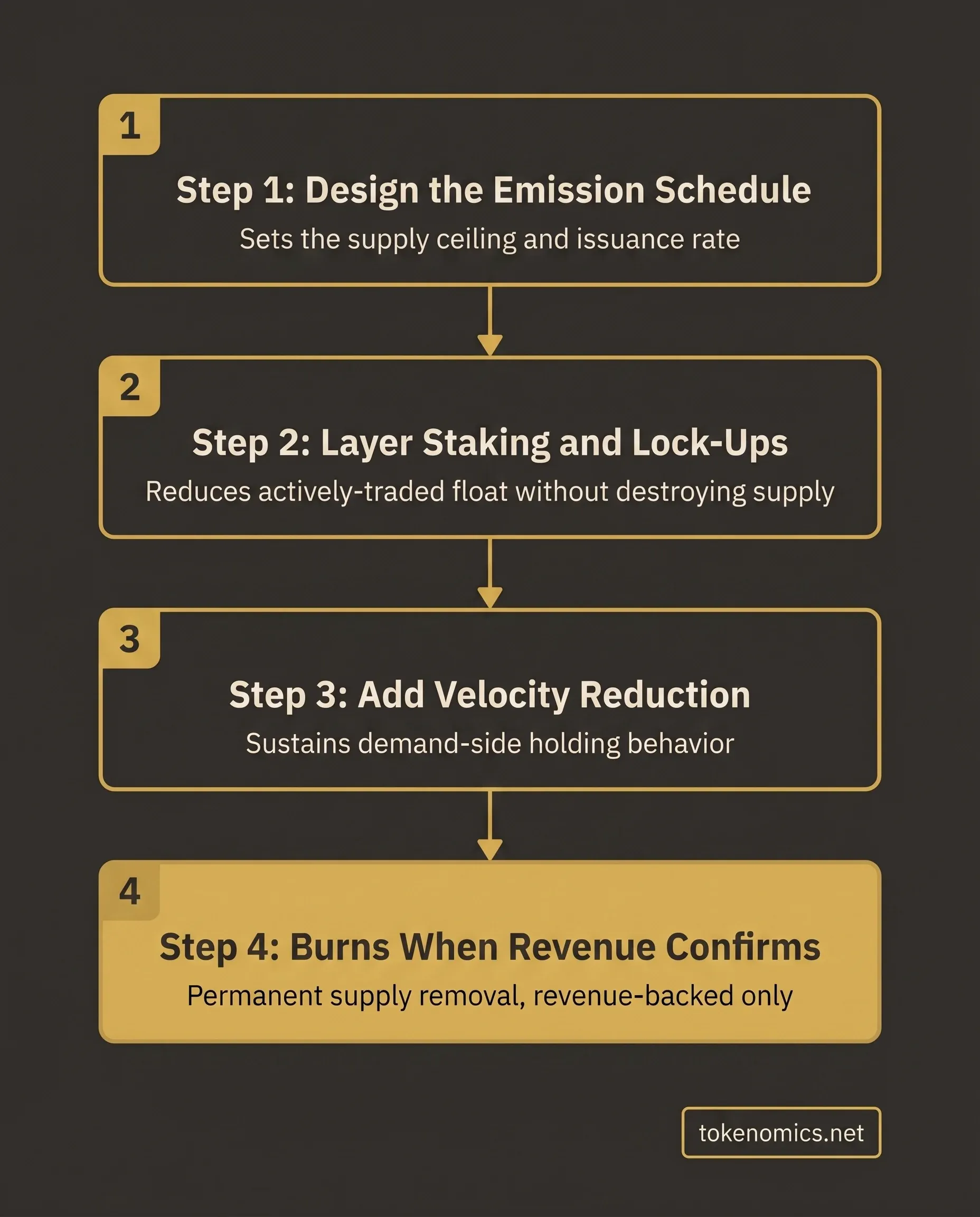
Design dependency is the concept founders most often misunderstand. Your emission schedule determines whether the other mechanisms are viable. If year-one emissions are too aggressive, no staking APY that remains treasury-solvent will absorb the outflow. The emission schedule is not one mechanism among five; it is the constraint that determines what each of the other four can actually accomplish.
The pattern we see most often across engagements: founders default to the mechanism with the best headline. Buy-and-burn is visible, defensible to community members, and easy to explain. But at year one of a protocol with no on-chain revenue, it is irrelevant. The emission schedule is not visible and not exciting. It determines everything.
#Common Mistakes Founders Make With Inflation Control
Mechanism overload at launch. Deploying all five mechanisms simultaneously signals complexity without signaling clarity. Investors and protocol participants cannot parse an incentive structure that layers five overlapping systems. Start with the emission schedule. Add mechanisms as the protocol matures and as the revenue or participation data justifies them.
Using burn to paper over a bad emission schedule. If your emission curve is front-loaded and your circulating supply is growing faster than demand, a burn mechanism does not fix the underlying design. Fix the schedule first. Burns are a supplement, not a correction.
Staking APY set to market rates, not treasury capacity. Matching a competitor's staking yield without confirming your treasury can fund it through market cycles is not a competitive strategy. It is a liability schedule dressed as an incentive.
No cap or kill-switch on programmatic buybacks. Automated buyback triggers with no upper limit can drain the treasury under adversarial on-chain conditions. Governors belong on every automated treasury action.
Tokenomics documentation that names the mechanisms without quantifying them. Institutional investors now require Monte Carlo scenario analysis showing how circulating supply evolves under stressed staking participation and low on-chain volume. Naming the mechanism is not enough. Quantifying its projected effect under multiple scenarios is the standard. If you need an independent review of your inflation control design, book a strategy call to discuss what a structured assessment covers.
#What Investors Expect to See on Inflation Control
Institutional capital entering Web3 has raised the documentation bar. Naming your inflation control mechanisms in a whitepaper is no longer sufficient due diligence preparation.
What investors review: a projected circulating supply curve over 36 months across at minimum three scenarios, a mechanism activation table showing the on-chain conditions that trigger each control, and a sensitivity analysis showing how circulating supply changes when staking participation is 20%, 40%, and 60% of issued supply.
Monte Carlo stress testing is now standard in investor-grade tokenomics documentation. The central question is not "does the mechanism exist" but "what does supply look like when the mechanism underperforms its design assumptions?" A 10,000-iteration Monte Carlo run that shows circulating supply within a defensible band across adverse scenarios carries more weight than a narrative description of five mechanisms.
Inflation control documentation belongs in the token model section of your tokenomics data room, alongside the emission schedule, the vesting table, and the governance framework for modifying any of the control parameters.
#Frequently Asked Questions
What are inflation control mechanisms in tokenomics?
Inflation control mechanisms are protocol-level tools that regulate how quickly new token supply enters circulation. The five core mechanisms are token burns, staking and lock-up structures, emission schedule design, buyback programs, and velocity reduction. Most protocols use two or three of these in combination. The emission schedule is always the foundational layer; the other mechanisms are additive.
How does a buy-and-burn mechanism work?
A buy-and-burn mechanism uses protocol revenue to purchase tokens from the open market and send them to a dead wallet address, permanently removing them from supply. The mechanism is effective only when the protocol has confirmed on-chain revenue to fund the purchases. Deploying a buy-and-burn schedule before revenue is established draws down the treasury instead of controlling supply.
What is the difference between a burn mechanism and a staking lock?
A burn mechanism permanently destroys tokens, reducing total supply. A staking lock removes tokens from active circulation temporarily but leaves total supply unchanged. Tokens that are staked will eventually unlock and re-enter the market. Burns are irreversible; staking locks are not. Both reduce effective circulating supply in the near term, but burns have a permanent supply effect while staking locks have a temporary one.
#Conclusion: Build the Control Stack Before You Set the Emission Curve
The emission curve determines what is possible. Inflation control mechanisms determine what is sustainable. These are not the same thing, and confusing them is expensive.
The right sequencing: design the emission schedule with the control stack in mind, then layer staking and velocity reduction, then add burns when on-chain revenue justifies the mechanism. Inflation control is not a feature added at launch. It is the structural layer that all other mechanism decisions sit on top of.
If you are designing or auditing a token model and want to map your inflation control stack against current investor expectations, book a strategy call.
We have advised 100+ projects on token design across $100MM+ in combined raises. Specific design recommendations are the firm's analysis; this post is informational and does not constitute investment advice.