Sui Tokenomics Explained: Supply, Staking, and Fee Burn
A breakdown of Sui tokenomics: the fixed 10B max supply, declining emission schedule, delegated staking, and the storage-fund gas burn mechanism.


#Why Sui's tokenomics is worth studying on its own terms
Sui's tokenomics only makes sense in light of what the network actually does: Sui's network generates real value through actual transaction volume and developer usage, and supply, staking, and fee design simply determine how that value gets distributed among validators, delegators, and long-term holders over time. Reading the mechanism in isolation from that underlying activity is how token analysis turns into a price story instead of a design study, so the two are worth reading together. This is protocol analysis, not investment guidance, and nothing here should be read as a recommendation to buy, sell, or hold SUI or any other asset. What makes Sui useful as a case study is that its design choices diverge from a generic proof-of-stake template in three specific places: a declining emission schedule, a delegated staking model, and a gas fee structure that routes part of every transaction fee into a dedicated storage fund. Each of those is a real design tradeoff with downstream consequences, which is exactly the kind of thing worth understanding whether you are building on Sui, allocating capital around it, or designing token mechanics for your own protocol.
#Token supply and allocation
#The fixed 10 billion SUI max supply
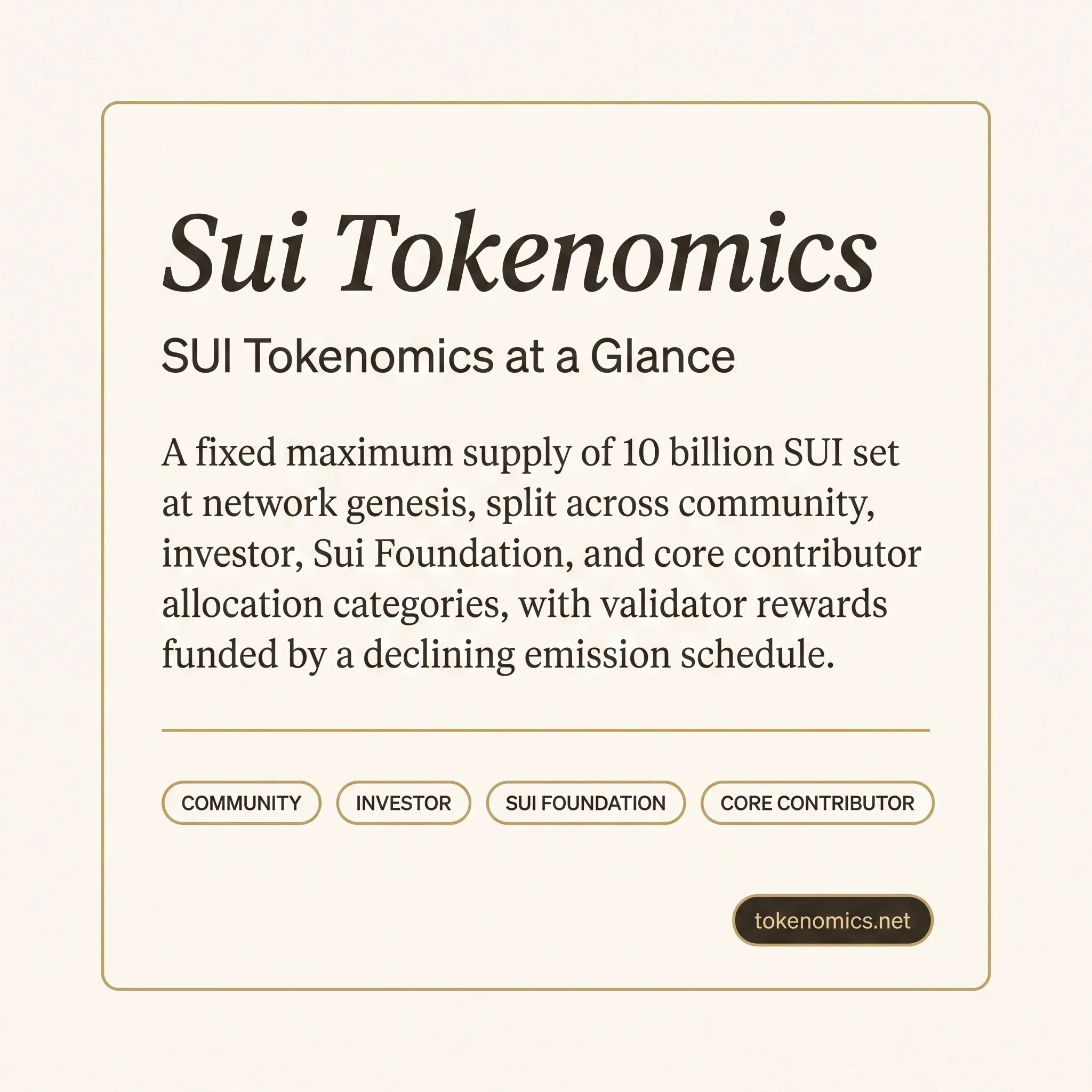
SUI was launched with a fixed maximum supply of 10 billion tokens set at genesis, rather than an uncapped or purely inflation-driven model, per Sui's official tokenomics documentation. That distinction matters mechanically: a capped supply gives holders and validators a legible ceiling to plan against, since total dilution has a known upper bound even before the full emission schedule plays out. Not every layer-1 token makes this choice, and the ones that do not require a different kind of long-term modeling from anyone trying to reason about future supply.
#Allocation categories at a glance
The 10 billion SUI max supply is split across several allocation categories, generally including a community access and reserve allocation, an investor allocation, a Sui Foundation allocation, and a core contributor allocation. The exact percentage breakdown across these categories is set out in Sui's official tokenomics documentation, and that source, not a secondary summary, is the one to check before treating any specific split as current. The allocation split is worth reading as a signal of who bears dilution risk over time and on what schedule, not as a judgment of whether the split itself is good or bad. A founder evaluating Sui, or designing a comparable structure, should treat the category breakdown as the starting input for a vesting and unlock analysis, not the conclusion of one.
For founders working through a comparable allocation and vesting design of their own, our Tokenomics Design service walks through exactly these tradeoffs before they get locked into a token contract.
#Sui's declining emission schedule
Validator rewards on Sui are subsidized from a defined emission schedule, and that schedule declines over a multi-year period rather than staying flat or continuing indefinitely. The exact duration and step-down cadence of that schedule are set out in Sui's official tokenomics documentation, and that is the source worth checking directly, since an emission schedule is exactly the kind of detail that goes stale in secondary write-ups. The practical effect of a declining sui emission schedule is straightforward: as scheduled emissions taper, the share of staking yield funded by those emissions compresses, and the share funded by real network gas fees grows in relative importance. That is the same design lever covered in general terms in inflation-control-mechanism analysis, applied here to a protocol that is already live and generating real transaction volume rather than a hypothetical model.
For a broader look at how token designers manage this kind of taper deliberately rather than by accident, see this breakdown of inflation control mechanisms for token design.
#How staking and delegation actually work
#Validator staking vs. delegated staking
Delegated proof of stake is a common pattern across newer layer-1 protocols: token holders delegate their stake to a validator rather than running validator infrastructure themselves, which lowers the operational bar for participating in network security. That same structure also concentrates influence in whichever validators attract the most delegated stake, a tradeoff inherent to the delegated model itself rather than a design choice unique to any single chain. Sui's implementation of this pattern is a useful comparison point for anyone evaluating how a given chain distributes both rewards and influence among its validator set.
#What determines yield
Sui staking rewards are not a single fixed advertised rate. Yield is a function of scheduled emission-based rewards plus a share of network gas fees, and that mix shifts over time as the emission schedule declines, per the previous section. Delegated staking positions on proof-of-stake networks generally are not instantly liquid either: most chains impose some cooldown or unbonding period before a staked position can be withdrawn, which is a practical detail worth flagging for anyone modeling capital allocation around Sui or a comparable protocol rather than treating staked tokens as instantly redeemable.
#The gas fee and storage fund burn mechanism
The single most distinctive mechanism in Sui's tokenomics is how it handles gas fees. Per Sui's official tokenomics documentation, Sui's gas model splits transaction fees into two components: a computation component and a storage component. The computation portion compensates validators for processing the transaction, which is standard across most chains. The storage portion is different: instead of going directly to validators or being burned outright, it funds a dedicated storage fund. That storage-fund design is meant to track the actual cost of maintaining on-chain state over time, rather than charging every transaction a flat toll regardless of how much state it actually creates. It is a functional response to a real problem, state growth is a long-run cost for any chain, not a marketing feature, and it is worth understanding on those terms rather than as a headline claim.
#Post-launch reserve reallocations, as a case study
Token allocations set at genesis are not always the final word. Whether a given foundation has adjusted its community reserve or treasury allocation after mainnet launch is a question to answer against that project's own governance or treasury disclosure, not against secondary commentary. What matters for this framework is the pattern rather than any specific figures: a post-launch reserve reallocation is a real example of governance-adjacent supply decisions happening well after mainnet launch, not a one-time event locked in at genesis. The takeaway for a founder or allocator evaluating any protocol, Sui included, is to track disclosed reserve and treasury policy on an ongoing basis rather than assuming the original allocation table stays static indefinitely.
The same governance-adjacent questions apply to how a protocol's community votes on future changes, and this governance model comparison for DAOs is a useful reference point for how different voting mechanisms hold up in practice.
#What builders can take from Sui's design choices
Sui tokenomics offers three transferable lessons for anyone designing or evaluating a token model. First, a capped max supply paired with a declining emission curve gives holders and validators a legible dilution timeline instead of an open-ended one. Second, splitting fees into computation and storage components lets a chain price actual resource use rather than applying a flat toll to every transaction, which is worth considering for any protocol carrying persistent on-chain state. Third, post-launch reserve and treasury changes are common enough across the industry that a protocol's tokenomics should be treated as a living policy under ongoing disclosure, not a one-time design decision finalized at genesis. None of these three points is a claim about where SUI's price goes next. They are structural observations about how the mechanism is built, which is the part that tends to matter most once the initial hype cycle around any protocol has passed.
If you are evaluating a protocol's tokenomics as part of a broader allocation or partnership decision and want a second, independent read on the design, book a strategy call, that is a conversation worth having before you commit, not after.