How Much Does Tokenomics Consulting Cost? Pricing Models and Ranges
How much does tokenomics consulting cost? It depends on the pricing model and scope. Here are the three models, the four cost drivers, and typical ranges.


How much does tokenomics consulting cost depends on the pricing model and the engagement scope, not a single published rate. Firms typically charge a fixed fee for a defined deliverable, a monthly or quarterly retainer for ongoing advisory, or a hybrid with an equity or token component, with regulatory scope, technical complexity, and deliverable depth setting the range.
How much does tokenomics consulting cost depends on two things: the pricing model you choose and the scope the engagement actually covers. Most engagements are priced one of three ways. A fixed-scope project for a single deliverable like an audit or a design phase. A monthly or quarterly retainer for ongoing advisory through launch and beyond. Or a hybrid that layers an equity or token component on top of a cash fee. What moves the number up or down is rarely the consultant's name. It is regulatory scope, technical complexity, and how complete the deliverable package needs to be.
One frame matters before any number does. Tokenomics enhances value creation. It does not replace it. The cheapest engagement is still wasted money if there is no real business engine underneath the token, and the most expensive one cannot fix a project with no revenue logic to model. Cost only means something relative to whether the underlying business creates value.
This post is a pricing-model and cost-driver explainer built on general market ranges. It is not a published rate card. The numbers below describe patterns across the market, not a quote.
How much does tokenomics consulting cost: pricing varies by model and scope, typically structured as a fixed-scope fee, a recurring retainer, or a hybrid with an equity or token component.
#Tokenomics Consulting Pricing Models
Tokenomics consulting pricing follows three models, and the one a firm uses tells you a lot about how the engagement is scoped. Each fits a different stage and a different budget.
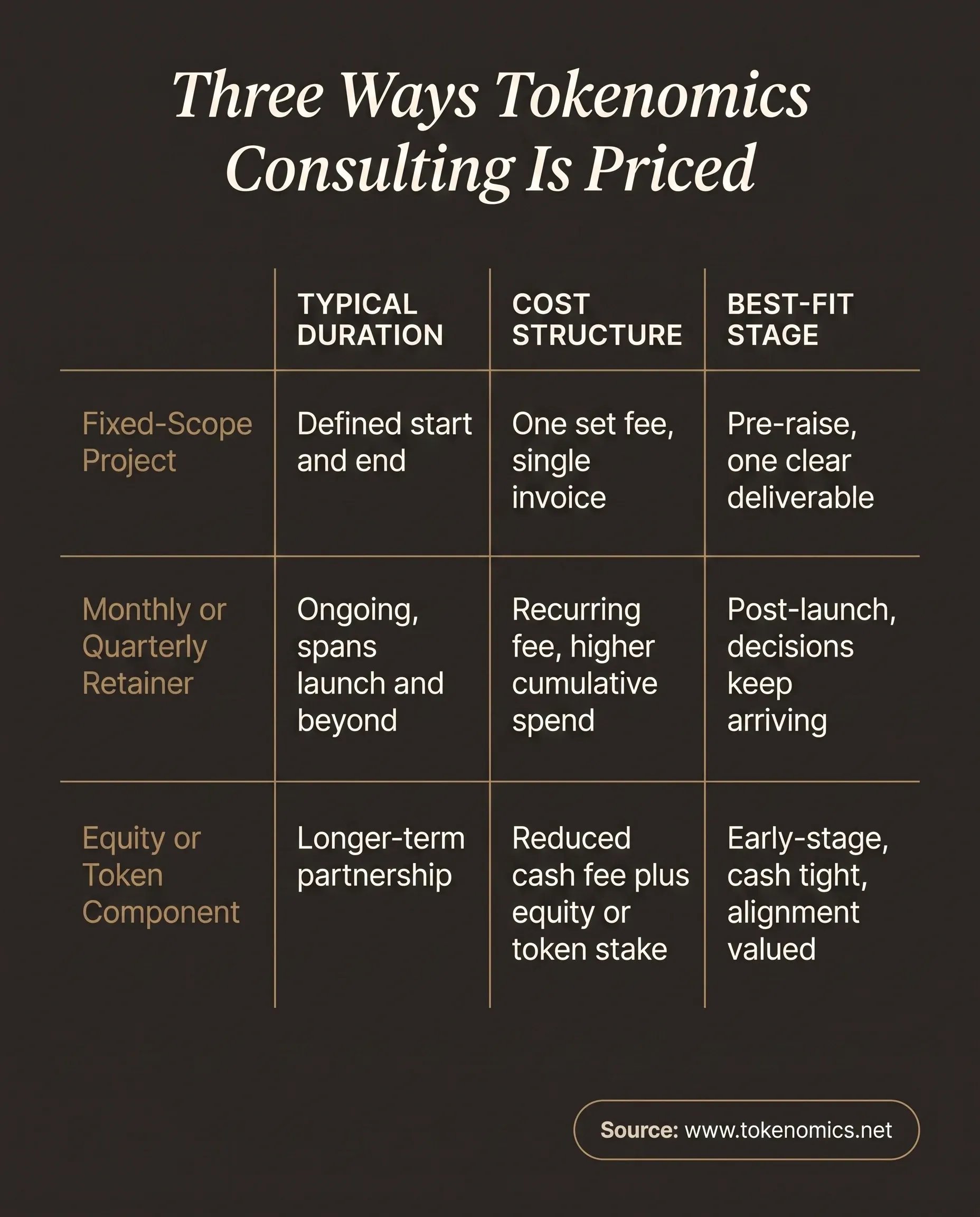
Fixed-scope project pricing. You pay a set fee for a defined deliverable: an audit, a design phase, or a documentation package. The scope has a clear start and end, which lets a founder budget against a known total before signing. You know what you are buying and what it costs before you sign. The tradeoff is that it covers the deliverable and stops there. When a new question comes up after the work ships, that is a new engagement.
Monthly or quarterly retainer. You pay a recurring fee for ongoing advisory across launch and the decisions that follow it. Total spend is higher over time, but it matches how tokenomics decisions actually unfold. Legal needs answers on one timeline, engineering needs specs on another, and marketing needs positioning on a third. A retainer keeps one team in context across all of them instead of re-scoping every time.
Equity or token-based components. Some engagements layer a partial equity or token allocation on top of a cash fee, and occasionally in place of part of it. This raises alignment, because the consultant now holds a stake in the outcome. It also raises disclosure and conflict-of-interest questions a founder should ask about directly before signing. Alignment is good. Undisclosed alignment is a problem.
#Fixed-scope vs. retainer vs. equity component
Think of the three models as matching three moments. Fixed-scope fits a pre-raise audit, where investors want one clear document and you want one clear invoice. A retainer fits a six-month arc from pre-launch design through post-TGE governance decisions, where the questions keep coming. An equity component fits an early-stage founder trading a smaller cash fee for a longer-term partnership, where cash is tight and alignment is worth more than a lower invoice.
None of these models is inherently cheaper. They price different amounts of work over different spans of time. The deliverable set matters as much as the fee structure, so it helps to understand what tokenomics consulting includes before comparing quotes.
Our founder's guide to what tokenomics consulting involves walks through the full scope, so quotes are easier to compare apples to apples.
#What Drives Tokenomics Engagement Cost
Tokenomics engagement cost is driven less by who does the work and more by what the work has to cover. Two firms can list the same service and quote very different numbers, because the scope underneath the label is different. Four drivers explain most of that gap.
Regulatory and compliance scope. An engagement that has to answer securities-classification questions costs more than one that does not, because it stacks a legal-analysis layer on top of the design work. When a token sits near a revenue-share or profit-expectation mechanism, the analysis of whether it looks like an investment contract gets harder, and the SEC's framework for that analysis is the reference point most US-facing projects work against. This is scope, not a verdict. The firm designs to make that review smoother. Whether a token is a security is a determination for legal counsel and the relevant regulator, not something a design engagement decides.
Technical complexity. A standard utility token is a smaller scoping exercise than a permissioned or security-token-adjacent design. Once you move into ERC-1400 or ERC-3643 territory, or into custom vesting and staking contract sets, the specification work expands. OpenZeppelin's audited contract standards are a useful gauge here: the further your design sits from a plain, well-audited pattern, the more custom logic has to be specified, reviewed, and documented, and the more the engagement costs.
Deliverable depth and completeness. A single audit costs less than a full engagement that produces design, documentation, and strategy together, because it is less work. A complete package is built to get your house in order across every stakeholder at once. Legal reads the classification logic, engineering reads the parameter set, marketing reads the positioning, investors read the model. That is what a complete tokenomics data room delivers, and it prices accordingly.
See what's included in the complete data room for the full deliverable set behind that price.
Track record and specialization. Pattern recognition costs money. A team that has designed tokenomics across 100+ projects and $100MM+ in combined raises prices differently than a first-time freelancer, because it has seen the failure modes before and designs around them. You are paying for the mistakes that do not happen.
#Regulatory scope and technical complexity
These two drivers are the ones most likely to double an estimate. A securities-adjacent classification question pulls legal analysis into the engagement. A non-standard token standard or a custom contract set pulls in specification and review work a plain ERC-20 never needs. Get either wrong and the cost shows up later as a migration, which is more expensive than doing it right the first time.
#Deliverable depth and specialization
Completeness and experience read like marketing lines until you price them against their absence. A design-only engagement that leaves the documentation gap open forces you to fill it later, usually under deadline, usually for more. An experienced team enables your stakeholders to move in parallel instead of waiting on each other. That is not a premium for a name. It is a premium for work that does not have to be redone.
#Typical Market Ranges by Engagement Type
Before any range: these are general patterns observed across the market, not tokenomics.net quotes. Every real number comes from a scoped conversation, because scope is exactly what moves it. With that framing fixed, the market tends to sort into a few tiers.
A standalone audit or review sits at the narrow end. It examines an existing model against known failure patterns and hands back findings. Scope is bounded, so the number sits at the narrow end of the range and is straightforward to forecast.
A design-only engagement sits above that. Here the firm builds the model rather than reviewing one, which is more work and a higher number, but still a single deliverable with a defined edge.
A full data room, design plus documentation plus strategy, sits higher again, because it is several deliverables assembled into one investor-ready package. You are paying for a model, the documents that prove it, and the go-to-market logic around it.
An ongoing retainer does not fit the same axis. Its cost is cumulative and depends on how long the relationship runs, so comparing a monthly retainer to a one-time audit is comparing a subscription to a purchase.
Why does the spread run so wide? Because the market it serves runs wide. DefiLlama tracks the total value locked across DeFi protocols, and the distance between a single-purpose utility token and a multi-pool protocol with billions at stake is enormous. Scope tracks that distance, and cost tracks scope.
The same logic holds up one level higher. EY-Parthenon global institutional digital assets research describes professional-services pricing that follows the drivers, scope, regulatory complexity, and specialization, rather than a flat rate card. That is the point of a driver-based model. The range is wide because the work is, and any firm quoting one number for every project is quoting the wrong project half the time. The market typically shows ranges, not rates.
#Retainer vs. One-Time Engagement: Cost Over Time
A tokenomics retainer costs more over the life of the relationship than a single engagement, and for many projects it is still the cheaper decision. The reason is what happens after launch.
A one-time engagement, a design phase or an audit, carries a lower single invoice. It also stops when the deliverable ships. New decisions arrive anyway: a governance change, a second unlock event, a new jurisdiction to support. Each one is a fresh scope, a fresh quote, and a fresh vendor who has to learn your model from scratch.
A retainer converts those unpredictable one-off asks into a predictable monthly line item. The team that designed your model keeps its context, so the next question does not start with a re-onboarding. Higher cumulative spend, lower friction, and no cold-start tax every time something changes.
The practical move is to match the model to your stage. Pre-raise founders often start fixed-scope, because they need one clear deliverable investors will actually read. Once the token is live and decisions turn ongoing, that is usually when a retainer starts to pay for itself.
#When a retainer is worth the higher cumulative spend
Three signals say a one-time engagement will not cover you. Post-launch governance is still evolving. Liquidity and treasury questions keep surfacing. Expansion into new jurisdictions is on the roadmap. When those are live, the recurring model usually costs less in total than a string of one-off engagements, once you count the re-onboarding you avoid.
#How to Evaluate Cost Against Value When Choosing a Consultant
Deciding how much does tokenomics consulting cost is the wrong first question. The right one is what the cost buys, and whether the work holds up when it matters. Cheap and fast is not a deal here. Tokenomics is infrastructure you build once and live with for years, so a lower bid is rarely the one that holds up.
Ask what is actually included before you compare prices across firms. Design only, or design plus documentation, or the full strategy? A quote for a narrower scope will look better next to a quote for a complete one, and the two are not the same purchase.
Ask whether the deliverable holds up under scrutiny. Will the model survive an investor's technical due diligence, a legal team reading the classification logic, and an auditor checking the math? A document that only convinces people who already agree with you is not worth much.
Ask what the fee covers over time. Does pricing include revision rounds, or does it end at a fixed cliff the moment the first draft lands? A number that excludes the revisions every real engagement needs is not the number you will actually pay.
Then hold all of it against the only frame that matters. The token is infrastructure. The business is the engine. Cost makes sense only relative to whether the underlying business creates value, and no tokenomics engagement, cheap or expensive, can manufacture value the business itself does not produce.
For the advisory scope itself, our tokenomics consulting service lays out what a full engagement covers.