Tokenomics Audit vs Tokenomics Design: What's the Difference?
Tokenomics audit vs tokenomics design: an audit reviews an existing token model for risk, design builds one from scratch. Here is when you need each.


Tokenomics audit vs tokenomics design comes down to one distinction: an audit reviews an existing token model to find risks, gaps, and weak points, while a design engagement builds a token model from scratch. An audit assumes the mechanism already exists and asks whether it holds up. Design assumes it does not exist yet and asks what it should be. Founders with a token already live or drafted typically need an audit first. Founders starting from a blank page typically need design. This is a definitional comparison, not a pitch for either service. The right choice depends on where your project actually sits, not on which one sounds more impressive.
#Tokenomics Audit vs Tokenomics Design: The Quick Answer
The audit-versus-design decision is really a question about where your project sits right now. An audit takes a model that exists and stress-tests it: does the supply schedule hold up, do the incentives point the right way, does the allocation concentrate risk in too few hands. Design takes a blank page and builds the model the business actually needs, starting from how that business makes money.
Both only matter relative to one thing: whether there is a real business underneath the token. Neither an audit nor a design engagement manufactures value that isn't already there. The token is infrastructure. The business is the engine. That framing decides which service fits, and it is why we treat the two as different tools for different situations rather than a ranking with a winner. The rest of this post walks through what each service is, a side-by-side comparison, and a stage-based guide to picking one.
#What a Tokenomics Audit Is
To pin down the tokenomics audit meaning, start with what it evaluates. A tokenomics audit is an evaluative service: it examines an existing or drafted token model, the supply, allocation, vesting schedule, incentive mechanics, and governance, against known failure patterns, then flags risk before a raise, a launch, or a listing.
Here is what founders often get wrong. A tokenomics audit is not the same discipline as a smart contract security audit. A security audit checks code, correctness and exploit surface, the kind of review documented in OpenZeppelin's smart contract security guidance. A tokenomics audit checks economic design, not code. The two are complementary. One tells you the contract will execute as written. The other tells you whether what is written makes economic sense in the first place.
The typical inputs are the artifacts a project already has: a whitepaper or tokenomics deck, an allocation table, a vesting schedule, and any governance documentation drafted so far. The typical output is a risk-taxonomy report. It names specific weaknesses, concentration risk, cliff-driven sell pressure, misaligned incentives, and it recommends fixes. It is not a rebuilt model.
Who needs one? Founders with a token already live or drafted, and investors running diligence on a project before they commit capital. An audit can also surface classification-relevant questions, whether the mechanics resemble a revenue-share or profit-distribution structure, the kind of review the SEC's own materials describe. That is a descriptive flag, not a compliance verdict. Whether a token is a security is fact-specific and jurisdiction-specific, and that call belongs to a legal team, not an audit report. For a fuller walkthrough of the process, we cover it in the complete tokenomics audit guide.
#What Tokenomics Design Is
Tokenomics design is the generative counterpart. It builds the token model from a blank page, starting from how the business actually makes money and working outward to supply, allocation, incentives, and governance.
Design starts from different inputs than an audit. The underlying business model. The target raise size and stage. The intended token utility. A stakeholder map covering team, investors, treasury, and community. From there the model gets built to hold up under investor, legal, and technical scrutiny.
Design work is grounded in established token standards, not invented from nothing. The baseline frameworks, ERC-20 for fungible tokens and ERC-721 for non-fungible tokens, are documented at ethereum.org, and a design engagement builds on top of them rather than around them. The judgment sits in how you combine and constrain those standards for a specific business, not in reinventing the plumbing.
The typical output is a full mechanism design: a supply schedule, an allocation table, a vesting structure, and the incentive and governance mechanics that hold them together. This is the design, documentation, and strategy the firm delivers as a package. Who needs it? Founders with a strong concept and no token model yet, and founders whose existing model failed an audit badly enough that a rebuild, not a patch, is the right call. If that is where you are, our tokenomics design services start from the business model and work forward.
#Audit vs Design at a Glance
Put side by side, the tokenomics design vs review distinction gets concrete. Review is another common name for an audit, so the real choice is design from scratch versus review of what already exists. The table below lays out the six criteria that separate the two.
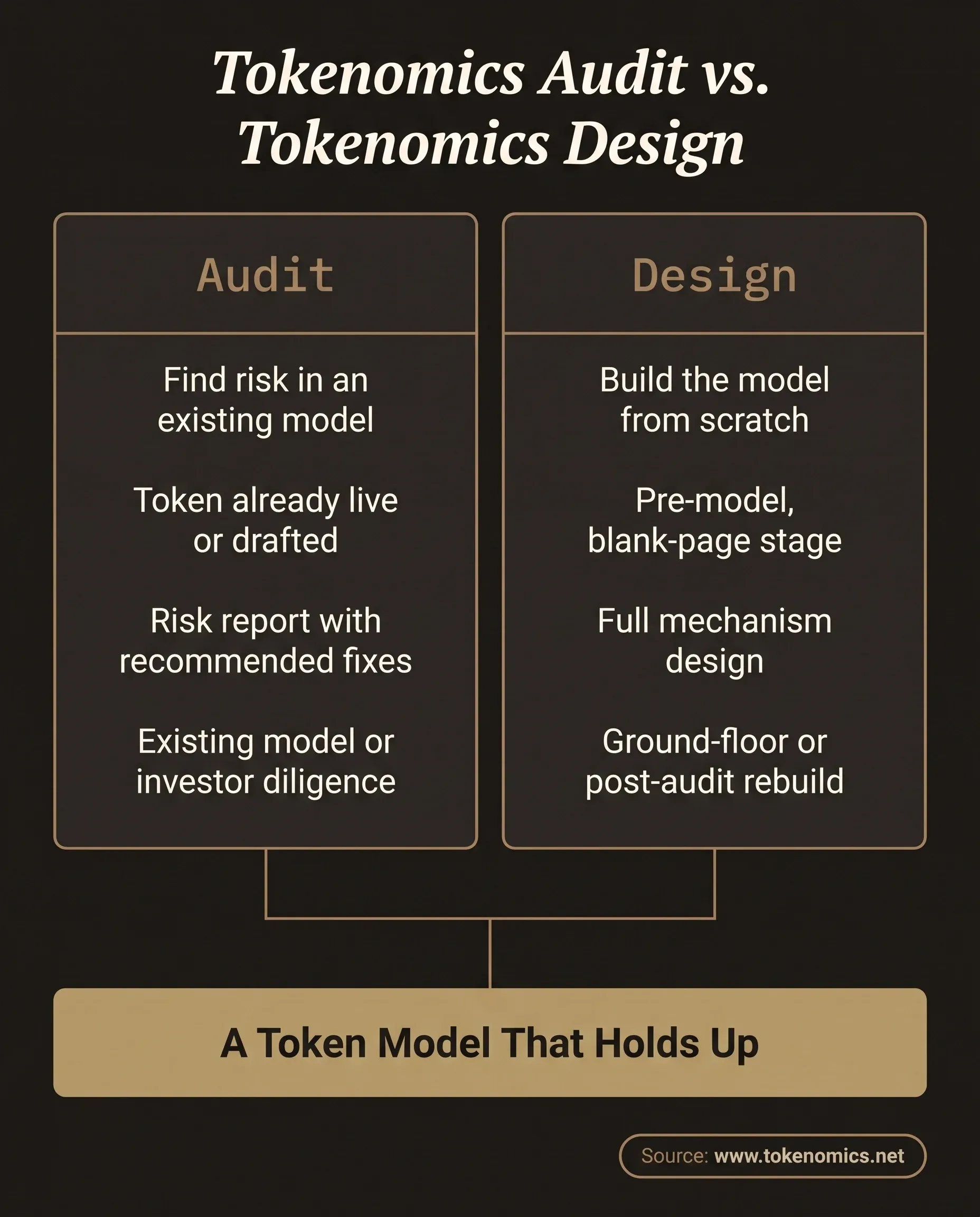
| Criteria | Tokenomics Audit | Tokenomics Design |
|---|---|---|
| Goal | Find risk in an existing model | Build the model from scratch |
| Timing / when | Token already live or drafted | Pre-model, blank-page stage |
| Inputs required | Existing whitepaper, allocation table, vesting schedule | Business model, raise stage, stakeholder map |
| Deliverable | Risk-taxonomy report with recommended fixes | Full mechanism design: supply, allocation, vesting, incentives, governance |
| Who needs it | Founders with an existing model, investors doing diligence | Ground-floor founders, or teams rebuilding after a failed audit |
| Typical lifecycle stage | Pre-raise, pre-launch, or pre-listing checkpoint | Concept stage, before any model exists |
The two services sit at different points on the same lifecycle, not in competition with each other. One reads a model that exists. The other writes one that does not.
#When to Get a Tokenomics Audit vs When to Get Tokenomics Design
Knowing when to audit tokenomics, and when to commission a design instead, comes down to the token lifecycle rather than preference. Three situations cover almost every case.
No model yet? Design. There is nothing to review, so the work is generative from the start. A model exists and has not been independently reviewed? Audit. An outside read catches concentration and incentive problems that the team that built the model tends to miss. A model exists and something already feels wrong, concentration, sell pressure, governance capture? Audit first, with design as the likely follow-on if the review finds structural problems rather than tunable parameters.
The practical triggers for an audit are consistent. Before a raise. Before a public launch. Before a listing. Or when investors or lawyers ask for independent validation. The triggers for design are different. A pre-seed concept with no model yet. A post-audit rebuild. Or a pivot that changes the underlying business enough that the old token model no longer fits.
One caveat worth naming: token and protocol designs vary widely in scale and structure. Browse the protocols tracked on DeFiLlama and you see supply models, fee mechanics, and incentive structures that share almost nothing in common. That variance is why a generic checklist cannot substitute for an independent review of the specific model in front of you.
#Can a Project Need Both?
Yes, and the sequence matters. The common path runs audit first, design second. An audit on an existing model surfaces structural problems, the kind that cannot be tuned away, and that finding is what defines the design engagement that follows. The audit says what is broken. Design rebuilds it.
The reverse sequence happens too. A freshly designed model benefits from an independent audit before it goes in front of investors, precisely because the team that built it is the wrong party to stress-test it alone. Founders who want their house fully in order often move through both, in sequence, rather than picking one and stopping. That is a pattern we see across engagements, not a rule that fits every project.
#The Bottom Line
The tokenomics audit vs tokenomics design question resolves the same way once you strip it down: an audit reviews what exists, design builds what does not exist yet, and the right starting point depends on whether a model is already on the table. Neither replaces a real underlying business. Both exist to make sure the token reflects one honestly. If a model already exists, start with a tokenomics audit and let the findings tell you whether a rebuild is warranted.
If you're building onchain and need your token model to hold up under institutional scrutiny, book a discovery call. We'll assess your project and tell you whether we're the right fit. Sometimes we're not. We'll tell you that too.