
Can You Learn Tokenomics on Your Own? A Study Order That Works

In short
You can learn tokenomics on your own, but the order decides whether it sticks. Study the business and its revenue first, then the token's job, then supply and unlocks, then the model under stress, and the documents last. Here is each stage and the three things self-study cannot do.
You can learn tokenomics on your own if you study it in the right order: the business model and its revenue first, then the token's job, then supply, allocation and vesting, then modeling under stress, and the documents last. Mechanism-first tutorials teach the fun part early. A token with no business underneath it cannot be rescued by clever design.
Most people learn this backwards. They watch a video on bonding curves, read a thread on vote-escrow locking, pick up an article about staking rewards, and six weeks later they can describe four mechanisms and still cannot say what their own token is for. The material was fine. The sequence was wrong.
That matters because the question underneath all of this is a business question, not a token question. Who pays this company, for what, at what cost to serve them, and does a token make that easier or only more complicated? Everything in the stages below exists to answer that, and a study plan that postpones it produces someone who sounds informed in a meeting and cannot build anything.
We would rather work with someone who can build a revenue model in a spreadsheet and has never heard of a bonding curve than the reverse. The spreadsheet person picks up the mechanism in an afternoon. The mechanism person has to unlearn a habit, and that takes longer.
#The order matters more than the material
There is more free tokenomics material online than anyone can read, and the quality is uneven in a way that is hard to detect while you are learning. A well written post about a staking design tells you nothing about whether that design suits a business with no revenue. You cannot tell the difference until you have the business layer underneath.
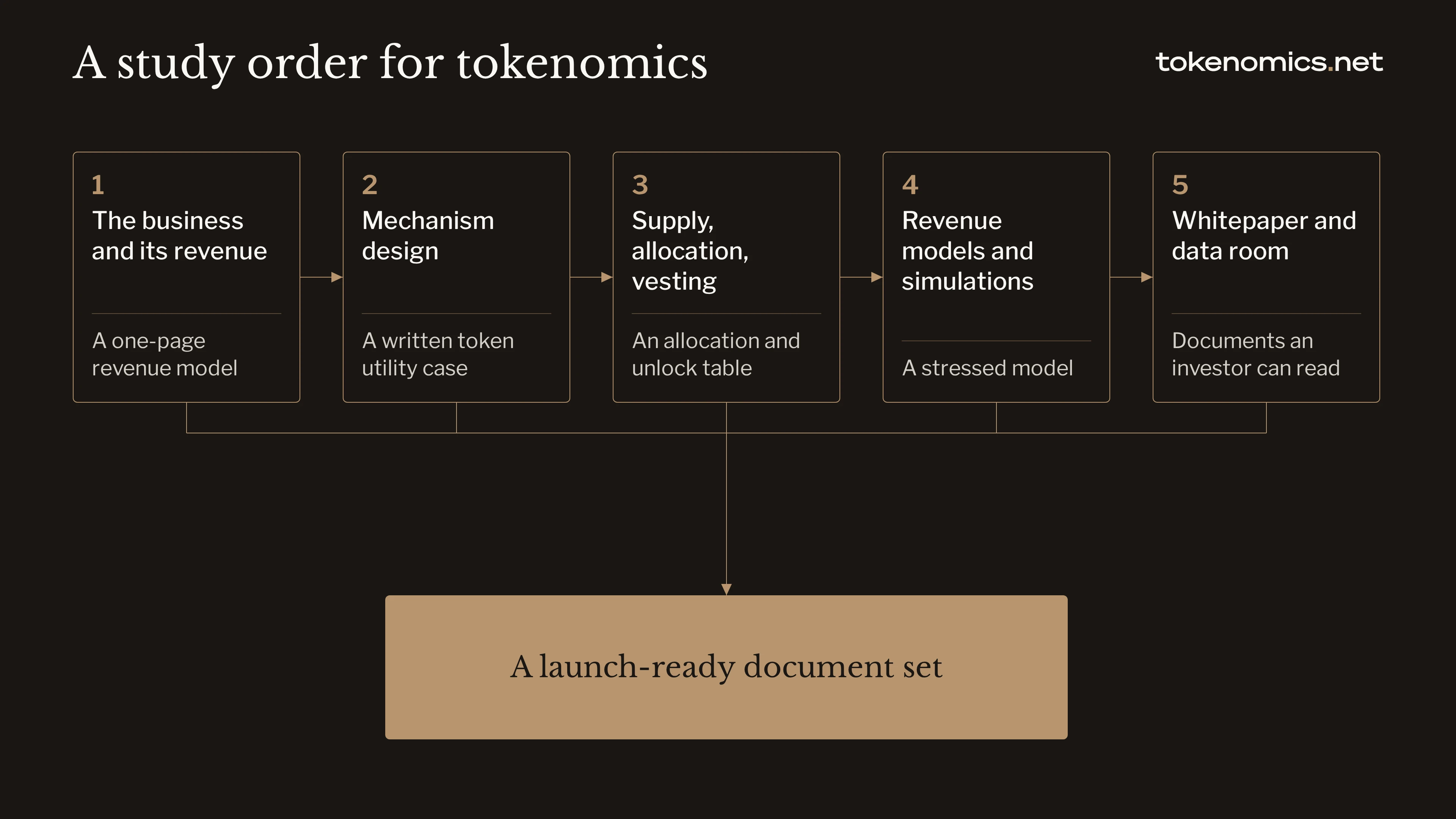
So treat the order as the thing you are actually learning. Five stages, each one producing a single artifact, each artifact feeding the next stage. Skip one and the next rests on nothing. That sequence is how a real engagement runs, and it is the order we published the free tokenomics course in, because a course arranged by topic rather than by sequence teaches people to argue about mechanisms.
#Stage 1. The business and its revenue
Start where the money is. Who the customers are, what they pay for, what it costs to serve them, and where the cash lands.
What you study here is market research and business modeling, not crypto. The first four modules of our course are Why You're Here, Discovery, Market Research and Mechanism Design: Business Model, and none of them mentions a token standard. Module 2 exists because research is what forces a pivot, and a pivot in week three is cheap.
The artifact is a one-page revenue model: customers, what they pay, unit cost, and the lines where money moves. If it does not fit on a page, you do not have it yet. Teams that cannot fill that page usually discover their token was doing the work the product was supposed to do.
#Stage 2. The token's job
Now ask what the token adds. Three questions, answered in writing: what does the token do that the business could not do without it, who has to hold it and why, and what happens to that holder's reason to hold when the price moves against them.
Most answers fail the third question. A token whose only use is governance gets held by people who want upside, not votes, and they behave accordingly. Our write-up on token utility design covers the test we use.
This is also the stage where regulatory scoping belongs, and scoping is the right word. Our Mechanism Design: Operations and Compliance module runs a project against five regimes, the US SEC and CFTC, EU MiCA, Swiss FINMA and the DLT Act, Singapore MAS, and UAE VARA and ADGM, and against five classification buckets: backed commodity, security, payment or stablecoin, utility, and NFT. The output is a question list for counsel. It is not an opinion about whether your token is a security, and nothing you study on your own makes you able to form one.
Stage 2 ends with two documents. A written case for the token, and a list of the legal questions your structure raises.
#Stage 3. Supply, allocation and vesting
This is the stage people want to start at, and it goes fine once stages 1 and 2 exist.
Study allocation first, since it decides who owns the thing: team, investors, treasury, community, liquidity, and the reasoning for each slice. Then unlocks, because the schedule decides when those owners can sell. Our token allocation framework and the guide to vesting design and schedules are the long versions, and the token generation event entry covers the vocabulary you will hit in both.
The habit to build is arithmetic. For every month in the first three years, how much supply becomes sellable, and how does that compare to the float and the liquidity you expect to have. Teams get surprised by month 13 constantly, and month 13 was visible on day one in a spreadsheet nobody built.
You finish this stage with an allocation table and an unlock schedule, and a written reason beside every row.
#Stage 4. Revenue modeling and simulations
A model is where the previous three stages meet and argue.
You build revenue, costs, supply and unlocks in one place, then run the thing somewhere unpleasant. A stress test is a written run with named assumptions that produces named outputs. Which unlock date lands in the worst spot. What happens to the treasury if revenue comes in well under plan. What breaks first, and what you would do about it. Our modeling approaches sets out the methods, including where Monte Carlo helps and where it is theater.
Learning this alone is possible. Learning whether your assumptions are reasonable is not, and that is the honest limit of self-study at this stage. A model with cheerful inputs runs beautifully.
The output is a model you can defend line by line, plus a bad-market run with the response written down.
#Stage 5. The whitepaper and the data room
Last, because documents record decisions and you now have decisions to record.
The skill here is writing one document three different readers can each act on. A lawyer needs defined terms. A developer needs parameters with no number left to interpretation. An investor needs the assumptions stated and what happens when they fail. Most whitepapers serve none of the three because they were written to impress a fourth audience that does not exist. Our whitepaper guide covers the structure, and the Tokenomics Data Room is the version of this work we run for teams who are issuing.
What you end up with is a document set somebody outside your company can read without a call.
#What self-study cannot do
Three things, and we would rather say them than have you find out at stage 4.
It cannot review your own work. You can read every lesson we publish and still not know that your revenue assumption is wishful, because the error is in the input and the model will happily process it. Reviewing your own model is like proofreading your own writing, except the typo costs a launch.
It cannot replace counsel. The scoping in stage 2 produces a question list. A lawyer answers it, for your structure, in your jurisdiction, and nothing in any course changes that.
And it cannot put your live deal in a room with somebody who has run one. That is the part we sell, and we would rather be plain about it than pretend a video does it. Live training for teams exists for the same reason: a session where your people argue with their own files beats watching slides about somebody else's.
Here is the fair complaint about the order above, including as we teach it. It is arranged the way a project runs, which means the first two stages are market research and business modeling, and that is less fun than designing a token. People quit in module 2. We know they do, and we still put it there, because the alternative is a beautifully designed token for a business nobody checked. If you are going to skip something, skip stage 5 until you need it. Do not skip stage 1.
#Frequently Asked Questions
#Can I learn blockchain on my own?
Yes, and the reading is free. The part self-study does badly is judgment, because nobody tells you which of the things you read actually applies to the business in front of you.
#How do I learn tokenomics?
In five stages, in this order: the business and its revenue, the token's job, supply and unlocks, the model under stress, then the documents. Each stage produces one artifact, and the next stage needs it.
#Is there a free tokenomics course?
Ours is free. The intro video plays with no account, and the 67 lessons, the 11 finished deliverables and the Readiness tools open with a free account.
#What should I learn first in tokenomics?
The business model. Who pays, for what, at what cost to serve, and what the token changes about that. Mechanism reading before that question is answered gets rebuilt later.
#Do I need to know how to code to learn tokenomics?
Not for the economics and the documents, which is what this subject mostly is. Our course works in spreadsheets and written deliverables, and the one piece of code in it is simulation code you run rather than write.
#Where to start
Start at stage 1 today, with a blank page and your own business on it. If you want the stages taught rather than listed, the free tokenomics course is the whole method in 67 lessons, with 11 finished deliverables and the Readiness tools opening with a free account. You can read about the instructors before you hand over an email address, which is the right order for that decision too.
Tokenomics.net is an advisory and education firm for token issuers and asset owners. The order is the lesson. The material is just material.
Bring the question to a call
Thirty minutes with the team that wrote this, on your token or your asset. You leave knowing what to fix first.