Pump.fun Tokenomics Explained: Not a Business Model
A plain-language breakdown of pump fun tokenomics: the bonding curve, migration, and why a launch mechanism is not a designed token economy.


Pump fun tokenomics is one of the most searched phrases in crypto right now, and most of what ranks for it either sells the platform or walks through the mechanics without ever asking the question that actually matters to a founder: does this create value, or does it just move volume around? This post answers both. It explains how the bonding curve, dev allocation, and liquidity migration actually work, in plain terms, and it draws a hard line between a launch mechanism and a designed token economy. Treat what follows as a cautionary case study, not a blueprint.
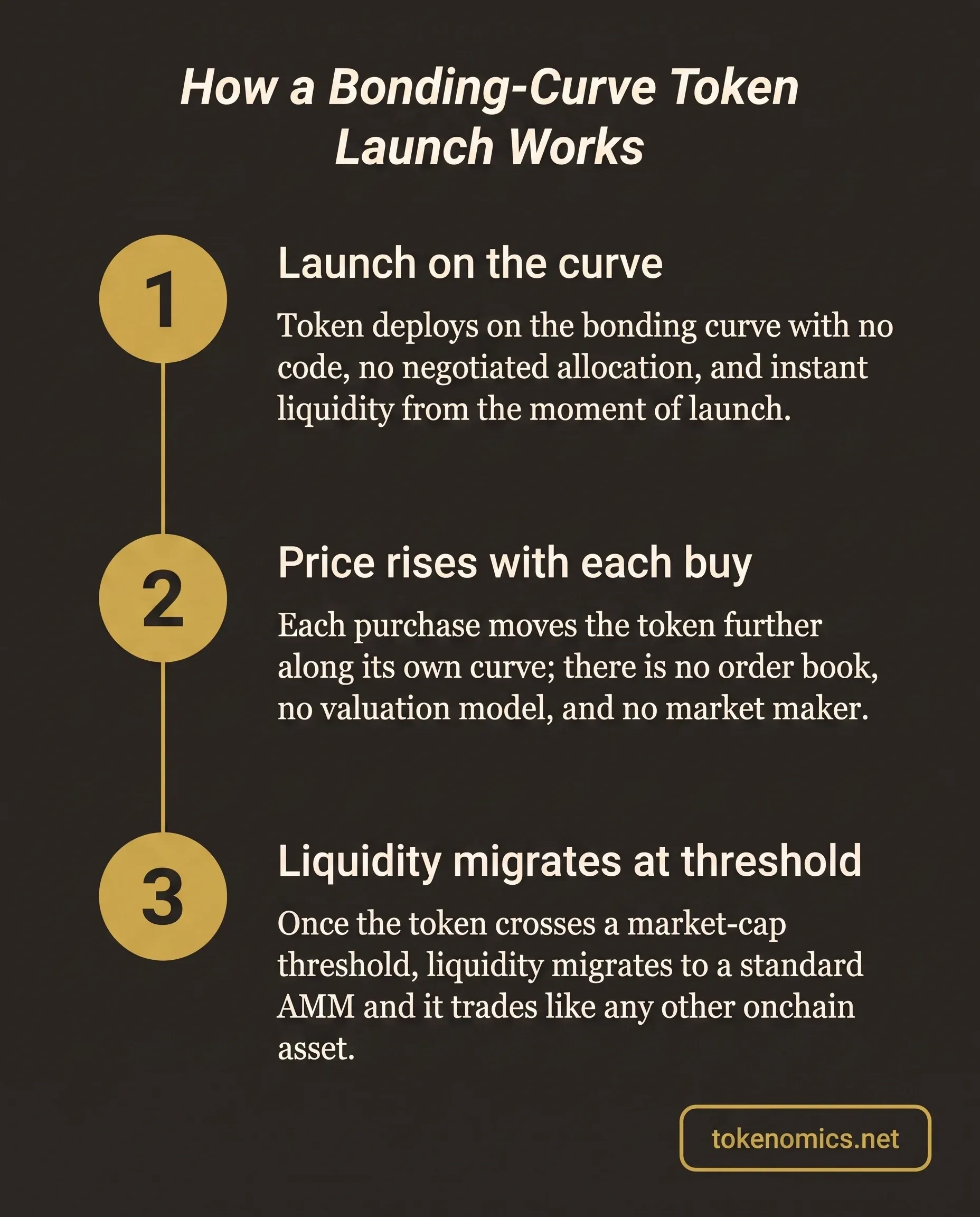
According to Pump.fun's own documentation, Pump.fun is a permissionless token-launch platform built on Solana around an automated bonding curve. Anyone can deploy a token in minutes with no code, no negotiated allocation, and instant liquidity from the moment of launch. That zero-friction appeal is exactly why it spread so fast: it removed every barrier that used to sit between an idea and a tradable token. But a launch mechanism is not a business, and it is worth saying that plainly before going further, because everything below evaluates the mechanism itself, not any specific project that has used it.
#What Pump.fun actually is
#The bonding curve, in plain terms
Understanding the pump fun bonding curve starts with a simple idea: the token's price is set entirely by a formula tied to how many tokens have already been bought, not by an order book, a valuation model, or a market maker. Buy, and the price ticks up along the curve. Sell, and it ticks back down. There is no fixed supply sale, no negotiated price, and no allocation round. The curve is the entire pricing mechanism from the first purchase to the last.
#Who uses it and why it spread
The appeal is speed and access. A founder, a community, or an individual can launch a token with no code and no gatekeeper, and buyers get instant liquidity without waiting for an exchange listing. That combination, zero friction on both sides, is why volume on this model grew so quickly. It is also why the category gets confused with tokenomics design: the mechanics are visible and easy to explain, so they get mistaken for the whole discipline. A launch mechanism answers how a token gets priced. It says nothing about whether the thing being priced creates value.
#How the bonding curve prices a token
#The math in one paragraph, no formulas required
No formula is required to understand the shape of it. Each token sits on a curve where price increases as more tokens are bought and decreases as they are sold. The curve itself, not demand for a product or a service, is the entire pricing engine. This is bonding curve tokenomics in its purest form: a supply-and-demand function operating on the token alone, with nothing external feeding into the price.
#Why price rises with each buy, structurally
Because every purchase moves the token further along its own curve, buyers who enter early are mathematically advantaged over buyers who enter later, by design, not by any traction the underlying idea has achieved. That is a structural feature of the mechanism, not a signal of quality. Compare that to a vesting schedule, a staking reward, or a utility-based model, the kinds of mechanisms a real tokenomics engagement actually designs: those tie value to time, usage, or a real economic function. A bonding curve ties value to the order buyers arrived in.
#What happens at migration (the graduation event)
#The liquidity migration threshold
Per Pump.fun's documentation, once a token crosses a market-cap threshold on the bonding curve, its liquidity migrates to a standard automated market maker and the token starts trading like any other onchain asset. Whether any given token crosses that threshold depends entirely on continued buying activity on the curve; the mechanism itself does not guarantee migration and does not force it. The bonding curve is the only pricing structure a token has before migration, so its price is a function of that buying activity and nothing else.
#What changes for holders once a token "graduates"
Migration changes where the token trades and how its price forms afterward, but it changes nothing about what the token does. A token that graduates to an AMM is not more legitimate than one that never does. It has simply crossed a mechanical threshold built into the platform. Anyone searching pump fun tokenomics to understand what graduation means is really asking a factual question about plumbing, not a question about whether the underlying project is sound.
#Who actually captures value in this model
#The platform's cut
Per Pump.fun's documentation, the platform takes a fee on trading activity and on the migration event itself. That fee is the platform's business model, and it is worth naming plainly: the platform earns from volume passing through the curve, regardless of whether any individual token succeeds or fails afterward. Volume is the product being monetized, not the token's long-term outcome.
#The dev allocation and why it matters
Whether a launch platform allocates any tokens to its creator, and on what terms, is a real design variable in this category, and it shapes who benefits from early price movement before the public ever encounters the token. This post does not have a primary source confirming Pump.fun's own allocation practice, so it makes no claim about it here; that is exactly the kind of detail worth confirming directly against the platform's documentation before relying on it. What most searches for pump fun tokenomics are actually asking about is this kind of distribution and fee question, not governance rights, incentive alignment, or any of the design questions a real tokenomics engagement works through. Knowing who takes a cut and when is useful information. It is not the same as understanding whether a token economy has been engineered to hold up over time.
#Why this is not tokenomics design
#Speculation vehicle vs. engineered token economy
Here is the firm's standing position, stated plainly: a token that exists solely to go up in price is not a design category we work in. That is not a judgment about any individual project. It is a category distinction. An engineered token economy ties incentives to something that exists independent of the token itself: real usage, real revenue, or real governance rights over a business that would still exist if the token disappeared tomorrow. A bonding-curve launch, by default, ties everything to the token's own trading activity. That is the tokenomics vs speculation line, and it runs directly through this mechanism.
#The question every real token model has to answer
Every engineered token model has to answer one question before launch: what does this token capture value from, other than its own price? A bonding curve does not answer that question by default. It can be paired with something that does, a real product, a real revenue stream, but the curve itself is silent on the point. That silence is exactly what separates a launch mechanism from a designed economy, and it is why most tokenomics designs fail in the first place: the structural gap is left open at launch and often stays open.
#The failure pattern this category shares with other high-velocity launches
#What happens after the volume moves on
The pattern repeats across high-velocity launch categories, not just this one: attention concentrates in a narrow early window, trading volume is heaviest in the first hours or days, and then it moves on to whatever launches next. Tokens built around a real product can survive that attention cycle because something keeps functioning after the volume leaves. Tokens with nothing underneath the price action generally cannot.
#The structural reason most bonding-curve tokens go to zero
The structural reason is simple: if a token's only source of demand is speculative buying on a curve, then once that buying stops, there is no other mechanism left to hold the price up. Where no revenue-generating business, governance function, or utility case sits underneath the token, nothing remains once the volume evaporates. That is not a prediction about any specific token. It is the mechanical consequence of a design gap.
#What a founder should ask instead
#Three questions that separate a launch mechanism from a token economy
Before treating any launch mechanism as a business model, three questions do most of the filtering work. Does the token capture value from something other than its own trading volume? Is there a real product or revenue stream underneath the token, one that would keep functioning if the token's price went to zero? And would the model still make sense if the token's price stayed flat for a full year? A design that fails all three is a speculation vehicle wearing tokenomics language.
#Where a bonding-curve launch can be a legitimate distribution tool, narrowly
None of this rules out fair-launch mechanics entirely. Paired with a real product and a real revenue stream, a bonding-curve launch can be a legitimate, low-friction way to distribute a token to an early community, and getting that pairing right is exactly the work of our Token Launch Strategy service. The mechanism itself is not the problem. Treating the mechanism as the whole strategy is.
That is pump.fun tokenomics explained in full: a fast, permissionless pricing mechanism, not a business model, and not a design pattern worth copying on its own. If you are evaluating a launch mechanism for your own project and want a second opinion on whether there is a real token economy underneath it, book a strategy call before you launch, not after.