How to Choose a Tokenomics Consultant: Evaluation Framework
A framework for evaluating a tokenomics consultant: what to ask about track record, process, and deliverables before you sign an engagement.


Choosing a tokenomics consultant is an evaluation problem before it is a hiring problem. The engagement runs multiple weeks, costs five figures at minimum, and produces a deliverable your lawyers, your developers, and eventually your board will all have to live with. Get it wrong and you do not find out for months, usually right when an auditor or a listing exchange starts asking questions the deliverable cannot answer.
This is a framework for evaluating a tokenomics consultant before you sign anything. It works whether or not you ever talk to us. What matters here is track record, process, deliverables, and honesty, and you can check any vendor on your shortlist against all four without needing to already understand tokenomics yourself.
#Why this is an evaluation, not a shopping trip
Here is the reframe that matters most: tokenomics is not the product. It is infrastructure that either amplifies or undermines the real business underneath it. A well-designed token model makes your actual value-creation engine, the thing that generates revenue or usage or network effects, work better. A poorly designed one adds a layer of financial engineering on top of a business that either did not need it or gets distorted by it. So the first question in how to evaluate a tokenomics consultant is not "is this a good token model in isolation," it is "does this vendor understand what my business actually creates value from, or are they selling me a template."
The decision in front of you is not "which vendor has the nicest deck." It is closer to hiring outside counsel: a $15,000-plus, multi-week engagement that someone else, usually your lawyers or your board, will need to defend later. If the token design does not hold up under scrutiny, that defense falls on you, not on the tokenomics consultant who left six months ago.
Name the fear directly, because it is the real one: professionally-packaged garbage. A deck with the right vocabulary, clean charts, and confident language that falls apart the moment your counsel or an external auditor pokes at the vesting math or the utility claims. That outcome looks identical to a good outcome for the first month. The difference only shows up later, which is exactly why evaluation has to happen up front and cannot rely on how polished the pitch sounds.
#Start with track record, not with claims
Every tokenomics consultant you talk to will describe themselves well. That is not evidence of anything. The distinction that matters is proof versus claim, and they look different in a specific way.
A claim sounds like "we're the best in the space" or "cutting-edge tokenomics design." Those are adjectives. Adjectives are free to say and impossible to verify, and any vendor who leads with them is telling you, whether they mean to or not, that they don't have anything more specific to offer.
Proof sounds like a number attached to a pattern. Ask directly: how many engagements have you completed, and what is the range of outcomes across them. A vendor with a real track record can tell you something like "this particular design choice, a specific vesting structure or a liquidity mechanism, shows up in a meaningful proportion of our engagements because it solves a recurring problem." That is a pattern drawn from repetition, not a single cherry-picked success story dressed up as a methodology.
Two follow-up questions do a lot of work here. First: "can you walk me through the range of outcomes, not just the best one." A vendor who only wants to discuss their single best result is hiding the distribution. Second: "what's a project count you can point to, and what's the aggregate scale." An answer in the range of dozens of engagements and meaningful combined capital raised across them tells you something. An answer that dodges the number entirely tells you something too.
#Ask about process, not promises
The second filter is whether the consultant can describe a repeatable process or whether they jump straight to a quote. This matters more than it sounds like it should, because process is the thing that survives contact with your specific, messy business situation. A promise is just a hope wearing a suit.
Run what amounts to a five-question process test in the first call. Ask: what are the phases of your engagement, and what does each one produce. What happens if the design phase surfaces a problem with our current plan. How do you handle a business model with an unusual revenue structure that doesn't map cleanly to a standard token utility case. Who reviews the documentation before it's considered final. And what happens after delivery if a regulatory or market condition changes.
A specific answer names concrete phases with concrete outputs. Something like: design phase produces a token model with defined mechanics, documentation phase produces a whitepaper and technical specification ready for legal review, and strategy phase produces a go-to-market and distribution plan. Each phase has a deliverable you can hold in your hand.
A vague answer talks in generalities: "we'll figure out what you need," or "it depends on the project," offered without any follow-up specificity even when you push for it. A consultant who cannot describe their own process, unprompted and in detail, most likely does not have one. They are building the plane as they go, on your engagement, at your expense.
#Tokenomics engagement deliverables: what a complete package actually includes
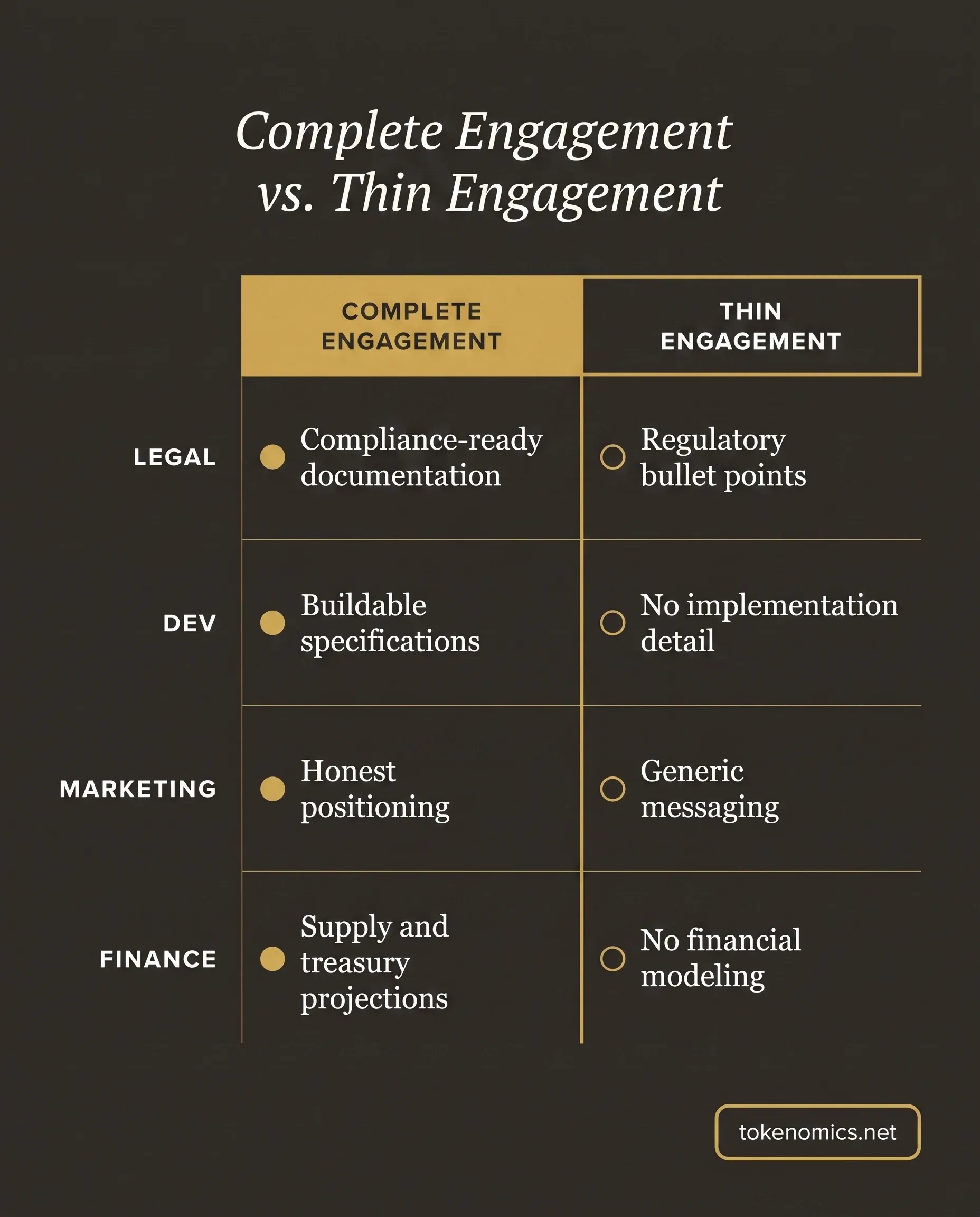
This is the section to bookmark, because it gives you something concrete to check any vendor's proposal against. A complete set of tokenomics engagement deliverables has to satisfy four different internal stakeholders, and each one needs something different.
Legal needs documentation that is compliance-ready, meaning it can be handed to counsel for review without a rewrite first. Not a deck with bullet points about "regulatory considerations," but structured documentation of the mechanism, the distribution, and the rights attached to the token, written so a lawyer can actually assess it. Note the distinction: no consultant should describe a deliverable as "compliant," since compliance is a legal determination, not a vendor claim. It also moves: the SEC withdrew and replaced its digital-asset investment-contract framework in March 2026, and the SEC's Crypto Task Force is where that guidance now develops. A consultant who cannot tell you which standard a deliverable was written against is not tracking the thing you are paying them to track. The honest framing is "reviewable by counsel" or "compliance-ready," not "compliant."
Dev needs specifications they can build against. Vesting schedules, contract logic, distribution mechanics, all specified precisely enough that an engineer does not have to guess or come back with clarifying questions before writing code.
Marketing needs positioning. What the token does, why it exists, and how to communicate that honestly to a community and to potential holders without overpromising.
Finance needs projections. Supply schedules, unlock timing, and how token flows interact with the treasury and the business's actual cash position over time.
A thin engagement hands you a deck. It looks complete because it has sections labeled legal, dev, marketing, and finance, but none of those sections gives the relevant function something they can act on without coming back to you with follow-up questions. A complete engagement hands each function a working document. The test is simple: could you forward each section to the relevant person on your team today and have them start working from it, or would they immediately need to ask you what it actually means?
For the fundamentals this framework builds on, see when to hire a tokenomics consultant. And for a concrete look at what a complete deliverable package looks like end to end, our own complete data room engagement documents every layer a real one produces.
#Questions that separate operators from advisors
There is a meaningful difference between someone who has designed tokenomics from a whiteboard and someone who has been the person staring at a live token chart at two in the morning wondering why a mechanism is not behaving the way the model predicted. Both can sound equally confident in a first meeting with a prospective tokenomics consultant. The way to tell them apart is to ask directly.
Ask: "have you actually operated a token launch, or have you advised on the design and then moved to the next client." This is not a trick question, and a good vendor will answer it plainly, including naming which parts of their experience are operating experience and which are advisory.
Then get specific on the areas where theory and practice diverge most: vesting, allocation, and liquidity. An operator's answer to "tell me about a design choice that didn't work in practice" sounds different from an advisor's answer. The operator names a specific mechanism that behaved unexpectedly once real holders and real market conditions were involved, describes how the problem was caught, and describes what changed as a result. The advisor, by contrast, tends to speak in frameworks with no attached failure case, because they were not present for the failure.
Neither answer disqualifies a vendor by itself. Plenty of good advisors bring frameworks worth having. But if every answer in the conversation stays at the level of theory with zero examples of something that went wrong and got fixed, that is worth noting before you sign anything.
#Tokenomics consultant red flags that should end the conversation
Some tokenomics consultant red flags are strong enough that they should end the evaluation on their own, regardless of how the rest of the conversation went.
On pricing and scope: a vendor pushing hard for a price meaningfully below what the described scope of work requires is not being efficient, they are underscoping the engagement, and you will find out what got cut later, usually at the worst possible time. Watch also for vague scope boundaries that leave room for "that's a separate engagement" surprises once you're already committed.
On communication and honesty: a consultant who promises a specific outcome, a funding round, a valuation, a listing, tied to a specific timeline is promising something outside their control. No one is in a position to promise that. Equally telling is a consultant who does not say "this part of your plan won't work." Every real business plan has at least one weak point a competent outside evaluator should be able to identify. A vendor who agrees with everything you propose is not evaluating your plan, they are managing your comfort.
Watch their own marketing too. Hype language like "moon," "guaranteed," or "revolutionary" anywhere in how they present themselves signals what they are likely to produce for you, because a vendor's own positioning is the clearest sample of their actual standards. And if a vendor will not name, directly and specifically, what a complete deliverable includes when you ask, treat that unwillingness as an answer in itself.
#What honest pricing signals actually look like
Pricing tells you almost as much about a tokenomics consultant as the proposal itself, if you know what to read for.
"Cheap and fast" is a red flag, not a value signal, for the same reason a suspiciously fast home inspection would worry you. Serious tokenomics work involves modeling, documentation, and cross-functional review, none of which compresses well without something getting skipped. A quote that promises both speed and thoroughness at a bargain price is usually promising one and quietly dropping the other.
A serious quote scopes design, documentation, and strategy as a single connected package, because those three pieces need to stay consistent with each other. A design document alone, without the documentation and strategy layer built around it, is a partial deliverable dressed up as a complete one.
Timeline specificity matters too. A concrete timeline measured in weeks, with named phases and named deliverables at each phase, signals a defined process. An open-ended "ongoing" engagement with no defined endpoint signals either an undefined process or a billing structure designed to extend indefinitely. Neither is inherently wrong for every situation, but you should know which one you are agreeing to before you sign.
If you are not ready to commit to a full design engagement yet, a tokenomics audit service is a lower-commitment way to get an independent read on where your current plan stands.
If you have already run your shortlist through this framework and want a second opinion on where it lands, that is a conversation worth having before you sign anything, not after. Book a strategy call to get it.