Suilend Explained: How Sui's Lending Protocol Actually Works
Suilend explained: how the Sui lending protocol handles collateral, interest rates, and liquidation, and where its public token documentation stops short.


Suilend is an overcollateralized lending and borrowing protocol built on the Sui blockchain. Depositors supply assets into per-asset reserves, borrowers post those deposits as collateral against a loan in a different asset, and an interest rate driven by utilization moves value between the two sides (Source: Suilend documentation).
Two things make the mechanism worth reading closely. A money market only creates value when real borrowing demand sits underneath it, and incentive programs that look generous during an emissions window rarely survive the end of one. That is the business question this post keeps returning to. It is a mechanism explainer written for founders and operators studying live protocol design, not guidance on whether to deposit anything anywhere.
#What Suilend is, and what it is not
Suilend: an overcollateralized lending and borrowing protocol on the Sui blockchain where depositors supply assets to per-asset reserves and borrowers post those deposits as collateral for utilization-priced loans.
Suilend is a money market. Users deposit supported assets into reserves, those deposits earn interest paid by borrowers, and the same deposits back loans in other assets. Suilend's own materials describe it as built by the team behind Solend on Solana, which shows in a reserve-and-parameter architecture that will read as familiar to anyone who has worked through Aave or Compound documentation.
What it is not: a change to how SUI itself works. It is an application sitting on top of the chain. SUI's supply schedule, staking rewards, and gas fee burn are a separate layer with separate mechanics, covered in our sui emission schedule and staking breakdown. Collapsing the two into one analysis is the most common error we see when a team writes up an L1 and its applications in the same document.
The question we would ask before any parameter table: who borrows here, and why? A lending market with deep supply and no borrowers is a subsidy, not a business.
#How Suilend's lending and borrowing mechanism works
Every asset on Suilend carries its own reserve configuration, and those parameters are the risk model (Source: Suilend documentation). Three levers do most of the work.
Collateral parameters. Suilend's documentation describes per-asset loan-to-value settings: a ceiling that governs how much you can borrow against a deposit, and a higher threshold at which the position becomes eligible for liquidation. Assets also carry a borrow weight that scales how expensive a given borrow is against your collateral. Specific values move by asset and by governance action, so read them out of the reserve configuration onchain rather than from a secondhand table.
Interest rates. The documentation describes a utilization-based rate model: as more of a reserve's deposits get borrowed, the borrow rate climbs and the supply rate follows. We could not verify exact curve points per asset against a protocol-published parameter table, so treat the curve shape as the documented mechanism and pull live values from the app or the contract.
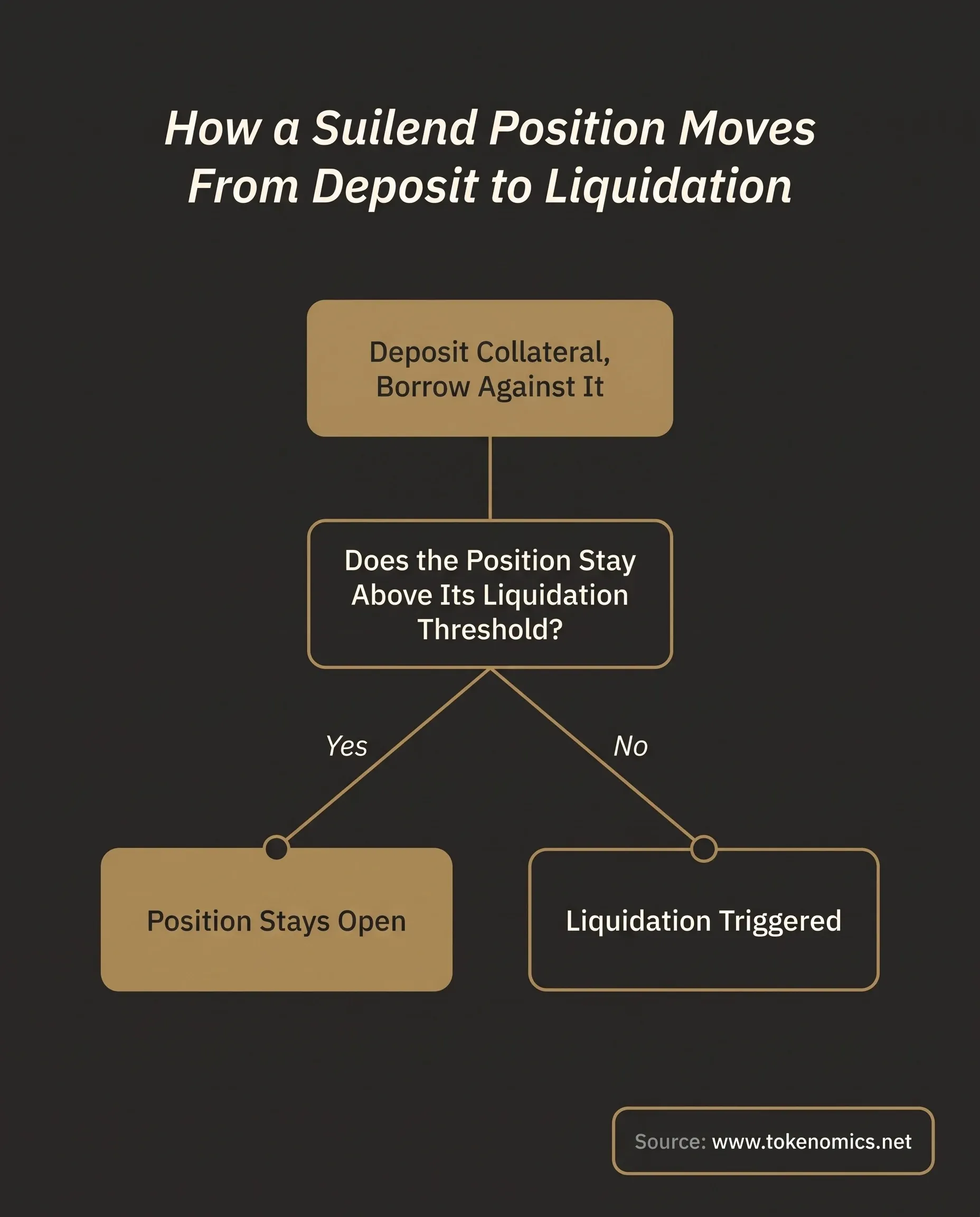
Liquidation. Once a position's borrowed value crosses its liquidation threshold, a third party can repay part of the debt and claim collateral at a discount. That discount is the liquidator's incentive. It is also the price the borrower pays for being late.
Most teams reading a money market go straight to the rate curve. That is the wrong first read. Collateral parameters and the liquidation path decide whether the protocol survives a fast drawdown. The rate curve only decides how revenue splits on a normal day.
One composability note, sourced to the chain rather than the application: Sui's object model lets a deposit position be held and moved as its own object, which is what makes lending receipts usable inside other Sui applications (Source: Sui documentation).
#Suilend's token model and the documentation gap
Suilend has a native token, SEND, described in the protocol's own materials and distributed in part through a points program that ran before the token existed.
That is close to where confident, primary-sourced description stops. We are going to say so rather than fill the gap.
Checking in September 2026, we could not locate a protocol-published tokenomics specification for SEND carrying the detail a larger protocol would publish: a full allocation table by bucket, a vesting schedule with cliff dates, and a stated emissions policy for ongoing incentives.
Aggregator sites carry numbers for all three. Those sites are not the protocol and they do not publish their sourcing, so we do not cite them for supply or emissions claims. If you need the figures, read them off the SEND contract and its distribution transactions on a Sui explorer, or wait for the protocol to publish them.
Treat that as a finding rather than a hole in the research. A protocol that documents reserve parameters in detail and its token in outline is telling you where engineering attention has gone. Whether that reflects deliberate sequencing or an oversight is not something we can source, so we will not guess at it.
The pattern worth naming is general, not a claim about intent. Incentive designs that pay a token for supplying liquidity produce supply that arrives for the reward and leaves with it. Designs like this are typically judged on what borrowing volume does after emissions taper, not on the size of the program while it runs. That test applies to every money market.
#Where Suilend sits in Sui's broader design
A lending market inherits its constraints from the chain underneath it. Liquidations have to land fast and cheaply, or the protocol carries bad debt it never priced. Sui's documentation describes sub-second finality and parallel execution for transactions touching independent objects (Source: Sui documentation). For a money market that is the property that matters most: a liquidator competing for a position should not be queued behind unrelated traffic.
Fee cost is the second constraint. Liquidating is only worth doing when the discount clears gas plus the price risk the liquidator absorbs. On a chain where fees spike under load, that incentive has to be set high enough to survive the worst moment, which means borrowers pay for the headroom on every ordinary day.
Composability is the third, and it cuts both ways. How LST tokenomics works is the adjacent mechanism: a liquid staking token posted as collateral in a money market stacks two yield sources and two risk surfaces in one position.
None of this says the protocol has solved any of it. It is the checklist to run when you are deciding whether your own mechanism fits the chain you picked. Teams working through a similar lending-market or incentive design usually want our Tokenomics Design service before parameters get written into a contract.
#What founders building similar mechanisms should take from Suilend
Four patterns hold across the lending-market designs we have reviewed.
Collateral parameters are the product. The rate curve is tuning. Loan-to-value ceilings, borrow weights, and the liquidation threshold are the risk position the protocol genuinely takes. Price those first.
Liquidation incentives are a standing cost, not a launch decision. Set them too low and the protocol eats bad debt in the one hour it cannot afford to. Set them too high and borrowers subsidize an event that rarely fires.
Emissions buy supply, not demand. Supply follows the reward. Borrowing follows a reason to borrow. If the second one is missing when the first one stops, there was no market underneath.
Publish parameters where risk teams can check them. Documentation that holds up when someone looks under the hood is a cheaper form of credibility than any amount of positioning.
Whether this shape fits a given protocol's own mechanism is a separate question. The lending market is infrastructure. The borrowing demand underneath it is the engine.
If you're building onchain and need your lending-market or incentive design to hold up under institutional scrutiny, book a strategy call. We'll assess your project and tell you whether we're the right fit. Sometimes we're not. We'll tell you that too.