Decentralized AI Tokenomics: How Token Incentives Work for AI Networks
Decentralized AI tokenomics is the incentive design behind AI agent transactions and AI x DePIN compute networks. Here's how the token mechanics actually work.


Decentralized AI tokenomics is the incentive design behind token payments in AI agent platforms and the compute or inference networks they run on. It covers how AI agents transact value, how the AI x DePIN bridge coordinates hardware and data, and which incentive patterns fit an AI-shaped workload.
Decentralized AI tokenomics is the economic design behind token incentives in AI agent platforms and AI-adjacent compute or inference networks. It covers how token rewards reach the operators, data providers, and infrastructure that AI agents and models depend on, and how those incentive structures borrow from and extend DePIN token design patterns.
This post walks three moving parts in order: how AI agents transact value onchain, how the AI x DePIN bridge coordinates compute and inference markets, and the incentive design patterns and tradeoffs that follow. It is a teardown of the mechanism, not a roundup of platforms.
Here is the economic logic underneath the whole thing. AI agent platforms and compute networks pay token incentives because real inference, compute, and data work is being performed and needs to be priced and coordinated. The token is not there to be traded. It is there to pay for work that someone wants done.
#What Is Decentralized AI Tokenomics? (Direct Answer)
Decentralized AI tokenomics: the economic design governing token incentives across AI agent platforms and AI-adjacent compute or inference networks, covering how rewards reach the operators, data providers, and infrastructure that AI agents and models depend on, and how those incentives extend DePIN token design patterns.
Break that into three parts: an agent side, where autonomous software spends tokens for the work it needs, an infrastructure side, where compute and inference get supplied and paid for, and a design side, where the incentive pattern connecting the two gets chosen. It is worth studying because a growing number of teams are designing token models for AI agent platforms and compute marketplaces right now, and they face tradeoffs DePIN designers already worked through once.
#How AI Agent Tokenomics Works
AI agent tokenomics starts with a shift in who initiates the transaction. In a standard dApp, a human clicks a button and signs. In an AI agent model, the party spending tokens is frequently an autonomous agent: a wallet-holding piece of software acting on a pre-set budget or policy. That changes the tempo of the whole system.
#Agent-to-network payment flows
An agent that pays for compute needs a way to hold and spend tokens without a human signing each transaction. The primitive that makes this possible is account abstraction: smart-contract wallets that can hold tokens and spend them under programmable rules, described in Ethereum's account abstraction documentation and standardized in ERC-4337 (Source: Ethereum). This describes the general wallet-abstraction pattern, not any specific AI agent protocol's implementation.
Machine-initiated payments run at machine speed and machine frequency. Incentive design has to price a pattern of near-constant automated spending rather than assume a human clicking occasionally.
#Where AI agent tokenomics differs from standard dApp tokenomics
The core design question is plain: does the agent hold its own token balance and spend against a budget, or does a human-controlled account settle on the agent's behalf after the fact. Both patterns exist. An agent-held balance lowers transaction friction and lets the agent act at speed. It also concentrates custody risk in software. A human-settled model reduces custody exposure and adds friction and latency. The tradeoff is real either way, and it is a first-order choice, not a detail. Getting that choice right is core tokenomics design work, not something to bolt on after launch.
#The AI x DePIN Bridge: Compute, Inference, and Data Networks
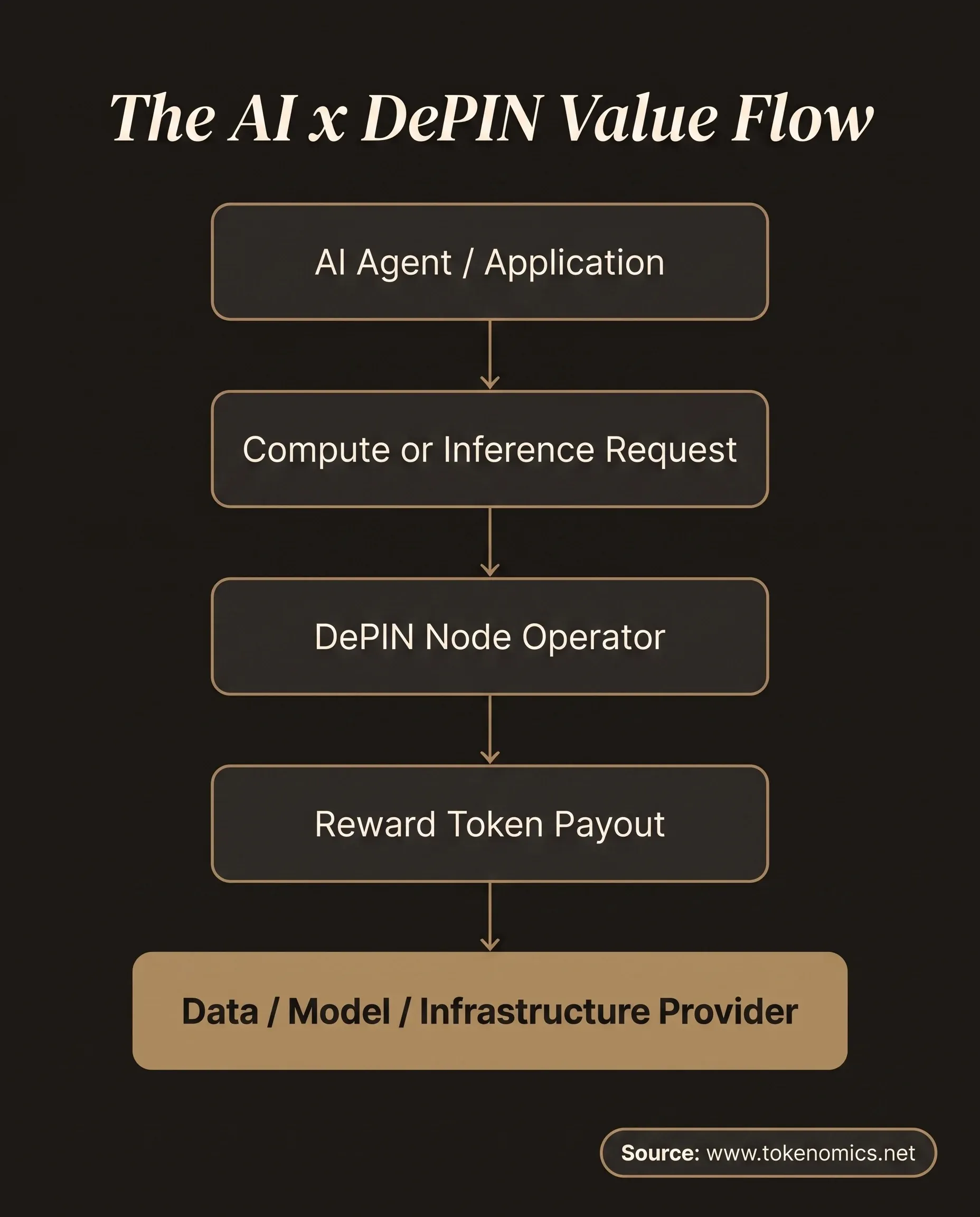
AI x DePIN tokenomics is where the agent side meets the hardware side. The infrastructure an AI agent or platform actually pays for, GPU compute, inference cycles, storage, and data, is a decentralized pool of hardware and data operators being coordinated and paid through token incentives. That is a DePIN network. So AI x DePIN tokenomics is not a new category. It is DePIN incentive design applied to an AI-shaped workload.
#Compute and inference marketplaces as DePIN networks
A compute or inference marketplace matches demand from AI applications with supply from operators who run the hardware. The token coordinates that market: it prices the work, pays the operators, and gives the network a unit to settle in. DefiLlama tracks DePIN as one of the larger onchain verticals by total value locked, a useful scale reference for how much capital these coordination networks now hold (Source: DefiLlama). That figure sizes the coordination problem, not what any operator earns; this post makes no yield projection.
#Borrowing node-operator incentive design from DePIN
The reward design carries over nearly directly. Node-operator rewards, coverage-weighted or utilization-weighted payouts, and stake-slashing patterns were built for DePIN networks that supply wireless coverage, storage, or sensor data. A compute or inference network supplies a different resource, but the incentive question is the same: pay operators for verified capacity and penalize those who claim capacity they do not deliver. Teams designing here can lift the mechanics from existing DePIN work rather than reinventing them.
#Token Incentive Design Patterns and Tradeoffs for AI Networks
Decentralized AI token incentives tend to fall into two dominant patterns, and which one fits depends on the network's revenue mechanics.
#Work-token vs. fee-capture models for AI networks
In a work-token model, holding or staking the token is required to provide compute, inference, or data and to earn rewards, which ties demand for the token to demand for the work. In a fee-capture model, the token captures a share of the fees that AI agents and applications pay to use the network, and providers are paid out of that fee flow. Each pattern trades off differently on token velocity and long-term holder incentive. Neither is universally right; the fit depends on how the network actually earns. Both inherit their core reward mechanics from DePIN networks, which our DePIN tokenomics guide breaks down in full.
Both patterns issue their reward token under the ERC-20 standard, defined in EIP-20 on the Ethereum Improvement Proposals site (Source: Ethereum Improvement Proposals). Naming the standard says nothing about a token's regulatory status. ERC-20 is a technical interface, not a legal classification.
#Design tradeoffs: agent autonomy, custody, and security risk
There is a risk category here that barely exists in human-driven tokenomics. When the transacting party is an autonomous agent, custody and authorization become first-order design questions, not edge cases. An agent can spend outside its intended policy. A compromised agent can drain a token balance before anyone notices. Audited access-control and staking patterns, like those documented in OpenZeppelin's contract libraries, handle the onchain half of agent-initiated token flows well (Source: OpenZeppelin). The harder half is bounding what an autonomous spender is allowed to do in the first place.
There is a securities-adjacent question worth naming carefully. When an autonomous agent transacts value on someone's behalf, whether that raises novel legal-agency or custody questions is, in our view, unsettled, and it gets harder the more independently the agent acts. We are not asserting that any specific structure is or is not a security; that is a fact-specific, jurisdiction-specific determination for a legal team and the relevant regulator, with the U.S. Securities and Exchange Commission's own guidance as the reference point (Source: SEC).
Close the loop back to where we started. The incentive design only works if the AI agent or compute network is doing real, priced work. A token layered onto agent transactions without a real compute, inference, or data market underneath does not manufacture value on its own. The token is infrastructure. The work being coordinated has to be the engine.