
How to Tokenize Real Estate: The Order of Work for an Owner

In short
Tokenizing real estate runs in a fixed order, with tokens last. See the five steps an owner takes and where deals go wrong. Read the sequence.
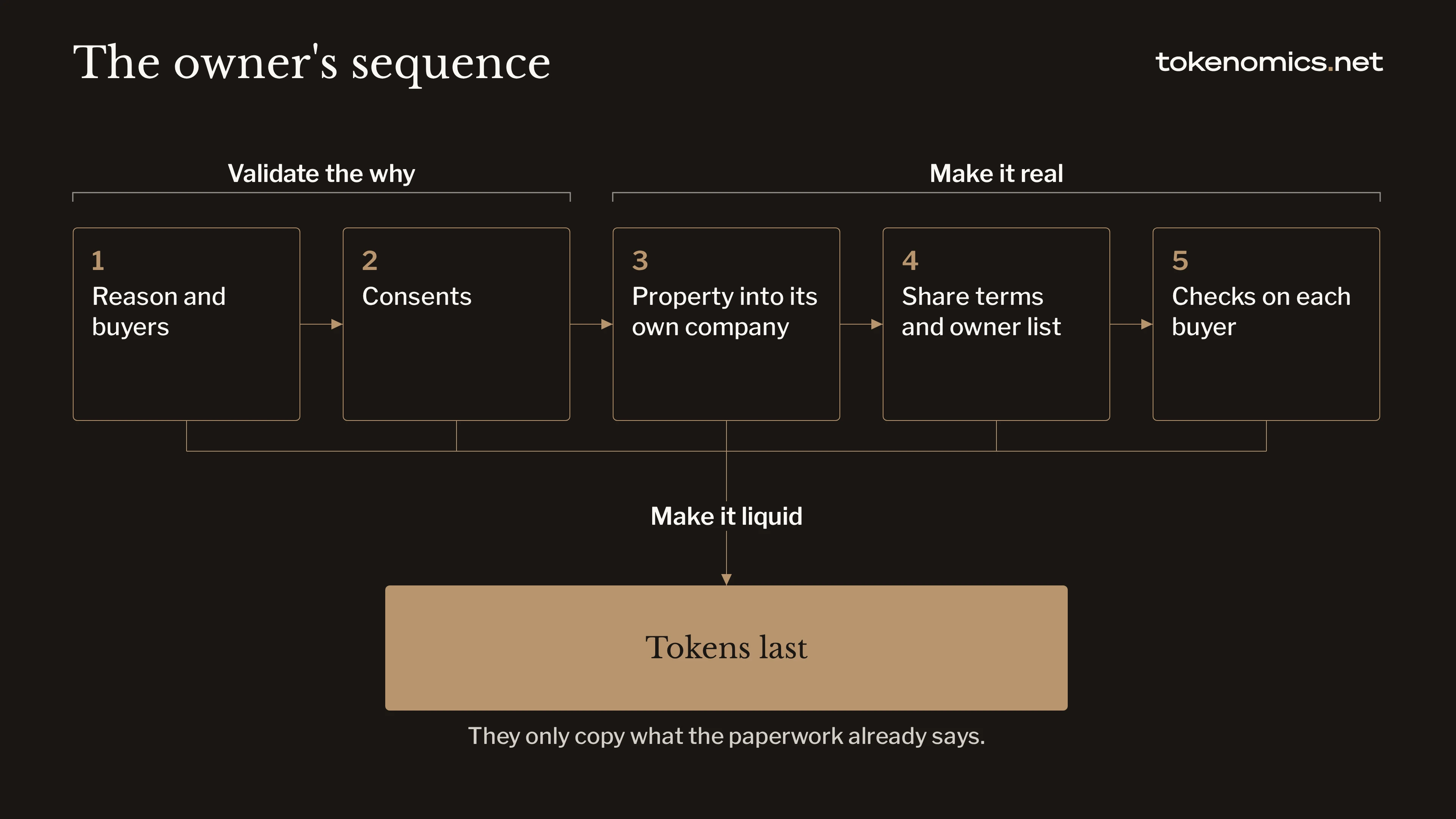
Tokenizing real estate runs in a fixed order: confirm the reason and the buyers, get consent from anyone with a claim on the property, move the property into its own company, set the share terms and the owner list, check each buyer, and issue tokens last, because the token only records what the paperwork already says.
#The order is the job
Every part of this is ordinary real estate finance except the last step. The token is a register entry with transfer rules attached. It can only record a right that already exists in a document, which is why it comes last and why putting it first is the most reliable way to waste a year.
The business question sits in front of all five steps. You are selling part of an asset to raise cash, so you need a use for the cash with a number against it, and you need buyers who want what you are selling at a price you would accept. If a loan against the property does the same job with less work, take the loan. We say that to owners regularly, and the version of tokenization advisory worth paying for is the one that will tell you to stop.
The three stages below are the same three we use with every asset owner. Validate the why, make it real, make it liquid. Tokens live at the end of the third one. The generic version of the process is in our asset tokenization guide; this is the real estate path specifically, from the owner's side.
#Step 1. Confirm the reason and the buyers
Two numbers, both written down. How much cash do you need and what for, and what would five named people pay for a slice of this property.
Most of this step is phone calls, which makes it the cheapest step and the one most often skipped. Ask directly. Would you buy a slice of this building, and for how much? The answers reprice the whole project, because they tell you the discount the market applies to a minority interest in an illiquid asset, and that discount is the real cost of the exercise. Our decision test for owners is the long form of this step.
A go or no go at the end of Step 1 is a successful outcome, in both directions. Deciding not to proceed here costs you a week of calls. Deciding not to proceed at Step 4 costs considerably more.
#Step 2. Consent from anyone with a claim
Before the property can move anywhere, find out who has a say. The list depends entirely on the property, and the only way to produce it is to have a lawyer read your documents.
The usual candidates are the lender, because a mortgage or loan agreement commonly restricts transfer of the property or a change of control of its owner, co-owners under a partnership or shareholder agreement, a ground lessor if you hold a leasehold, and occasionally tenants with rights of first refusal or consent rights written into their leases. Local filing and tax rules can also attach to a transfer of title.
Get each consent in writing before the next step starts. A deal that proceeds on an assumed consent is a deal that can be unwound by the person who was assumed.
#Step 3. The property into its own company
The property moves into an entity whose only job is to hold it. That entity holds title, carries the debt, receives the rent, pays the owners, and issues the interests that investors buy.
This is what makes a fractional interest possible at all. You cannot sell a transferable slice of a building. You can sell a share in a company that owns a building, and that share is what a token represents. The entity also ring-fences the asset from the rest of your affairs, which is usually why institutional buyers expect one before they will look at the deal.
The form of the entity, where it is established and what it says are legal decisions with tax consequences, and they belong to counsel. We cover the structural logic in tokenization legal structure and what the token actually represents.
#Step 4. Share terms, owner list and transfer rules
Now the entity's shares get defined, and someone becomes responsible for the register of who owns them.
The terms say what an owner gets. The distribution right and its timing, voting rights if any, what happens on a sale or refinancing of the property, what happens on default, and the transfer restrictions that control who an owner can sell to. Those restrictions matter more than they look, because they are the thing the token has to enforce in code later.
Then the register. Someone has to maintain the authoritative record of ownership and process transfers. For a private offering to a small group that may be the entity's own administrator. For larger offerings, the question of whether a registered transfer agent is required comes up, and the answer is narrower than it is often described. Reading Section 17A(c)(1) of the Securities Exchange Act of 1934, the registration requirement applies to a transfer agent performing transfer agent functions with respect to a security registered under Section 12 of that Act, or one that would be required to be registered but for specified exemptions. A transfer agent for which the Commission is the appropriate regulatory agency registers on Form TA-1 under SEC Rule 17Ac2-1, and that registration becomes effective on the thirtieth day after filing unless the Commission acts to accelerate, deny or postpone it.
Whether any of that applies to your offering depends on facts we cannot see from here, and it is a question for securities counsel rather than for us or for a technology provider. What we will say is that every deal needs an answer in writing to the plain version of the question: who keeps the list, and what happens to the list if they stop.
#Step 5. Checks on each buyer, then tokens
The last step before issuance is confirming that each buyer is someone you are permitted to sell to.
In the United States, private offerings commonly rely on Regulation D. Reading the current rules, Rule 501(a) defines who counts as an accredited investor across a set of categories covering institutions, certain entities, directors and executive officers of the issuer, individuals meeting income or net worth tests, and individuals holding professional credentials the Commission has designated. Rule 506(b) permits sales to no more than 35 purchasers who are not accredited in any 90 calendar day period, with limits on how the offering may be marketed. Rule 506(c) removes those marketing limits, but requires that all purchasers be accredited investors and that the issuer take reasonable steps to verify it. Rule 506(c)(2)(ii) sets out non-exclusive methods for doing that verification for a natural person. One is reviewing IRS forms reporting the purchaser's income for the two most recent years. Another is reviewing dated documentation of assets together with a consumer report covering liabilities. A third is obtaining written confirmation from a registered broker-dealer, an SEC-registered investment adviser, a licensed attorney in good standing or a certified public accountant in good standing.
That is a summary of what the rules say, not advice about your offering, and nothing here means any particular offering is registered or exempt. Which exemption fits, or whether one does, is counsel's call. Offerings outside the United States and offerings to buyers outside it raise their own rules, and legality is the subject of is tokenized real estate legal.
Tokens are issued after all of the above. At that point the work is mechanical, because the transfer restrictions are already written, the owner list already exists, and the token is enforcing decisions that were made in documents weeks earlier.
#Where real estate deals go wrong
Based on what we have seen across 100+ companies, four patterns account for most of it, and all four are ordering problems rather than technology problems.
The token gets built before the consents are in hand. The work looks like progress, the demo is impressive, and then a lender says no and the whole structure has to be rebuilt around a different entity.
Nobody writes down the exit path. Buyers are brought in on the strength of the asset, and the first time anyone asks how they sell their interest in year three is after the money is in.
The entity is formed after buyers are found. Commitments get taken against a structure that does not exist yet, terms change during formation, and early buyers end up with something different from what they agreed to.
The valuation cannot be defended. A number is produced to support the raise rather than derived from the asset, and it falls apart under the first serious question from a buyer who does this professionally.
#Frequently Asked Questions
#How do I tokenize my real estate?
In a fixed order. Confirm the reason and the buyers, get written consent from anyone with a claim on the property, move the property into its own company, set the share terms and the owner list, check each buyer, and issue tokens last.
#How do you tokenize a commercial building?
The same sequence applies, with one difference that usually controls the timeline. A commercial building almost always carries a mortgage or loan, and the lender's written consent to the transfer has to be obtained before anything else is built.
#What is the first step in tokenizing real estate?
Confirming that you need the money and that real buyers exist at a price you would accept. Choosing a platform is not the first step, and treating it as the first step is the most common way these projects go wrong.
#Do you need a company to tokenize a property?
In practice, yes. The property is held by a company or trust that issues the interests investors buy, because that is the thing a transferable interest can exist in. The form of that entity is a decision for counsel. The structure is explained in what the token actually represents.
#Who can buy tokenized real estate?
It depends on how the offering is structured and where the buyers are. In the United States an offering relying on Regulation D Rule 506(c) may sell only to accredited investors, and the issuer must take reasonable steps to verify that status.
#Where to start
Start at Step 1, even if you are confident about it, and especially if someone has already shown you a platform. The issuer-side token design question, which is a different question from this one, is covered in tokenizing real estate and the tokenomics behind it.
Tokenomics.net is an advisory and education firm for token issuers and asset owners. We have advised 100+ companies through $100MM+ in combined raises, and the sequence above is what we run. The 67 lessons in the free course cover the same ground if you want to work it yourself first. When you want someone to walk the order with you, that is tokenization advisory. This post is general information and not legal advice.
Bring the question to a call
Thirty minutes with the team that wrote this, on your token or your asset. You leave knowing what to fix first.