
What Is a Tokenization Feasibility Study? What It Should Answer

In short
A tokenization feasibility study tests whether an asset can and should be tokenized. See what it covers and what a go or no go looks like. Book a call.
A tokenization feasibility study is a short, structured test of whether an asset can be tokenized and whether it should be. It checks the reason for raising money, buyer demand, the legal wrapper, the exit path for buyers and the work involved, and it ends with a plain go or no go.
Nobody tokenizes an asset twice, so there is no reason you would already know what to ask for. The pitches arrive in the wrong order. A platform build gets quoted before anyone has established that your asset needs one, and the quote looks like a plan because it has line items.
The study exists to put the order back. It asks about your money and your asset first, which is the part that decides everything after it, and it costs conversations rather than engineering. It is step one of our tokenization advisory, which begins with this study.
#What a feasibility study is for
The study's job is to produce a decision you can defend to a board, a co-owner or a lender, with the reasoning attached.
It is deliberately cheap and deliberately early. Almost all of its value sits in the questions that can be answered before anybody writes code or drafts a subscription agreement, because those are the questions that make the rest of the work either necessary or pointless. We call this step Validate the why, and it is mostly phone calls.
A study that cannot end the project is not a study. If the only outcome on offer is a recommendation to proceed, what you have bought is a scoping document for work somebody already decided to sell you. Stop has to be an available answer, and it has to be an answer the person running the study is willing to give.
#The five questions the study answers
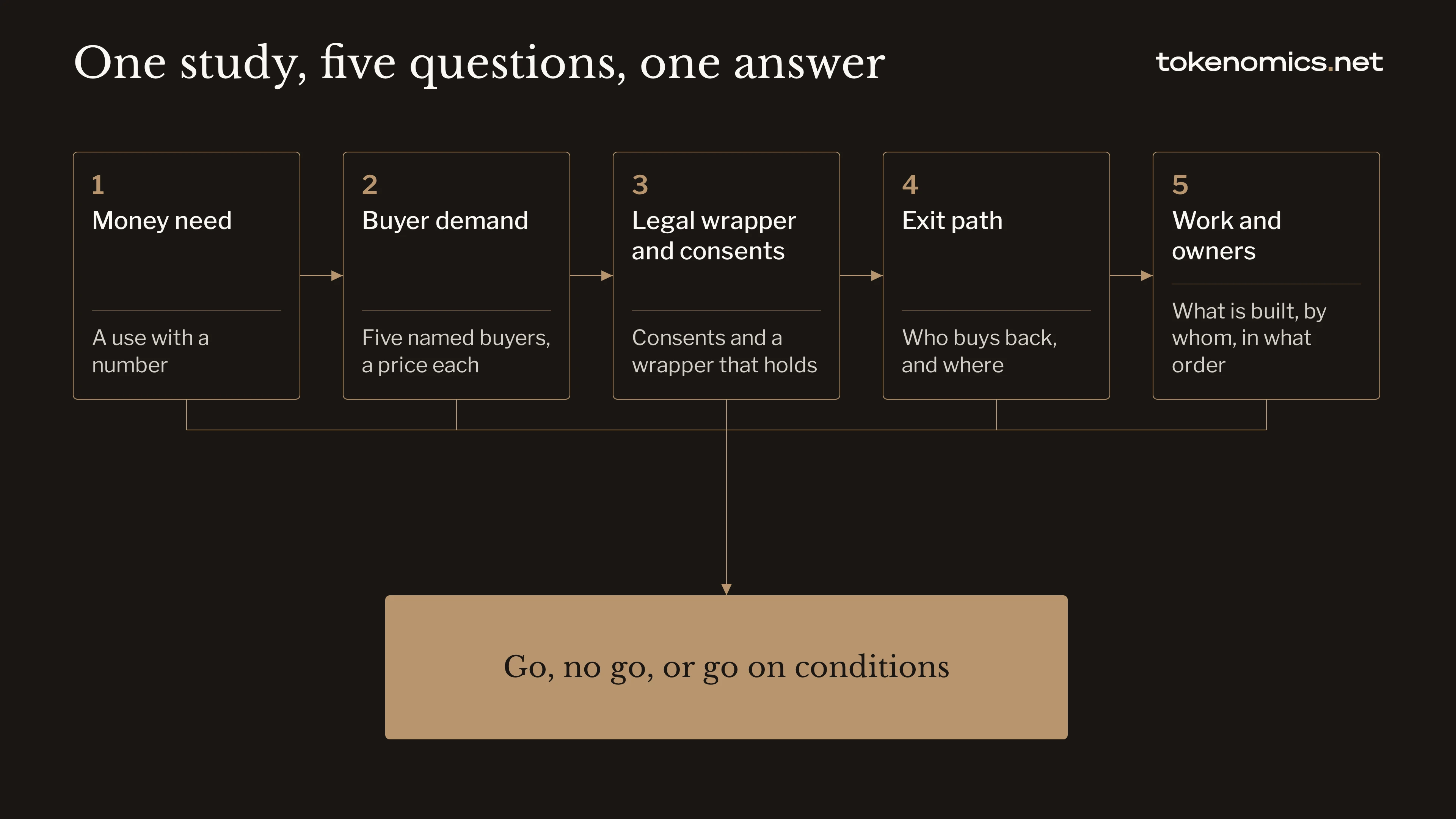
#1. Why do you need the money?
A specific use with a number on it, documented. Not "raise capital," which is a wish rather than a use.
Evidence required: the use of funds in one sentence with a figure, and the document the figure comes from. A signed lease, a partner's exit agreement, a construction quote, a payoff statement.
#2. Would anyone actually buy a slice?
Five named buyers, each of whom has said what they would pay and what would stop them.
Evidence required: notes from five real conversations. Not a market-size estimate, not a survey, not a platform's claim about its investor base. Five names. If nobody will name a price, the study has found its answer, and it found it in week one.
#3. Can the legal wrapper and the consents be put in place?
Whether the asset can go into its own company, with written consent from everyone holding a claim on it.
Evidence required: a list of everyone with a claim, which means lenders, co-owners, lienholders and anyone with a contractual veto, and an initial read from counsel on the structure. Whether a given structure works in a given jurisdiction is counsel's call, not ours and not a platform's.
#4. How do buyers get back out?
A written answer to the question every buyer asks second. The first question is what it costs. The second is how they sell it.
Evidence required: a named path to resale, or an honest statement that there is not one yet. Buyers price a slice by how readily they can sell it again, so a thin exit shows up as a discount on the price you get today. Better to put a figure on that cost up front than discover it in the term sheet.
#5. What is the work, and who does it?
The sequence, the parties and the order they arrive in. A platform, counsel, a transfer agent, a distributor. Getting them in the right order is most of the job and most of what goes wrong.
Evidence required: the order of work written down, with a named owner for each piece.
| Question | Evidence | Go signal | Stop signal |
|---|---|---|---|
| Why the money | Use of funds with a figure and a document behind it | A fixed need with a deadline | A general wish to raise |
| Buyer demand | Notes from five buyer conversations | Prices named, objections specific | No prices, or only enthusiasm |
| Wrapper and consents | Claim-holder list plus counsel's initial read | Consents reachable, structure workable | A lender unlikely to consent |
| Exit path | A named route to resale | Buyers can see a way out | Silence on resale |
| Work and owners | Sequence with a named owner per piece | Order agreed before anything is built | Platform first, everything else later |
#What the study produces
A short written result: go, no go, or go on conditions, with the reasons and the evidence each conclusion rests on.
"Go on conditions" is the most common outcome in our experience, and it is usually the useful one. It reads like this: proceed once the lender's written consent is in hand, and once two of the five buyers confirm at the indicated price. The conditions are specific enough that you know when they are met.
What it is not is a deck. A feasibility study whose main output is a market overview has answered questions you did not ask.
#Who should run it
The person running the study should not be paid on the platform build that follows it.
That is the criterion. It has nothing to do with anyone's integrity and everything to do with what a study is for. If a no outcome costs the author the engagement, the no gets harder to write, and you lose the only outcome you were paying for. Ask directly how the work is paid for and what the person running it builds. Ask whether stop is an answer they have given before.
The second criterion is sequence. Counsel should be engaged before anything is drafted, and technical choices should come after the paperwork, not before. A study that recommends a chain and a token standard before it has tested buyers has made a technical decision in place of a business one. Our note on the team behind the method covers how we hold that order.
#Warning signs in a feasibility study
- It recommends a platform before it has tested whether buyers exist.
- It has no stop outcome, only degrees of yes.
- It is silent on how buyers sell their slice later.
- It skips consents, or treats them as paperwork to handle after the launch date is set.
Any one of those is worth raising with whoever wrote the study. All four together means the document is a proposal wearing a study's clothes.
#Frequently Asked Questions
#What is a tokenization feasibility study?
It is a short structured test run before any build. Five questions: why the money is needed, whether buyers exist, whether the legal wrapper and consents can be put in place, how buyers get back out, and what the work involves. It ends in a written go or no go.
#How long does a feasibility study take?
It depends on the asset and on how quickly you can get five buyer conversations booked, since most of the study is phone calls rather than analysis. The paperwork review and the consent questions usually move faster than the buyer conversations do.
#Who should do a tokenization feasibility study?
Someone who is not paid to build the platform afterwards, because the study has to be able to end in a no. It runs before counsel drafts anything and before any technical work starts, so that what gets built is decided by the findings.
#What happens if the study says no?
That is the system working, and you have spent phone calls rather than a build budget to find out. You also finish with the ordinary route documented: the loan terms, the share sale terms, and the reason tokenizing did not beat them.
#Next step
If you want to run the first checks yourself, the free course that includes the step one checks publishes the whole method as 67 lessons, free with an account. Before that, our decision test on whether you should tokenize your asset is the short version of question one and question two.
If you would rather we ran it, book a strategy call. Bring the asset, the reason you need the money, and who you think the buyers are.
Tokenomics.net is an advisory and education firm for token issuers and asset owners. The study is the cheapest part of this work and the part that decides the rest of it.
Bring the question to a call
Thirty minutes with the team that wrote this, on your token or your asset. You leave knowing what to fix first.