Zebec Staking: Mechanics, Lock Terms, and Where Rewards Come From
Zebec staking explained: where ZBCN staking happens, how lock and unstaking terms work, and how to check whether rewards come from revenue or emissions.


Zebec staking means committing ZBCN, the token behind the Zebec Network payment-streaming protocol, to a staking contract in exchange for a reward claim, with lock terms and reward rates set by the deployed contract rather than fixed. The mechanism is ordinary; where the rewards come from is not.
That question decides everything else. If Zebec staking rewards are paid from newly issued tokens, you are compensated in dilution. If they are paid from fees the payment-streaming product actually earns, you are compensated out of revenue. Two different mechanisms, one interface.
Tokenomics.net has no advisory relationship with Zebec. The specifics that change, lock terms, venues, reward rates, are pointed at primary sources here rather than printed.
#What Zebec Staking Actually Involves
zebec staking: Locking ZBCN tokens in a staking contract on the Zebec Network payment-streaming protocol in exchange for a reward claim funded by issuance, fees, or treasury allocation.
Zebec Network runs payment streaming: continuous, per-second transfers between addresses, used for payroll, vesting, and subscriptions. The token attached is ZBCN. Staking moves those tokens into a contract that holds the balance and accrues rewards.
Settle one thing first. Which token. Zebec's token has carried two tickers, and the ZBC to ZBCN migration moved holders from the old to the new. Conversion ratio, deadline, and whether the old contract still accepts conversions get repeated wrong across tracker sites. Read them from Zebec's own announcement.
Underneath sits the business question: does payment streaming earn enough in fees to fund a reward program? A token without sustainable revenue mechanics is a countdown timer. The staking program inherits the same clock.
The same revenue-versus-issuance question shows up in liquid staking token mechanics, where staking yield is funded by protocol activity rather than newly minted supply.
#Where Zebec Staking Happens
Two venues are possible for Zebec staking, and they are not the same product.
Protocol-native staking. A contract published by the project, reached through its own interface or called directly. The contract holds the tokens, you hold the position.
Exchange-hosted staking. A custodial product where the exchange holds your tokens and pays a rate it sets. The exchange writes the terms, not the protocol.
We won't print a portal URL or name an exchange. Treat any guide that does as stale until you verify it. Staking surfaces get deprecated and replaced. The live venue is whatever Zebec's official site and documentation point to today.
#How to Stake ZBCN, Step by Step
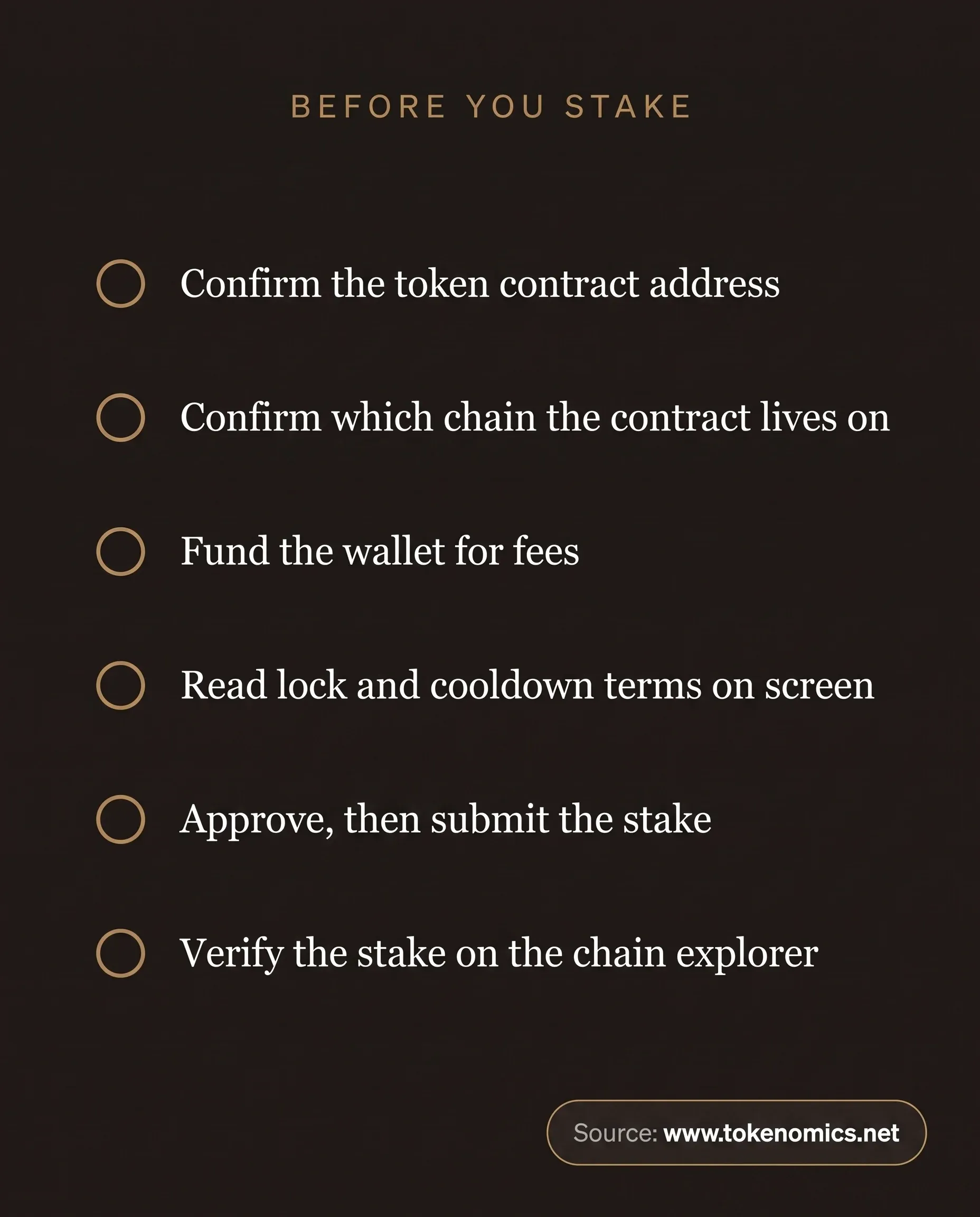
The Zebec staking flow has the same shape as most contract-based staking.
- Confirm the token contract address. Take it from Zebec's official documentation, then check it on the chain explorer. Ticker collisions are common and the explorer settles them.
- Confirm which chain. A token can exist on several networks while the staking contract lives on exactly one. Check before you bridge anything.
- Fund the wallet for fees. Keep enough gas for an approval, a stake, and a later exit.
- Read the terms on screen before approving. The interface states lock duration, cooldown, and reward rate at the moment you stake. Screenshot it. That is your record.
- Approve, then stake. Most implementations take two transactions: a token approval, then the stake.
- Verify on-chain. Take the transaction hash to the explorer. Confirm the tokens landed in the staking contract, and that the contract is the one Zebec's documentation names.
Step 6 is the one people skip, and the only one that proves the rest worked.
#Lock Terms and Unstaking Mechanics
Lock terms are where staking stops being reversible.
Three shapes are common. No lock, with withdrawal on demand. A fixed term you cannot exit early. A cooldown queue, where you request an exit and wait before the tokens move.
We won't state a specific Zebec staking lock duration, because any number printed here ages the day the contract changes. Guides quoting a cooldown in days are the most reliably wrong pages in this category. The terms in force are the ones the deployed contract enforces. Read them in Zebec's documentation, then confirm against the contract. When the two disagree, the contract wins.
A lock is an unlock schedule at personal scale. Same timing question: when can these tokens move.
For the project-level version of that same question, see how to read a token unlock schedule.
#Where Staking Rewards Actually Come From
Here's what most guides get wrong about Zebec staking: they report the rate and skip the source. The rate is an output. The source is the mechanism. ZBCN staking rewards come from one of three places.
New issuance. The protocol mints tokens to pay stakers. Supply rises, and holders who did not stake absorb the dilution. The rate can be set at almost any level because it costs no cash.
Protocol fee revenue. Fees the product earns route to the staking contract. The rate floats with usage. This is the version that ties the token to the business.
A fixed treasury allocation. A pre-allocated bucket pays rewards until it empties, which makes the end date worth knowing.
To tell which, follow the money into the reward account. New issuance shows as minting against the token contract. Revenue-funded rewards show as transfers from a fee-collection or treasury address. Documentation that publishes a rate but no emission schedule leaves the source unestablished.
We could not establish Zebec's reward funding source from its primary documentation at the time of writing. That gap is the finding. Ask before you commit tokens.
For a broader look at how projects design and cap issuance-funded rewards, see our guide to token supply control mechanisms.
#Risks to Understand Before You Stake
The risks in Zebec staking are the ordinary risks of any contract-based lock.
Smart contract risk. Staked tokens sit inside a contract. A flaw there exposes the position regardless of how the protocol performs. Check the audit and whether it covers the deployed code.
Custody risk. Exchange-hosted staking means the exchange holds the asset. That is counterparty exposure, not protocol exposure.
Liquidity risk. Locked tokens cannot be sold, moved, or posted as collateral. A cooldown is time in which a decision cannot be reversed.
Dilution risk. When rewards are minted, part of the reward is a transfer from holders who did not stake. Whether that trade works depends on what the issuance buys.
Whether a staking program raises securities issues is fact-specific and jurisdiction-specific, and it is a legal team's call.
#Zebec Staking vs Holding ZBCN
The comparison is a tradeoff, not a ranking.
Holding keeps the position liquid and carries no contract exposure. Zebec staking adds a reward claim and subtracts liquidity for the length of the lock. Providing liquidity in a trading pair is a third shape with its own mechanism, impermanent loss.
#Key Takeaways
Zebec staking is a standard lock-and-earn mechanism. What matters is what the interface does not display: which contract holds the tokens, what the exit terms are, and whether rewards are funded by revenue or by issuance. Two of those are readable on the explorer.
Every staking program is a claim about where value comes from. Programs funded by real revenue keep paying through a bear market. Programs funded by issuance run until the emissions taper. That distinction is knowable before tokens get committed, and knowable from primary sources.
If you're building onchain and need your staking design to hold up under institutional scrutiny, book a strategy call. We'll assess your project and tell you whether we're the right fit. Sometimes we're not. We'll tell you that too.
If the mechanism itself, not just the staking wrapper, needs a second look, that's what our Tokenomics Design service is for.
This post describes mechanisms, not investment advice, and contains no recommendation to buy, sell, hold, or stake any token.