DeepBook Explained: Sui's Shared Order Book and the DEEP Token
DeepBook is Sui's native on-chain central limit order book. How the shared order book works, what the DEEP token does, and what founders should verify.


DeepBook is a central limit order book built natively into the Sui blockchain, where limit orders rest on-chain as shared objects any Sui application can read and trade against (Source: DeepBook protocol documentation). It is not a trading app. It is base-layer liquidity infrastructure, and the DEEP token pays for and governs access to it.
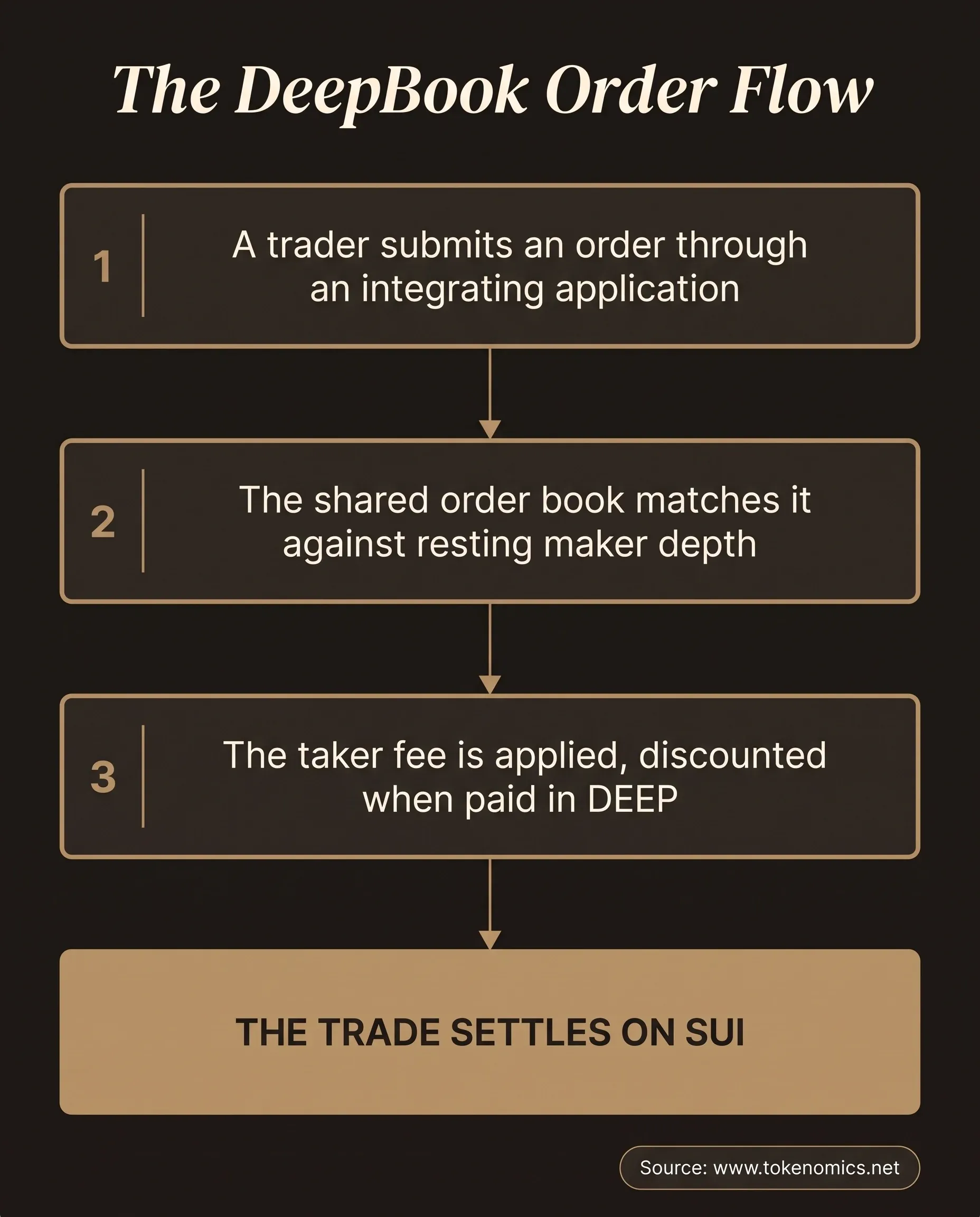
Most order-book exchanges keep the book off-chain and settle on-chain, so the liquidity belongs to the venue running it. DeepBook inverts that. The book is a public object on Sui, so a wallet, an aggregator, and a competing front end all route into the same resting orders.
Underneath the mechanism is the question that decides whether any of it creates value: who captures the trading fees, and does the volume behind them exist. A shared order book changes the first answer. It does nothing about the second.
#What DeepBook is
DeepBook: a central limit order book built natively into the Sui blockchain, where limit orders rest on-chain as shared objects any Sui application can read and trade against.
Makers post limit orders at prices they choose, takers fill them, and the book lives in Sui's shared-object model rather than on a company's servers (Source: Sui developer documentation).
Two things follow from calling it a Sui central limit order book rather than a Sui DEX. DeepBook ships as open-source Move packages in a public repository (Source: the MystenLabs deepbookv3 repository on GitHub). And any application on the chain can call it directly, with no listing negotiation and no API key.
An AMM prices a trade off a bonding curve against pooled reserves. The order book prices a trade off resting orders someone placed deliberately. Both are DEX designs, and they produce different fee flows, different work for liquidity providers, and different demands on the token above them.
#From Mysten Labs infrastructure to protocol governance
DeepBook was engineered by Mysten Labs, the company behind Sui, and released as open-source protocol infrastructure rather than a Mysten product line (Source: the deepbookv3 repository maintained by Mysten Labs).
What happened next is where most write-ups get loose. Public summaries describe a shift toward a broader DeepBook Protocol structure with its own governance surface. We are not restating a handover date or naming a current governing entity here. Those claims circulate across aggregator pages with nothing primary behind them. Read them in official Sui Foundation or Mysten Labs announcements, and note the date.
Governance structure determines who can change fee parameters on a venue other applications depend on. The documentation describes one thing concretely: governance is scoped per pool, with DEEP staked into a pool carrying voting weight over that pool's parameters (Source: DeepBook v3 protocol documentation).
#How the order book and matching engine work
#Shared liquidity instead of fragmented pools
Most DEX designs ask every new application to bootstrap its own liquidity. A team launches, seeds a pool, pays emissions to hold it there, and watches the incentive budget drain. That doesn't work well for the tenth app in a row.
Because the book is an on-chain object, a new application integrates against depth already resting there instead of renting its own. Think of it like a shared runway rather than every airline paving its own.
#Maker and taker roles
A maker posts a limit order that rests in the book and adds depth. A taker crosses the spread and fills against it. Takers pay a fee, and makers get different fee treatment, which is the lever that pays for depth (Source: DeepBook v3 protocol documentation).
The tradeoff: order books need active market makers to stay tight, while an AMM quotes a price at any hour with nobody at the keyboard. Depth is the whole product.
#The DEEP token: what it pays for and what it votes on
The DEEP token's documented roles are narrow and specific.
Trading fees. The fee model lets takers pay in DEEP at a rate more favorable than paying in the traded asset, giving applications that route volume a reason to hold working balances.
Pool governance. DEEP staked into a specific pool carries voting weight over that pool's parameters, including fee settings. Governance here is operational, not constitutional. Voters set the price of using a venue. They do not amend a charter.
Maker treatment. Staked DEEP also factors into how the protocol treats a participant's maker activity within a pool.
All three are described in the protocol's own technical documentation, which is the only place worth sourcing them from. This is a fee-capture design with a governance wrapper. The mechanism creates that pattern. Whether it fits your project depends on whether you have fee-generating volume to route.
If you are evaluating whether a similar fee-capture and governance structure fits your own token, that is the kind of question our Tokenomics Design service is built to answer.
#DEEP supply and unlocks: verify, do not repeat
Most projects make the mistake of sourcing supply figures from whatever page ranks first. That doesn't work, and it is the most common way a DeepBook write-up goes wrong.
We are not publishing a total supply number, an allocation split, or an unlock schedule here. A figure repeated from a dashboard is not a verified figure. Market-data aggregators are useful for orientation. They are not primary sources for supply, emissions, or unlocks.
Three checks, in order:
Read the protocol's own tokenomics documentation. Supply and distribution claims belong to the protocol that issued the token, not to a page summarizing it.
Read the coin on a Sui explorer and record the type address. Suiscan and SuiVision expose on-chain coin metadata directly. The address is what makes the claim checkable later.
Read the governance record for parameter changes. Fee settings move through governance, so a screenshot from six months ago is a historical artifact.
Date-stamp every figure. A supply number without the date you read it is not evidence.
#DeepBook vs AMM-style DEXs on Sui
#Where a shared order book changes incentives
An AMM pays liquidity providers through fees and, usually, emissions. Those emissions come out of token supply, which means the depth is rented. Stop paying and it leaves.
A shared order book shifts that cost. Makers post depth because the spread and the fee treatment make it worth posting, not because a program pays them in newly issued tokens. When it works, depth is bought with trading revenue instead of dilution.
The same revenue-versus-issuance question applies one layer down, in our sui protocol tokenomics case study covering how SUI's own supply and fee burn behave.
That is the revenue-first version of the question. Is the depth funded by real trading activity, or by issuance? The answer shows up in the emissions line, not the pitch.
#What it means for providers and integrators
For providers, the work changes shape. AMM provision is passive and carries impermanent loss. Order-book provision is active and carries inventory risk instead. Neither is less work.
For integrators, it takes the liquidity bootstrap off the launch checklist, which moves the competitive question to distribution and routing quality.
For a primer on how that pricing mechanism works, see our Automated Market Maker glossary entry.
#Who builds on DeepBook
Composability is the point. Wallets, aggregators, and Sui-native front ends route orders into the same book rather than each seeding an isolated pool, so Sui DEX liquidity concentrates in one place instead of fragmenting across venues.
We are deliberately not naming integrators. Announcements age badly and routing changes without a press release, so a named list in an explainer goes wrong quietly. Confirm any specific integration in that protocol's own documentation.
What matters structurally is the dependency direction. Applications routing through DeepBook inherit its fee parameters and its governance outcomes. That is a reasonable trade for not renting depth. It is still a dependency, and it belongs on a risk register.
The same fee-capture dependency shows up in other venue tokens; see how the Hyperliquid fee model works for a perp-DEX comparison.
#Risks and open questions
Three worth watching, none of them accusations about this protocol specifically.
Early governance concentration. Per-pool stake-weighted voting concentrates influence in whoever stakes the most. That is a structural property of the design, not a claim about any pool's current distribution. Read the stake distribution on-chain.
Dependency on network activity. Fee revenue tracks trading volume on Sui. A venue token with a clean fee-capture design still earns nothing if the volume is not there.
Coordination cost as adoption grows. Shared infrastructure gets harder to change as more applications depend on it. Parameter changes that are routine for a single venue become negotiations once a dozen front ends depend on them.
On classification: we are not characterizing DEEP as a security, as a non-security, or the protocol as decentralized. Those questions are fact-specific and jurisdiction-specific, and the analysis runs through the Howey test with a legal team.
If you want a structured second opinion on governance concentration or classification risk before launch, that is what our Tokenomics Audit service is for.
DeepBook changes who pays to bootstrap liquidity on Sui. It does not change whether the trading behind the fees is real. That is the test every venue token eventually faces, and founders should run it on their own design before an investor runs it for them. Get your house in order first.
If you're building onchain and need your token model to hold up under institutional scrutiny, book a strategy call. We'll assess your project and tell you whether we're the right fit. Sometimes we're not. We'll tell you that too.
This piece is mechanism analysis, not investment advice.