Top Tokenomics Development Companies: A Founder's Evaluation Guide
No single ranked list names the top tokenomics development companies. Here is the six-criteria framework founders use to evaluate any firm before they sign.


There is no single ranked list of the top tokenomics development companies, and any site that hands you one is usually ranking itself. Tokenomics engagements vary by stage, chain, and regulatory exposure. The reliable move is to evaluate any firm against a fixed set of criteria, not a leaderboard.
The stakes are higher than a design-taste decision. A weak tokenomics vendor produces a model that looks fine in a pitch deck and falls apart under investor, legal, or auditor scrutiny. That is a business-continuity problem, not a matter of preference. The token is infrastructure. The business underneath it is the engine, and a model that ignores how the business actually makes money will not survive contact with a real investor.
So this is not a listicle. It is a buyer's framework. Below are the six criteria we use to separate operators from vendors, the red flags that predict trouble, and the questions to ask before you sign. Score every firm you talk to against the criteria and compare the scores, not the sales energy.
#What a Top Tokenomics Development Company Actually Means
Founders who search for the top tokenomics development companies are rarely asking who has the most Google reviews. They are asking a sharper question: who will not waste a $15K-plus budget and burn months of runway on a model that does not hold up. Reframe the query that way and the evaluation gets easier.
Start with a precise definition. Tokenomics development is the design, documentation, and strategy behind a token model. It is not a whitepaper on its own, and it is not a smart contract on its own. It is the economic logic that decides how supply, demand, incentives, and value capture fit together, then the documentation that proves that logic to investors, exchanges, and legal teams. The token-standard documentation maintained at ethereum.org is a useful neutral reference here: it defines what a token technically is and how standards like ERC-20 behave, which is the substrate a firm designs economics on top of. A firm that cannot connect its economic design to that technical substrate is guessing.
Here is what most founders miss. The phrase "tokenomics companies" quietly lumps together three different trades: development shops, security auditors, and freelance designers. They solve different problems. We come back to that distinction later, because founders searching for a top tokenomics firm often hire the wrong category entirely.
#The Buyer's Evaluation Framework: Six Criteria That Separate Operators From Vendors
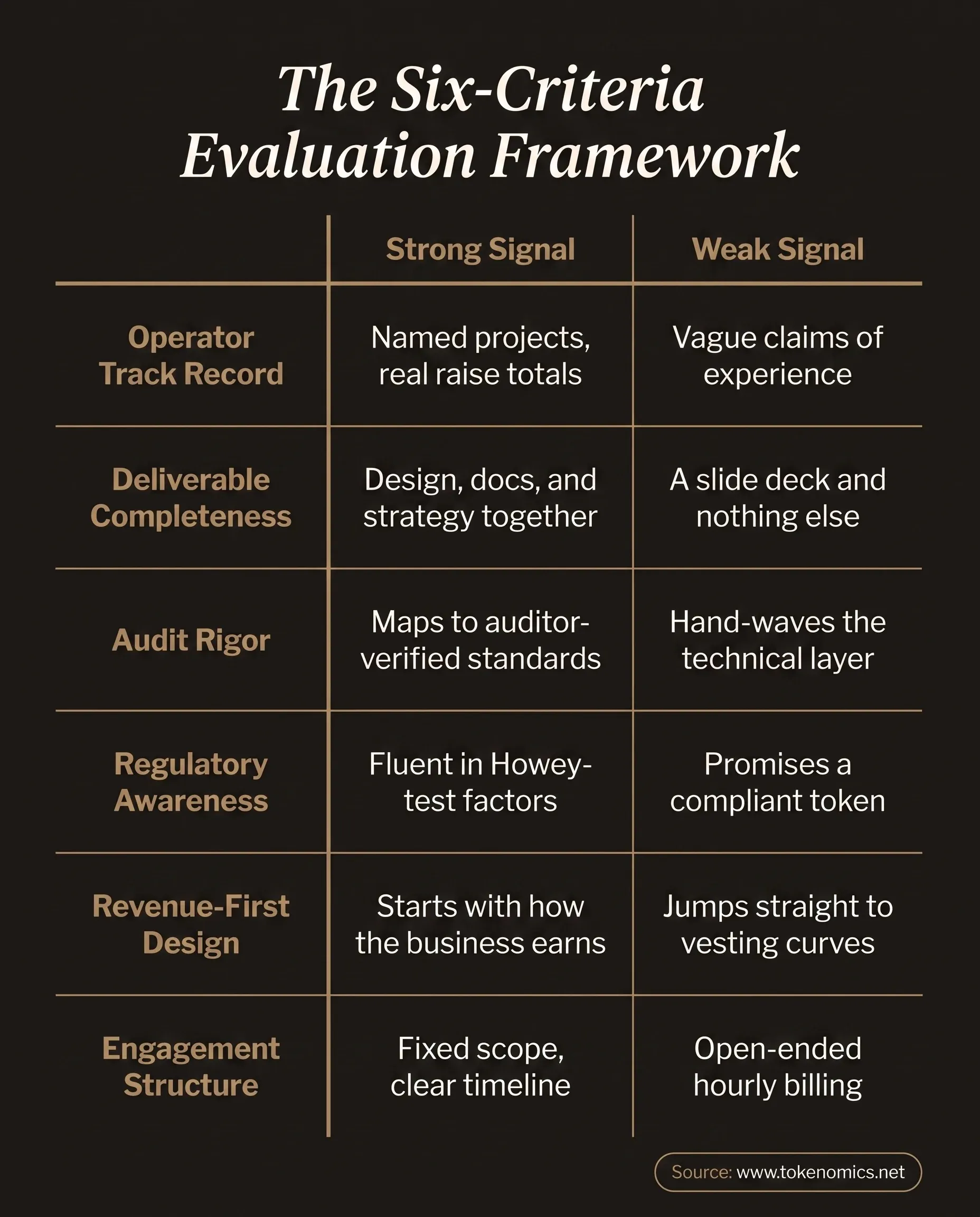
This is a rubric, not a ranking. If you want a practical answer to how to choose a tokenomics agency, this is it: score any firm you are evaluating against the six criteria below, and weight the ones that map to your stage and your regulatory exposure. The founders who end up happy with their choice are not the ones who found a list of the top tokenomics development companies. They are the ones who evaluated firms against a rubric and knew exactly where each one was strong and weak.
#Operator Track Record, Not Just Advisory Experience
There is a difference between a firm that has designed and shipped its own token and a firm that has only advised from the sidelines. Operator experience means someone in the room has lived through a launch: the unlock cliff that spooked the market, the exchange that asked for documentation nobody had prepared, the treasury decision that looked fine in a model and hurt in practice. A firm that references a specific project count and a combined raise total is giving you something you can verify. Vague claims of "deep experience" are not.
#Deliverable Completeness: Design, Documentation, and Strategy
Ask what the engagement actually produces. A slide deck is not a deliverable. A complete engagement gives your legal team utility definitions they can write an opinion against, gives your developers specifications they can build from, gives investors documentation that holds up under scrutiny, and gives you a liquidity and DEX budget grounded in real numbers. One engagement, four different outputs, because your lawyer, your developer, your finance lead, and your investors each need something different from the same model. If a firm only produces the investor-facing artifact, you will be paying someone else to finish the job. This is what getting your house in order actually means.
#Audit Rigor and Smart-Contract Literacy
A firm designing token economics should be fluent in the technical layer those economics run on. "Audit-ready" is not a slogan. It means the design assumptions map to contract patterns that a security auditor can actually verify. The audited-contract standards documented by OpenZeppelin are the reference here: their library of reviewed implementations for token contracts, access control, and vesting is what most reputable auditors benchmark against. When you ask a prospective firm whether their supply mechanics, vesting logic, and transfer rules align with those standards, you learn quickly whether they design for the auditor or hand-wave the technical layer and hope. The firms that hand-wave produce models that look clean on paper and break at audit, which is the most expensive place to discover a design flaw.
#Regulatory Awareness Without Overclaiming
A trustworthy firm narrows its claims. It does not promise you a "compliant" or "non-security" token, because those are legal conclusions that depend on your specific facts and your jurisdiction. What a competent firm can do is discuss the analytical frameworks fluently. The Howey test, the framework published by the SEC (sec.gov) for assessing whether an arrangement is an investment contract, is the obvious one: a firm that can talk through how your token's structure interacts with the Howey factors is thinking about the right questions. In our view, the closer a token sits to a revenue-share or profit-distribution mechanism, the harder the registration question becomes, and a firm that waves that away should worry you. A firm that promises you the answer is worse than one that admits it depends.
#Revenue-First Design, Not Mechanism-Only Design
Here is the single highest-signal question you can ask: does the firm start with how the business makes money, or does it jump straight to vesting curves and staking APYs? Revenue-first design begins with the business model and treats the token as infrastructure that supports value creation, not as the product itself. Mechanism-only design does the reverse, dressing up a weak business with clever emissions. We have a published position on this: anyone who thinks tokenomics is the product is not a fit for us. Revenue comes first. The mechanism comes second. Everything else follows. A token without sustainable revenue mechanics is a countdown timer, and a firm that cannot explain the revenue engine under your token is building you one.
#Engagement Structure and Timeline Clarity
Finally, look at how the engagement is structured. A defined scope with a clear timeframe signals a firm that has run this process before. Open-ended engagements that bill by the hour with no fixed deliverable list signal the opposite. You want to know what you are getting, in what order, and roughly when. Ask for the shape of the engagement before you ask for the price. A firm that can describe its process cleanly has usually run it many times. A firm that cannot is figuring it out on your budget.
The table below maps each of the six criteria to what a strong signal looks like against what a weak signal looks like, so you can score a firm at a glance.
#Red Flags: How to Spot a Tokenomics Vendor That Will Cost You Later
We have seen this pattern across dozens of projects: the red flags that predict a bad engagement are consistent, and they show up before you sign, not after. A useful tokenomics consulting comparison is not really about who has the slickest deck. It is about who trips these wires.
- Promised-outcome language. Any firm that promises a specific market cap, a price floor, or a "compliant" token is either naive or dishonest. Both cost you.
- A price-first sales conversation. If the first serious topic is the invoice rather than your business model, the firm is selling a template, not a design.
- Silence on legal and compliance. A firm that never raises regulatory questions has not thought about the part that gets founders in trouble.
- Generic, templated deliverables. If the sample report could belong to any project with the names swapped out, it will not hold up under investor scrutiny.
- Advisor-only experience. A firm that has only ever advised, and never shipped its own token, has not felt the consequences of its own advice.
- No answer on the revenue model. If a firm cannot articulate how your token connects to a business that makes money, it is designing mechanics in a vacuum.
None of these require inside information. They surface in the first two conversations if you are listening for them. If you need the foundational definition of the category before you start scoring firms, start there first.
#Questions to Ask Before You Sign
A rubric is only as good as the questions behind it. Here is the due-diligence list we would hand a founder walking into vendor conversations. Ask every firm the same questions and compare the answers side by side.
- What does the deliverable package include, end to end?
- How many of your past engagements involved my chain and my asset class?
- Have you designed and shipped your own token, or only advised?
- How do you handle the audit handoff, and which contract standards do you design against?
- How do you handle the legal handoff, and can your utility definitions support a legal opinion?
- What market and on-chain data do you benchmark liquidity and supply assumptions against?
- Can you walk me through the revenue model under a token you have designed?
- What does your engagement timeline look like, and what are the milestones?
Question six matters more than it looks. A firm should be benchmarking your assumptions against real market data, not vibes. On-chain data from DefiLlama, which tracks total value locked, fees, and liquidity across protocols, is exactly the kind of neutral reference a serious firm uses to sanity-check whether your liquidity budget and supply schedule are grounded in what comparable protocols actually sustain. If a firm has no answer for where its numbers come from, the numbers are decoration.
Write the answers down. Patterns show up fast when you compare firms on the same questions. When your checklist is filled in and you want to see what a complete engagement looks like, this is the next step.
#How Tokenomics Consulting Differs From Auditors, Dev Shops, and Freelancers
Remember the category confusion from earlier. Four different trades get lumped into "tokenomics companies" searches, and hiring the wrong one is one of the most common and most expensive mistakes we see.
A security auditor reviews your smart contracts for vulnerabilities. Essential work, but an auditor checks whether your code is safe, not whether your economics make sense. An auditor will not tell you that your emissions schedule creates sell pressure.
A development shop builds what you specify. Give it a spec and it ships clean contracts. But a dev shop does not design the economic logic. If you hand it a broken model, it will build you a broken model, faithfully.
A freelance designer can be sharp, but you are buying one person's bandwidth. A single freelancer rarely produces the cross-functional package that legal, development, and finance each need, and the work stalls when that one person is busy.
A tokenomics consulting firm designs the economics, documents them to investor and legal standards, and connects the model to your business strategy. Design, documentation, and strategy, produced as one coherent package rather than three disconnected purchases.
The key distinction is: auditors and dev shops verify or build what already exists. A consulting firm decides what should exist in the first place. You often need more than one of these. Just be clear about which problem you are solving before you sign, because paying an auditor to fix an economic design flaw, or a consulting firm to review contract code, wastes money and time. If you want the full picture of what the consulting category actually covers, read the deeper breakdown here.
#Where Tokenomics.net Fits
We built this framework from the seat we sit in. We have advised 100+ projects through $100MM+ in combined raises, and Tony's own project reached a $200MM+ market cap with a community of 75,000 members. That is the operator experience the first criterion asks about, stated as an aggregate you can hold us to.
Our whole approach starts with revenue-first design. Before we touch a vesting curve, we ask how your business actually makes money, because a token is infrastructure and the business is the engine. We produce the complete data room: the design, the documentation, and the strategy that legal, development, and investors each need to move. It is built to hold up under institutional scrutiny, which is the only test that matters once real capital is deciding whether to back you.
We are not the right firm for every project. If someone thinks the token is the product, we are not a fit, and we say so early.
#The Founder Who Ran the Rubric
The search for the top tokenomics development companies does not end with a ranked list. It ends with a founder who ran the six-criteria evaluation, asked the hard questions, and picked the firm that scored well across all of them instead of the loudest one. The expectations keep rising. The projects that get funded are the ones whose tokenomics hold up when investors, auditors, and regulators look under the hood, and that only happens when the business underneath the token is real.
If you are building onchain and need tokenomics that hold up under institutional scrutiny, book a discovery call. We'll assess your project and tell you whether we're the right fit. Sometimes we're not. We'll tell you that too.