Tokenization vs Tokenomics: What's the Difference?
Tokenization vs tokenomics: tokenization represents an asset as a blockchain token. Tokenomics designs the economic system that governs how the token behaves.


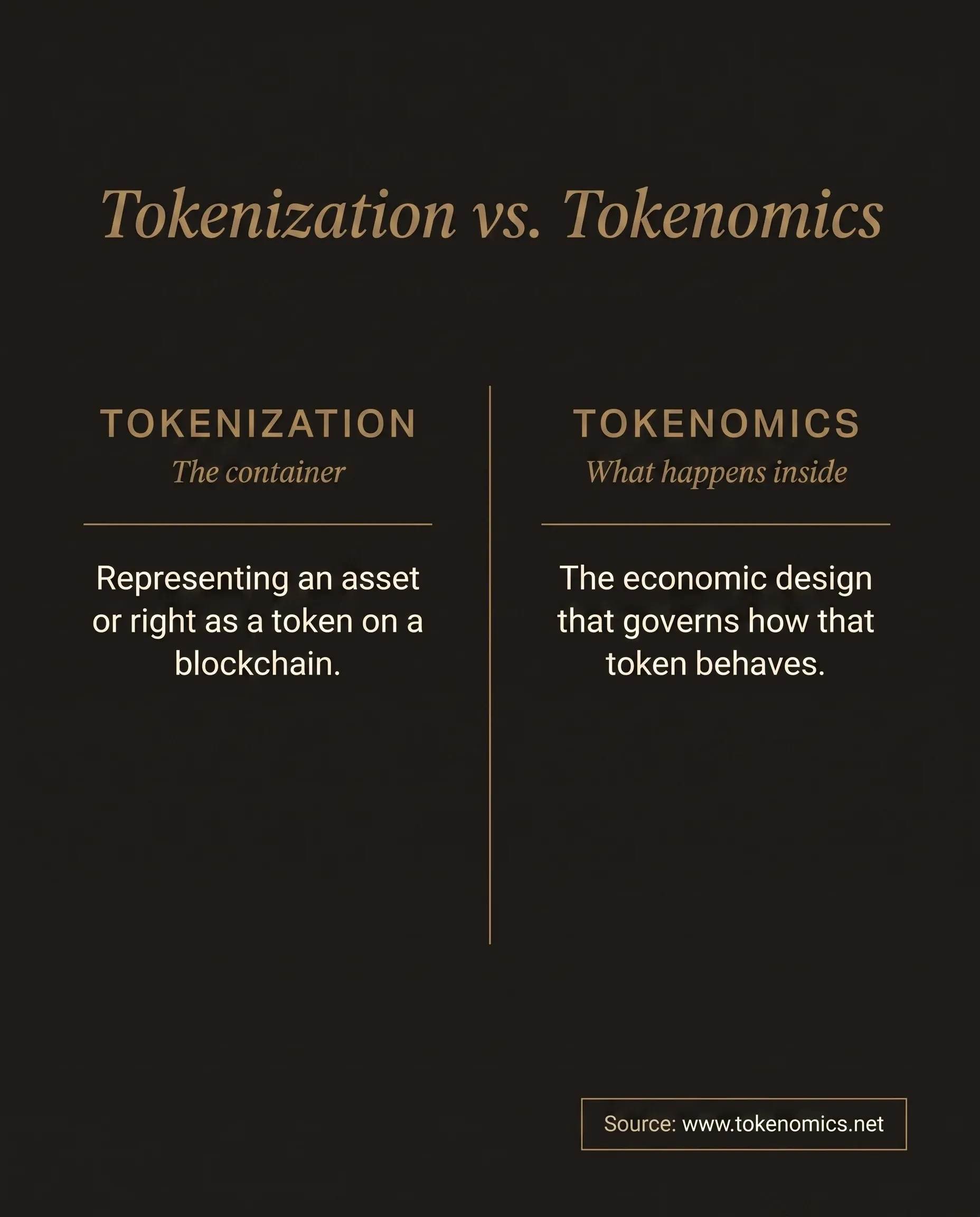
Tokenization is the process of representing an asset or right as a token on a blockchain. Tokenomics is the economic design of the token system that governs how that token behaves once it exists. One creates the container. The other decides what happens inside it.
Tokenization and tokenomics get used as if they mean the same thing. They do not. Tokenization is the technical act of representing an asset or a right as a blockchain token. Tokenomics is the economic design of the system that governs how that token behaves once it exists: its supply, its incentives, its governance. The tokenization vs tokenomics question matters because a founder who conflates the two scopes the wrong work and finds out after launch.
One frame runs underneath both. A token is infrastructure that amplifies a business. It does not replace one. You can mint a token correctly, follow every standard, and still watch the economics underneath it fail. Drawing the line between the two disciplines is the first step to knowing which one your project actually needs.
Tokenization is the process of representing an asset or right as a token on a blockchain. Tokenomics is the economic design of the token system that governs how that token behaves once it exists.
#Tokenization vs Tokenomics: The Core Difference
The core difference in tokenization vs tokenomics is a difference of layers. Tokenization is a one-time technical act. It answers how an asset becomes a token. Tokenomics is an ongoing system design. It answers how that token behaves and holds value after it exists.
| Tokenization | Tokenomics | |
|---|---|---|
| What it is | A technical process | A system design |
| Timeframe | A one-time act at creation | An ongoing economic structure |
| Question it answers | How does this asset become a token? | How does this token behave and hold value? |
| Output | A token that represents the asset | The rules of supply, incentives, and governance |
Neither replaces the other. Tokenization gives you a token. Tokenomics decides whether that token works as a system over time. Handle one without the other and you have either an asset with no economic logic or an economic model with nothing minted to run it on.
#What Is Tokenization?
What is tokenization in crypto? It is the process of representing an asset or a right as a token on a blockchain, where a smart contract encodes ownership, transfer rules, and sometimes compliance logic. To explain tokenization in plain terms: you take something that exists off-chain, equity, a fund share, a piece of real estate, a revenue right, and you issue a token whose contract records who owns it and how it can move.
#How the process works
The process moves in three steps. An asset or a right exists off-chain. A smart contract is written to represent it, encoding who holds the token, how it transfers, and any restrictions on holding it. The token is then issued on-chain, and from that point ownership and transfers are recorded on the blockchain rather than in a private ledger. On a smart-contract platform, a token is a standardized record of ownership that a contract controls (Source: ethereum.org).
#The token standards that make it possible
Tokens follow published standards so wallets, exchanges, and other contracts know how to read them. Two are foundational. ERC-20 is the standard for fungible tokens, where every unit is interchangeable, defined in EIP-20 (Source: eips.ethereum.org). ERC-721 is the standard for non-fungible tokens, where each token is unique, defined in EIP-721. A standard specifies how a token behaves mechanically. It does not, on its own, say anything about how that token is treated legally or economically. That is a separate question.
When the asset being represented is a real-world asset like real estate or private credit, the practice carries its own name and its own mechanics. Our glossary entry on RWA tokenization covers that case in detail.
#What Is Tokenomics?
If tokenization answers whether an asset can become a token, tokenomics answers whether that token will work as a system over time. That is the difference between tokenization and tokenomics in one line: one is a creation step, the other is an ongoing design discipline.
#The variables tokenomics designs
Tokenomics designs the economic structure a token lives inside. The core variables are consistent across projects: total supply and how it is issued, allocation across founders, investors, and community, vesting schedules and unlock timing, the incentives that reward holding or using the token, and the governance rules that decide how the system changes. Each of these is a decision. Together they determine whether the token holds value or bleeds it.
Here is where founders conflate the two and pay for it later. A token can be minted correctly, follow every standard, and still fail, because the economic design underneath it does not map to a real revenue engine. The token is infrastructure. The business is the engine. A token without sustainable revenue mechanics is a countdown timer.
#Why tokenomics is a separate discipline
Minting is a technical milestone. Tokenomics is a design discipline that starts before the mint and continues after it. This is also where regulatory questions enter. Whether a specific tokenized asset is treated as a security depends on the instrument and the jurisdiction, and US-facing projects generally work against the Howey test framework when assessing that question (Source: sec.gov). To be clear about the boundary: that is a determination for legal counsel and the relevant regulator, not something a design engagement decides. In our view, designing with the classification question in mind from the start makes the later legal review smoother, though the design itself does not settle the legal status.
#How the Two Concepts Work Together
Tokenization creates the container. Tokenomics designs what happens inside it. A founder needs both handled, and getting one right without the other is a common failure pattern.
Take a tokenized real-world asset. It needs the container: an ERC-standard token whose contract encodes ownership and transfer rules. It also needs an economic model that fits the asset class, how income reaches holders, how supply is capped or issued, what rights the token carries. Handle the tokenization and skip the tokenomics, and you have a compliant token wrapped around an economic model nobody designed. The pattern is consistent: the token exists, and the system around it does not hold together.
Real-world asset tokenization has moved from concept to measurable scale, with billions in assets now represented on-chain (Source: DefiLlama). Each one needs both layers: a standard-compliant token and an economic design that fits what the token represents.
If you want the full mechanics of representing a real-world asset on-chain, see our complete guide to RWA tokenization.