GameFi Tokenomics: Play-to-Earn Design and the Death Spiral
GameFi tokenomics is the economic design behind play-to-earn games: how reward tokens, dual-token economies, emissions tapers, and death spirals actually work.


GameFi tokenomics is the economic design layer behind play-to-earn and blockchain games. It covers how reward tokens, governance tokens, and in-game assets are issued, distributed, and balanced against player behavior and the game's built-in spending mechanisms.
#What Is GameFi Tokenomics?
That definition has three moving parts, and this post takes them in order: how play-to-earn reward design works, the dual-token structure many GameFi projects run, and the emissions and death-spiral risk that structure exists to manage. Get the vocabulary straight first. Then you can evaluate your own model or brief someone to build it.
One point settles everything that follows. The value engine in any game is the game. Real gameplay, real engagement, a reason to keep playing that stands on its own without the earning mechanic. Token design amplifies that engagement. It does not create it. Anyone who treats the tokenomics as the product is not building something durable, and a token bolted onto a game nobody wants to play is a countdown timer.
We keep a fuller reference on this at our GameFi tokenomics vertical page. This post is the supporting explainer underneath it.
#How Play-to-Earn Token Design Works
Play-to-earn design starts with a loop. Players complete in-game actions, and the game issues them a reward token for doing so. Matches played, resources farmed, quests cleared. That token can then be spent on in-game utility, held, or exchanged. It differs from DeFi staking rewards in one way that matters: here the earn trigger is gameplay, not capital deployment.
Under the hood, the fungible reward token is typically issued under the ERC-20 standard, the same token interface documented on ethereum.org that fungible tokens on Ethereum commonly use. Naming the standard says nothing about a specific game's implementation. It is the common interface the token conforms to, not a claim about any one project's contract.
The design tension to name early is the faucet and sink balance. Faucets issue new tokens to players: play rewards, staking yield, quest payouts. Sinks remove tokens from circulation: crafting costs, upgrade fees, marketplace burns, entry fees. When faucets consistently outpace sinks, circulating supply grows faster than in-game demand can absorb it. Hold that idea. It is the mechanism behind everything that goes wrong later.
#The Dual-Token Game Economy Model
A dual-token game economy splits the job across two tokens instead of one. On one side sits a scarce or capped-supply governance and value-capture token, typically investor- and founder-facing and traded on exchanges. On the other sits a higher-emission in-game utility and reward token, player-facing, earned through gameplay and spent on in-game sinks.
#Why separate a governance token from a reward token
The rationale is containment. Player rewards are inflationary by design, because the game needs a steady faucet to keep the loop turning. Pointing that inflation at a separate utility token keeps it from directly diluting the scarcer governance token that investors hold. The two economies run on different supply rules on purpose.
Both tokens are usually fungible ERC-20 contracts, with the standard itself published in the Ethereum Improvement Proposals repository at eips.ethereum.org. Where in-game items or NFT-based assets are part of the model, you also see ERC-1155 in the mix for those. This is a reference to the standards the tokens conform to, not a claim about any named project's audited contract.
#What stays coupled between the two
Separation is not insulation. The trade-off: splitting the tokens reduces direct dilution pressure on the scarce token, but it does not sever the two economies. Convertibility mechanisms still link them. In-game marketplaces and DEX pairs let players move value between the reward token and the governance token, so reward-token oversupply still transmits into pressure on the governance token over time. Slower, indirect, but real.
#Emissions Taper: Managing Reward-Token Supply Growth
An emissions taper is a scheduled reduction in the reward-token issuance rate over time. The shape varies: a halving-style step curve, a continuous linear or exponential decay, or a usage-conditional taper tied to milestones. The goal holds across shapes: slow supply growth as the game matures and the early bootstrapping phase ends.
On-chain, taper mechanics are commonly built with capped or decaying mint schedules. OpenZeppelin's contract documentation covers the audited minting and access-control patterns teams reach for when they implement this. That is a general technical reference for how the control is enforced, not a description of any specific project's live contract.
Here is what many founders miss. A taper schedule has to be modeled against realistic sink-capacity growth, not just a calendar. New spending mechanisms, burn events, marketplace activity. If the sinks the taper was counting on fail to scale, reducing issuance on schedule still ends in oversupply.
The trade-off runs both ways. An aggressive taper protects the token's scarcity but risks disengaging early players who counted on issuance-driven earning. A slow taper sustains early-player rewards but risks earlier oversupply if sink capacity lags. Sustainable beats aggressive, but only when the sinks are real.
#Why GameFi Tokens Fall Into a Death Spiral
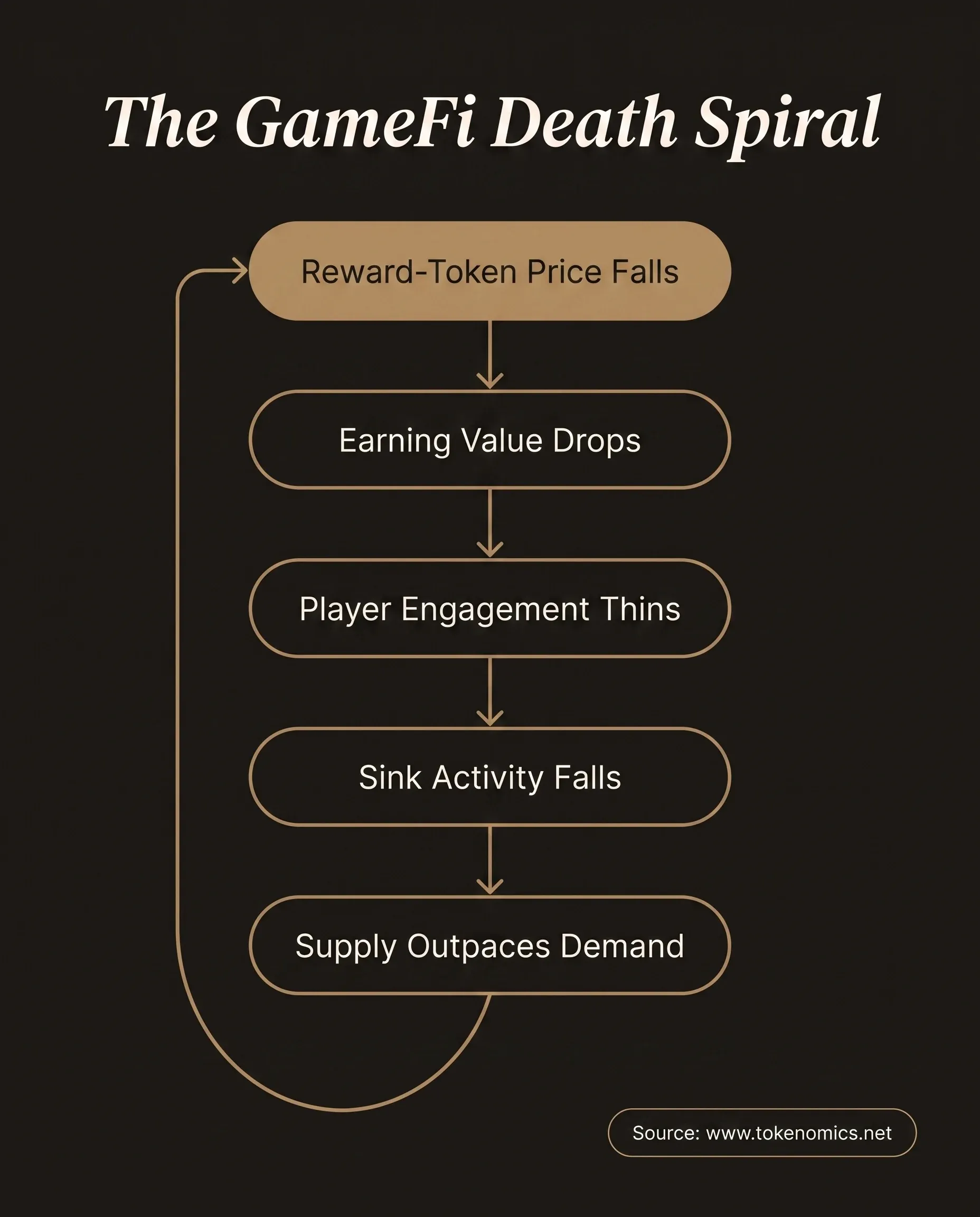
A GameFi death spiral is a reinforcing loop, not a single event. It starts when the reward token's price falls. This is the failure mode GameFi tokenomics is meant to prevent, and the one weak designs run straight into.
#The reinforcing loop, step by step
Walk the loop. Reward-token price decline cuts the real earning value of gameplay. Lower earning value reduces new-player acquisition and thins out existing engagement. Fewer engaged players means less sink activity: less in-game spending, fewer tokens burned. Weaker sinks leave more circulating reward-token supply chasing falling demand. That pushes the price down again, and the loop repeats. Each turn makes the next turn easier.
Based on what has been publicly documented across dual-token GameFi launches from the 2021 and 2022 play-to-earn cycle, this loop has repeated across designs that paired heavy reward-token issuance with thin, underdeveloped sinks. You can see the scale of that cycle's rise and fall in aggregate GameFi and DeFi activity tracked on DefiLlama. We are describing a mechanism pattern here, not making a price call on any token, past or present.
#What actually breaks the loop (or doesn't)
What slows it is not a token buyback announcement, and not a staking program that pays yield in the same token that is already falling. Those often add faucet pressure and speed the spiral up. What can slow it is sink capacity that scales with the player base, plus gameplay that holds players even when earning drops.
The death spiral is a symptom. The root cause sits upstream: whether the game had a durable engagement loop independent of the earning mechanic in the first place. If it did not, no emissions schedule saves a game players have already left.
#Design Considerations Before You Launch a GameFi Token
Before you finalize a GameFi token model, you should be able to answer a short list of questions without flinching. These are the ones we work through with founders, and they separate a design that holds up under scrutiny from one that only looks finished.
Does the game work without the earning mechanic? If players stop the moment rewards dry up, the token was carrying the game, and that arrangement has a shelf life.
Are the sinks concrete and already scoped? "We'll add more sinks later" is not a sink. Faucet and sink balance has to be designed in, not patched in after supply is already loose.
Is the emissions taper modeled against real sink growth? A taper tied to a calendar rather than to sink capacity is a guess dressed as a schedule.
Does the dual-token split insulate the governance token, or only nominally? Trace the convertibility paths. If reward-token oversupply reaches the governance token through a marketplace or a DEX pair, the separation is thinner than the diagram suggests.
None of this is quick to get right, and the decisions compound. If you want a second set of eyes before launch, that is the kind of work we do in our tokenomics design process. Sometimes the honest answer is that a model needs rework. We would rather say that before launch than after.
GameFi tokenomics is the economic design layer that decides whether a game's reward loop compounds or unwinds. Play-to-earn design, the dual-token split, the emissions taper, the death spiral: they are one question wearing four hats, which is whether the game underneath is worth playing once the earning slows down. The token is infrastructure. The game is the engine. Get that order wrong and no emissions schedule does more than time the collapse.
If you're building onchain and need your GameFi token model to hold up under institutional scrutiny, book a discovery call. We'll assess your project and tell you whether we're the right fit. Sometimes we're not. We'll tell you that too.