DePIN Incentive Design: A Framework for Node Operators and Delegators
DePIN incentive design determines whether node operators and delegators build the network or extract from it. Learn the framework that separates sustainable DePIN reward models from those that collapse under their own emissions.


DePIN incentive design: The reward structure that compensates node operators for providing physical infrastructure (compute, bandwidth, storage, sensing capacity) and delegators for curating network stake, structured to link reward rates to verifiable contribution metrics rather than fixed emissions schedules.
DePIN incentive design determines whether the people running the infrastructure build the network or extract from it. Most DePIN projects get this backwards: they design a fixed emissions schedule that rewards early participants regardless of whether the network delivers value, then discover at month 18 that the emissions curve has outpaced the revenue model.
The sustainable design inverts this. Reward rates are linked to verifiable network contribution metrics. Emissions are capped relative to protocol revenue. Node operators and delegators are compensated through separate mechanics that reflect the distinct economic roles each plays.
#The Two-Layer Incentive Problem
DePIN networks have two participant types with structurally different economic relationships to the protocol.
Node operators provide physical infrastructure: GPU compute for NOSANA, wireless spectrum for Helium, storage for Filecoin. Their investment is capital-intensive and long-duration, hardware purchased, co-location secured, bandwidth committed. They need deterministic reward rates they can model against hardware ROI before committing. If the reward rate is volatile or drops unpredictably, operators exit. Network capacity collapses.
Delegators stake tokens to node operators to earn a share of rewards. Their investment is liquid, tokens they can unstake and redeploy. They need reward rates sufficient to justify lock-up, but they do not need the same capital recovery certainty that operators require. They are also a network curation mechanism: delegators that stake to high-performing operators improve network quality, and delegators that stake to underperforming operators create a drag.
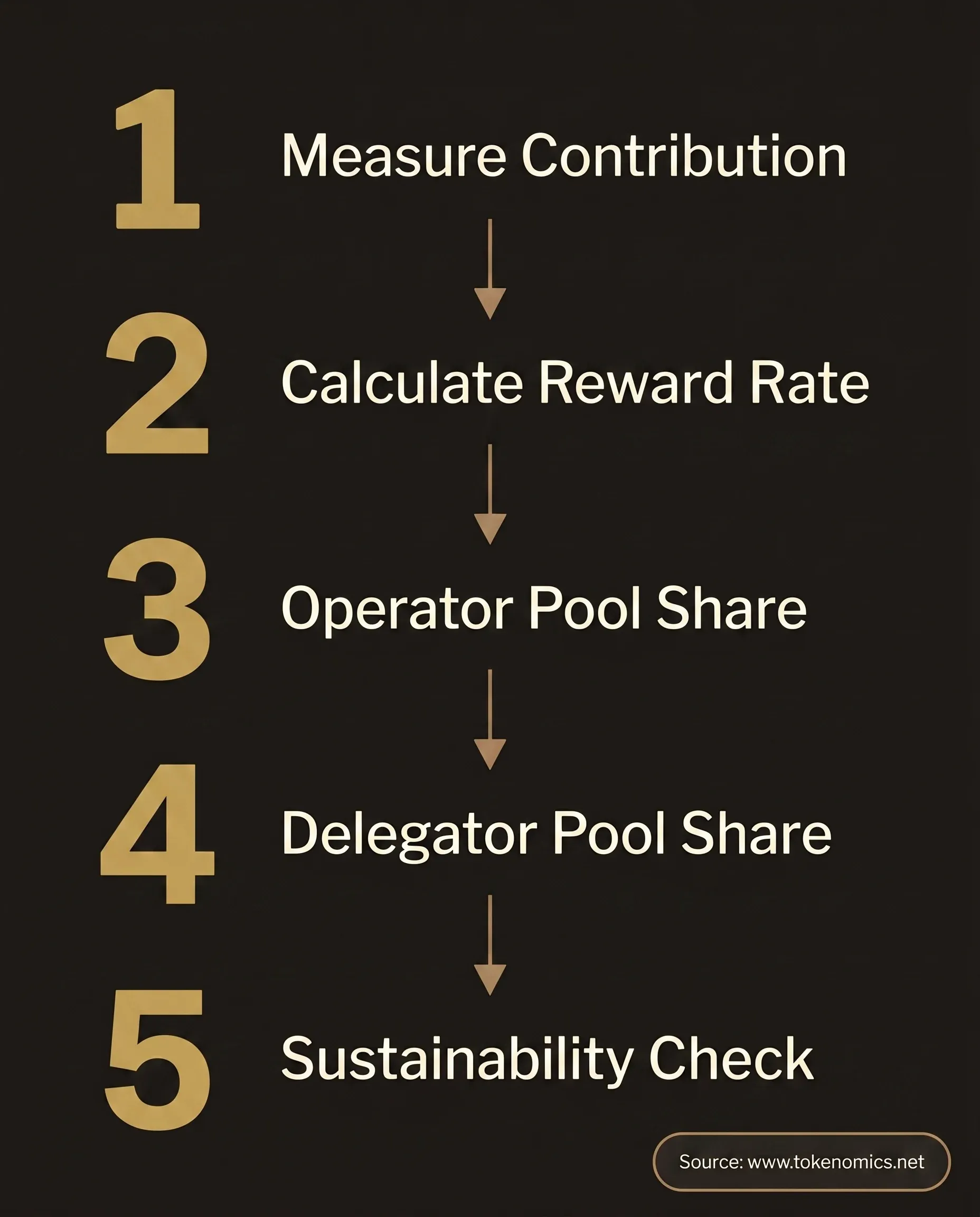
Most DePIN incentive designs treat these two roles identically, paying a single emissions rate to all staked tokens regardless of whether they're from an operator or a delegator. That doesn't work. The operator's economic need is hardware ROI. The delegator's economic need is yield on liquid capital. One fixed emissions rate cannot serve both correctly.
#The Four Design Principles
We use what we call the DePIN Incentive Framework to structure reward mechanics across both participant types. Four principles govern every design decision.
Principle 1: Contribution-linked reward rates. Node operators are compensated based on verifiable network contribution metrics: uptime percentage, tasks completed, bandwidth delivered, storage verified. A node that provides 99.9% uptime across 30 days earns the full reward rate. A node at 80% uptime earns a proportionally reduced rate. This is not a penalty system; it's a measurement system. The reward rate is the expected value of contribution at full performance; actual rewards track actual contribution.
Principle 2: Emissions capped at protocol revenue multiples. The emissions schedule should not outpace the protocol's revenue generation. We have seen across 100+ projects that DePIN emissions schedules designed at peak optimism (projecting 10x revenue growth in 12 months) produce dilution that operators cannot price in their hardware ROI model. The practical design: set initial emissions at a sustainable rate relative to current revenue, with defined step-downs as the network matures. The Helium network's burn-and-mint equilibrium model is the reference for this approach.
Principle 3: Separate operator and delegator reward pools. Maintain separate reward pools for node operator rewards and delegator yields. Operator rewards come from network fees plus a base emissions allocation. Delegator rewards come from a share of the operator's earnings (set at protocol level, adjusted by governance) plus a separate delegator emissions pool. This separation prevents delegators from diluting operator rewards as delegation scales.
Principle 4: Exit friction calibrated to hardware ROI cycles. Node operators commit to multi-year hardware investments. Delegators can exit in days. Exit friction mechanics (unstaking periods, slashing for rapid exit) should be calibrated to the hardware investment cycle, not applied uniformly. Operators with long lock-in commitments can receive higher base reward rates as a return for the liquidity sacrifice. Delegators with shorter lock-up windows receive lower rates. This is the basic token economics of time preference, applied to network infrastructure.
#Common Mistakes We See in DePIN Incentive Design
Rewarding token stake rather than network contribution. The most common failure mode. The incentive pays anyone who stakes tokens at the same rate, regardless of whether they're running infrastructure. This produces token-staking farms that look like network participation but deliver no actual infrastructure capacity. The network's tokenomics look healthy while the infrastructure layer is empty.
Emissions schedules disconnected from revenue. A DePIN protocol that emits $10M in token rewards annually on $500K in protocol revenue is borrowing from its future supply to subsidize current participation. This works until the token price declines enough that operators can no longer justify hardware costs on the diluted reward rate. We have seen this cycle complete in as little as 14 months post-launch.
No separation between operator and delegator mechanics. When delegator staking competes with operator staking for the same reward pool, the equilibrium depends on the ratio of delegation to operation. As delegation grows, operator reward rates compress. Operators exit. Network capacity declines. This is a structurally predictable failure that separated reward pools prevent.
#Frequently Asked Questions
What is DePIN incentive design? DePIN incentive design is the structure of reward mechanics that compensates node operators for providing physical infrastructure capacity and delegators for curating network stake. The core design challenge is linking reward rates to verifiable contribution metrics rather than fixed emissions schedules, while maintaining separate reward pools for node operators and delegators to prevent their incentives from compressing each other.
How do you prevent DePIN emissions from outpacing revenue? Cap initial emissions at a sustainable multiple of current protocol revenue, with defined step-downs as the network matures. Set the emissions schedule based on conservative revenue projections, not peak optimism. Build in governance mechanisms that allow the emissions rate to be adjusted as actual revenue data accumulates. The burn-and-mint equilibrium model (where token burns from protocol fee payments offset token minting from rewards) is the most robust structure for long-duration emissions sustainability.
Should node operators and delegators earn the same reward rate? No. Node operators and delegators have different economic relationships to the protocol. Operators invest capital in hardware; they need deterministic, hardware-ROI-justified rates. Delegators provide liquid stake curation; they need yield that justifies lock-up without requiring hardware-level certainty. Separate reward pools, with rates set independently, serve both correctly.
If you're building a DePIN network and need your incentive design to hold up under operator scrutiny, book a strategy call. We'll assess your project and tell you whether we're the right fit. Sometimes we're not. We'll tell you that too.