
How to Choose a Tokenization Course: Six Points to Check

In short
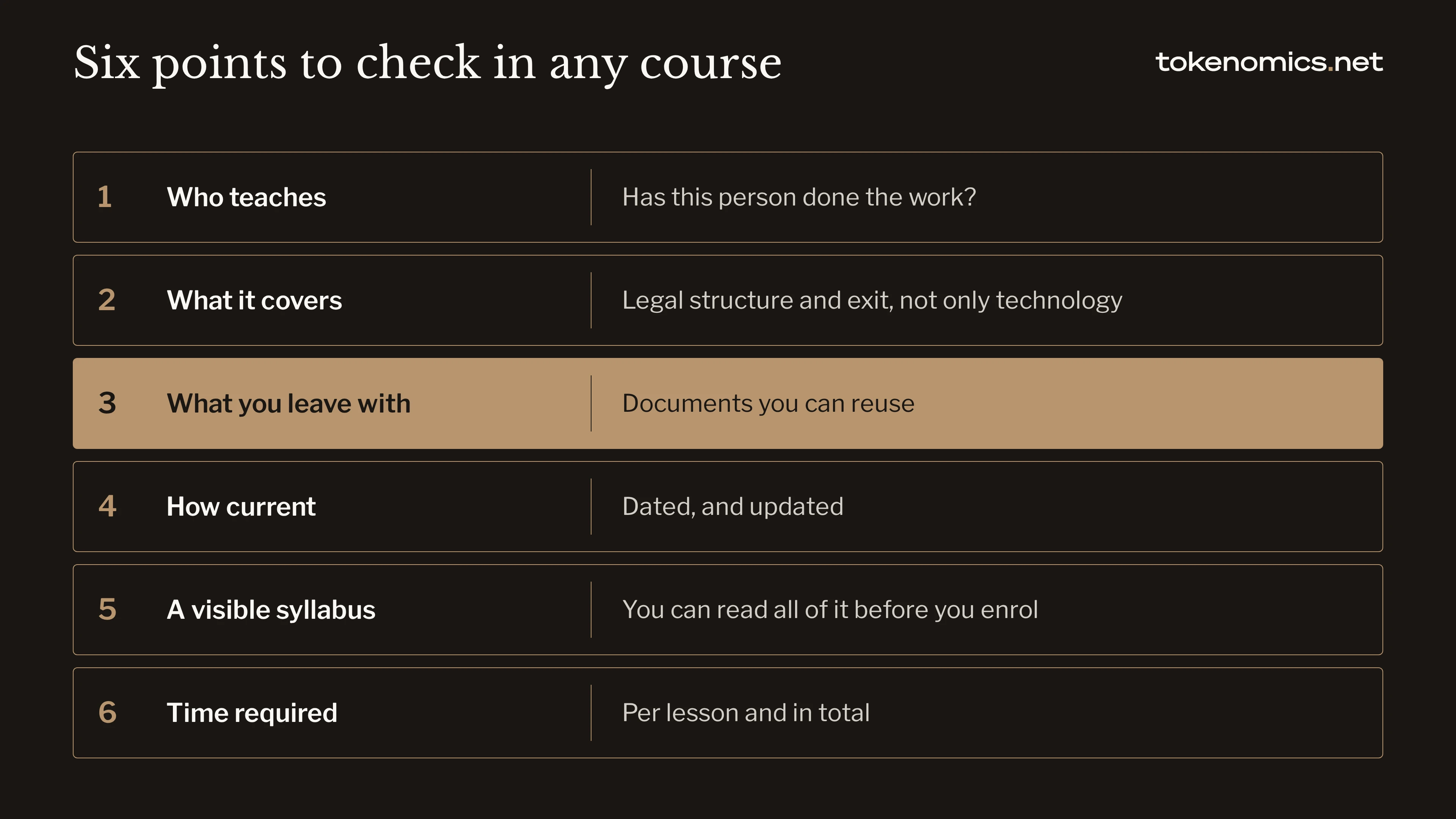
Six points sort a tokenization course from a tour of the technology: who teaches it, whether it reaches legal structure and exit, what you leave with, how current it is, whether the whole syllabus is visible before you enroll, and the time it takes. Including the two points our own course fails.
Judge a tokenization course on six points: who teaches it and whether they have closed deals, whether it reaches legal structure and exit, whether you leave with documents you can reuse, whether it is current, whether the full syllabus is visible before you enroll, and the time it takes. A brand name or a badge is not a test.
Start with why you are buying. Somebody is asking you a question you cannot answer yet, probably a client or a board, and it is about an asset they own rather than about a blockchain. Can we raise against this building without selling it. Who buys a slice of our loan book. What does our fund's partnership agreement allow.
Those are financing and documents questions. A course that answers them changes what you can do on Monday. A course that explains ledgers, wallets and consensus is accurate and will not help, and the only way to tell them apart before you pay is to check the syllabus against the six points below.
We publish a free course ourselves, so read this knowing we have an interest. The six points are useful anyway, because they are hard to pass without having done the work, and we have marked the two where our own course fails.
#Why most courses stop before the hard part
Technology is the part of tokenization that is closest to solved. Issuing a token against a register of owners is routine engineering, and it is also the part that is most fun to teach and simple to examine.
The parts that decide whether a deal happens sit earlier and later. Earlier: what the token represents in law, which entity holds the asset, and which consents the existing paperwork requires, starting with the lender. Later: who buys a slice, and how they turn it back into cash. Those two bookends are where deals stall, and a syllabus that runs from "what is a blockchain" to "deploying your first token" has skipped both.
So the first thing to do with any syllabus is read it backwards. If the last module is a deployment exercise and no module mentions consents, the course ends where your actual problem starts. Our live training and course building work came out of that pattern, because teams kept arriving having already done a blockchain course.
#The six points
#1. Who teaches it
Ask what the person teaching did last quarter, and look for deals rather than appearances.
A strong sign is an instructor who can describe a consent that arrived late and what it cost. A weak sign is a syllabus with no named instructor at all, or a name attached to a platform rather than to engagements.
#2. What it covers
Four things have to appear: the legal wrapper and what the token represents, the consents an existing asset needs, how the owner register and transfers are kept, and where the buyer's exit comes from.
A strong sign is a module about entity structure and one about redemption or resale. A weak sign is a course where the legal section is a single lesson called something like "regulation", with no mention of jurisdiction.
#3. What you leave with
The question is what sits on your desk a month later.
A strong sign is finished documents and editable models you can put your own numbers into. A weak sign is slides and a recording. Teams under-weight this one and then wonder why nothing changed after the training, and the reason is that nobody retains a lecture, they retain a file they reopen.
#4. How current
Ask when the material was last revised and what specifically changed.
A strong sign is a dated syllabus and a provider who can name the revision. A weak sign is undated material, which in this subject is the expensive kind, because jurisdictional treatment of these structures keeps moving and an out-of-date lesson sounds exactly as confident as a current one.
#5. A visible syllabus
You should be able to read every module and every lesson title before you pay or sign up for anything.
A strong sign is the full lesson list on the page. A weak sign is five bullet points of "what you will learn" and a form. A provider who will not show you the contents is telling you something about the contents.
#6. Time required
Look for a time against each lesson, not a headline total.
A strong sign is a per-lesson time, or at minimum a per-module one, so you can build a schedule before you start. A weak sign is a total with no breakdown, or nothing at all. Our own course fails this one, and the detail is in the next section.
#A checklist to take to any course
| Point | The question to ask | A weak answer sounds like |
|---|---|---|
| 1. Who teaches | What did you work on last quarter? | A platform's name, or no name at all |
| 2. What it covers | Which module covers consents, and which covers exit? | "Regulation" as a single lesson |
| 3. What you leave with | What documents do I keep? | Slides and a recording |
| 4. How current | When was this revised, and what changed? | Undated material |
| 5. A visible syllabus | Can I read every lesson title now? | Five bullets and a form |
| 6. Time required | How long is each lesson? | A total, or nothing |
#How our course and training work, scored on the same six
Here is our own scorecard, so you can hold us to the list rather than take our word for it.
Point 1. Tony Drummond teaches it, and the material comes out of the advisory work, which is why the examples are deals somebody had to get done. You can read about the instructors before you hand over an email address.
Point 2. Covered, with a caveat. The operations and compliance module runs thirteen lessons through entity architecture, ownership form and token standard, jurisdiction by jurisdiction, custody, the transaction lifecycle and redemption. Its second lesson is called "the compliance mindset: scope it, don't solve it", which is the honest framing, because a course produces the question list and counsel produces the answers. The caveat is point 2's second bookend. Exit is taught as token liquidity, pool depth and slippage, which is the issuer's version of the question. If you own a building and your question is who resells that slice and where, the lessons cover less of it than the advisory work does.
Point 3. Strong, and it is the reason to bother. 67 lessons, 11 finished deliverables running from a 22-page project charter to a 58-page whitepaper, and nine editable templates including a revenue model, a token distribution designer and the Monte Carlo simulation code. The worked examples are built around a fictional company we created for the course, so you do the translation to your own asset. That is a real limitation and it is also deliberate, since the alternative is teaching from a client's confidential file.
Point 4. We fail this one too. No revision date appears anywhere on the course page, so you cannot check whether a lesson is current without asking us, and our word is not a date.
Point 5. Strong. Every module and every lesson title is on the free tokenomics course page before you sign up for anything. The intro video plays with no account, and the 67 lessons, the deliverables and the Readiness tools open with a free one.
Point 6. We fail this. The worksheets state their own time budget, most of them ten to fifteen minutes, and the 67 lessons publish no runtime at all, so you cannot build a study schedule from the page before you start. It is a fair complaint, we have no excuse for it, and the fix is ours.
For teams rather than individuals, the same teaching runs as live training and course building, either in a room with your own people and your own deals or as a course we build for you to publish under your name. If what you want is the order of study rather than a course, learning tokenomics on your own sets out the five stages.
#Frequently Asked Questions
#Is there a free course on asset tokenization?
Ours is free. The intro video plays with no account, and the 67 lessons, the 11 finished deliverables and the Readiness tools open with a free account.
#How long does a tokenization course take?
Check the syllabus and look for a time against each lesson rather than a headline total. If no provider publishes per-lesson times, including us, count the lessons and plan conservatively.
#Do I need a technical background?
Not for the economics, the structure or the documents, which is most of this subject. Our own course works in spreadsheets and written deliverables, and its one piece of code is simulation code you run rather than write.
#What should a tokenization course cover?
The legal wrapper and what the token represents, the consents an existing asset needs, how the owner register and transfers are kept, and where a buyer's exit comes from. Technology that stops short of those four has covered the easy part.
#Is a certificate worth it?
A certificate is evidence of attendance, which is worth something to an employer and nothing to a client. The part that holds up in a meeting is the documents and worked examples you can reuse.
#Where to start
Take the six points to whatever you are considering, including the free tokenomics course. Point 5 means you can check our syllabus against point 2 in about ten minutes, which is the right way round to make this decision.
Tokenomics.net is an advisory and education firm for token issuers and asset owners. Read the syllabus backwards. The last module tells you where the course stops.
Bring the question to a call
Thirty minutes with the team that wrote this, on your token or your asset. You leave knowing what to fix first.