
Roark Aerospace
Simulation-Driven Reward Mechanism Design for Aerospace DePIN
Executive Summary
Roark Aerospace is building a decentralized physical infrastructure network (DePIN) for aerospace data collection. Their network relies on distributed devices that provide coverage, uptime, and new data to the system. The core challenge: how to fairly reward device operators for genuine contribution without creating exploitable loopholes or punishing high performers.
Tokenomics.net was engaged to design and validate a rewards distribution mechanism through rigorous simulation and analysis. Rather than relying on theoretical models alone, we built production-grade simulation code to stress-test the reward formula across thousands of scenarios.
Figures in this case study have been adjusted for confidentiality. The methodology and outcomes described are accurate representations of the engagement.
The Challenge
Roark's initial reward mechanism exhibited concerning behaviors when analyzed at scale:
- Monotonicity violations: Devices with better performance metrics sometimes earned less than underperformers
- Placement bias: Geographic positioning dominated actual contribution in reward calculations
- Low-overlap waste: Significant rewards flowing to devices providing redundant coverage
- Fairness gaps: New entrants systematically disadvantaged compared to incumbents
Technical Approach
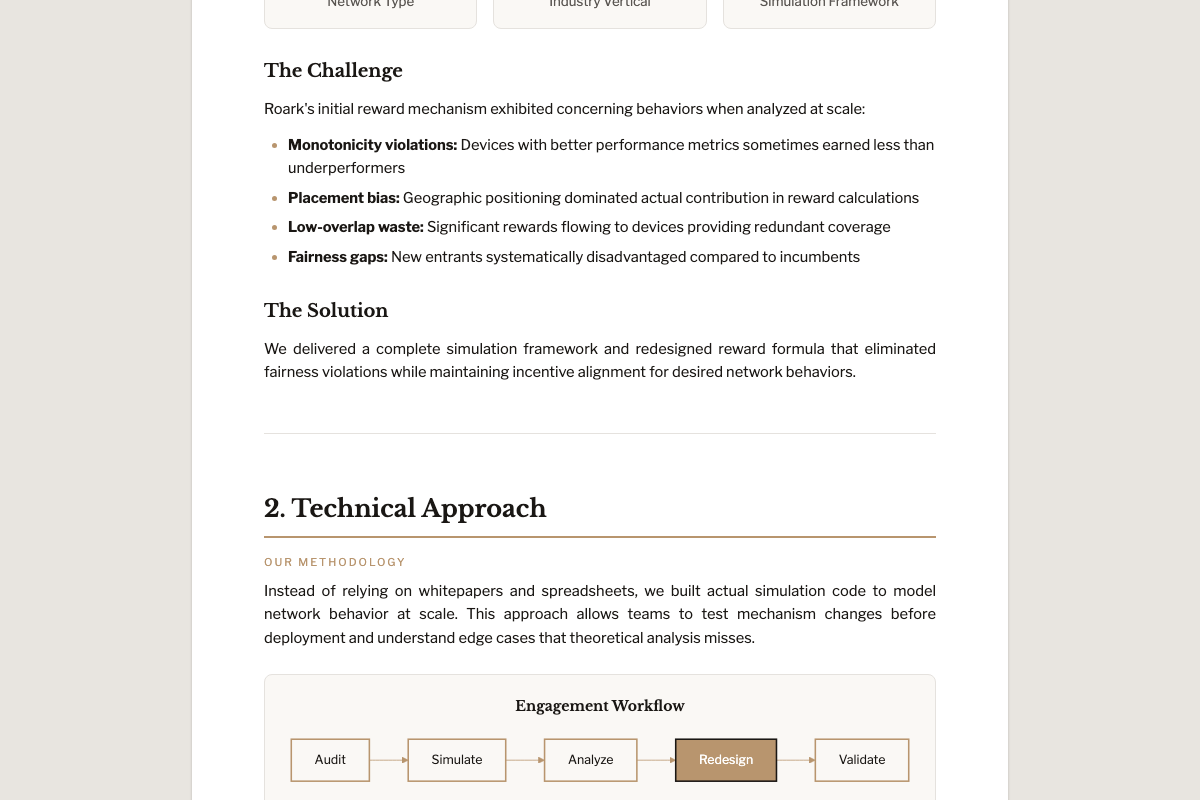
Instead of relying on whitepapers and spreadsheets, we built actual simulation code to model network behavior at scale. This approach allows teams to test mechanism changes before deployment and understand edge cases that theoretical analysis misses.
Engagement Workflow
Audit → Simulate → Analyze → Redesign → Validate
Technical approach and network model
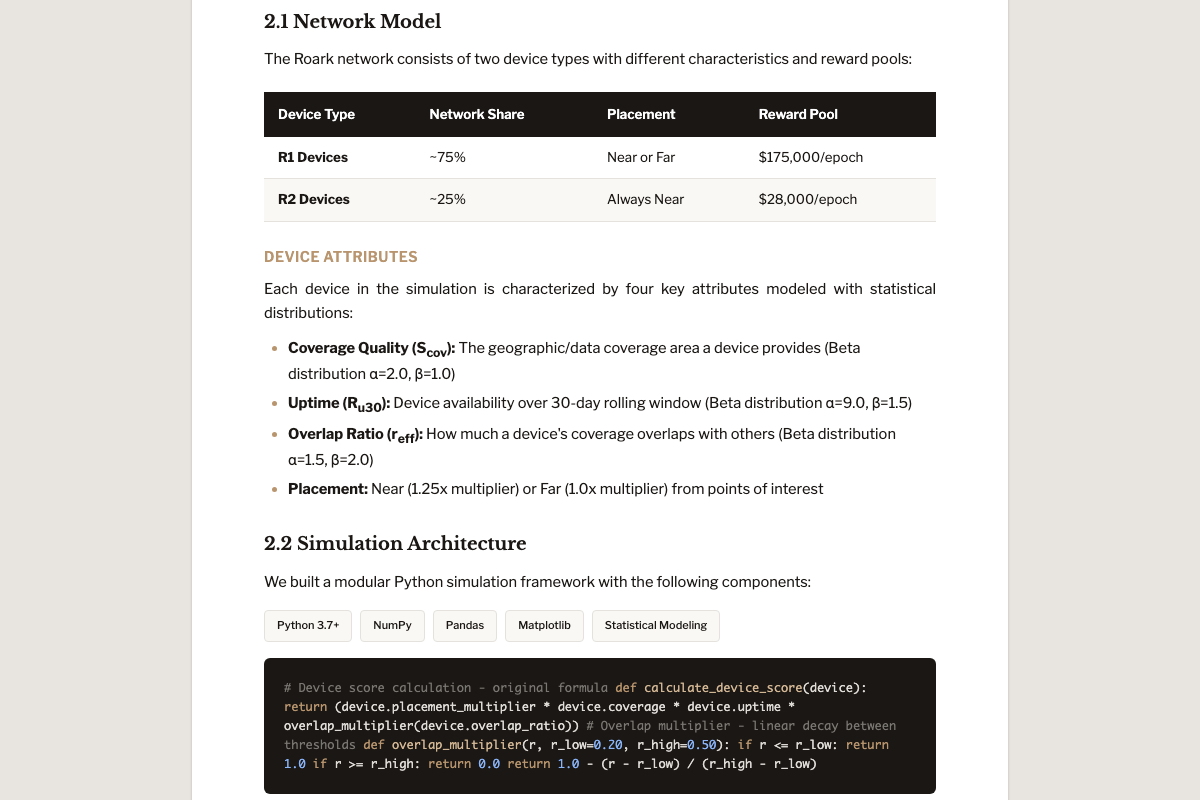
Network Model
| Device Type | Network Share | Placement | Reward Pool |
|---|---|---|---|
| R1 Devices | ~75% | Near or Far | $175,000/epoch |
| R2 Devices | ~25% | Always Near | $28,000/epoch |
Why simulation: At 12,500+ device runs, we could observe edge cases and distribution failures that don't show up in spreadsheets.
Analysis Results
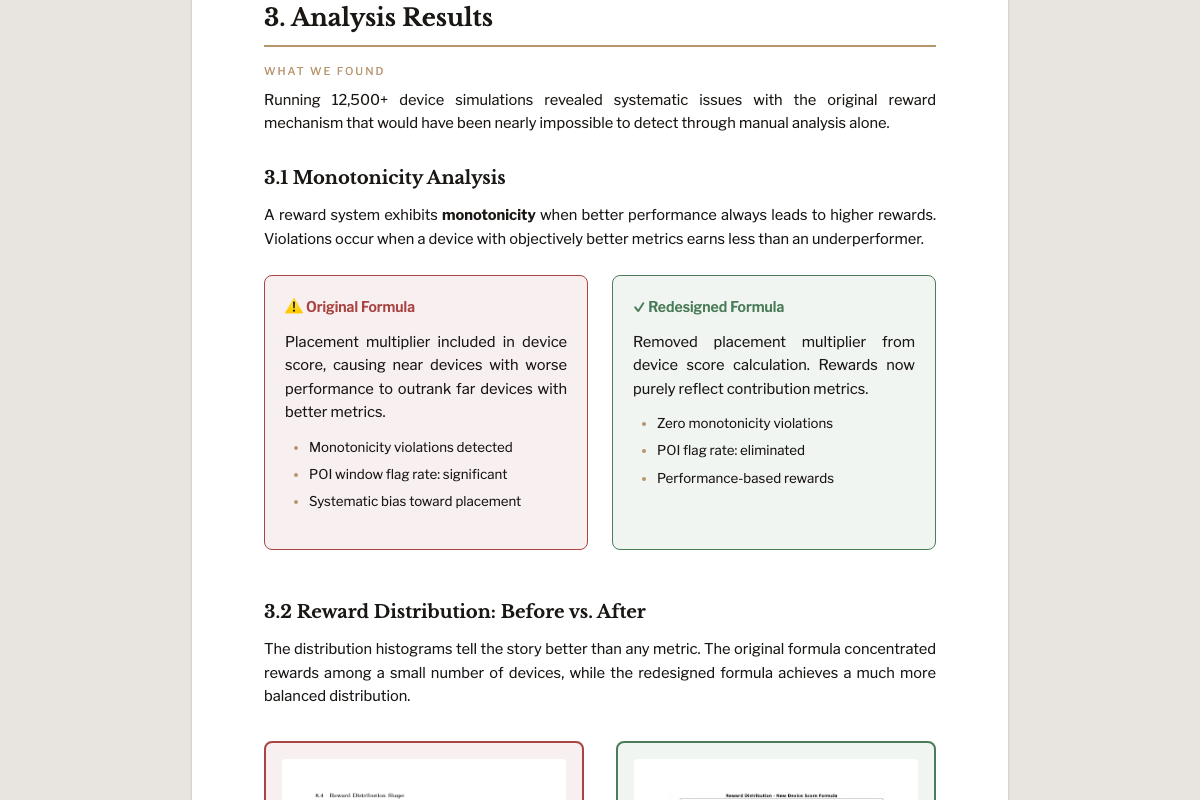
Running 12,500+ device simulations revealed systematic issues with the original reward mechanism that would have been nearly impossible to detect through manual analysis alone.
Simulation results and fairness analysis
Impact: The redesigned formula increased alignment between real contribution and rewards while eliminating fairness violations.
Reward Distribution: Before vs. After
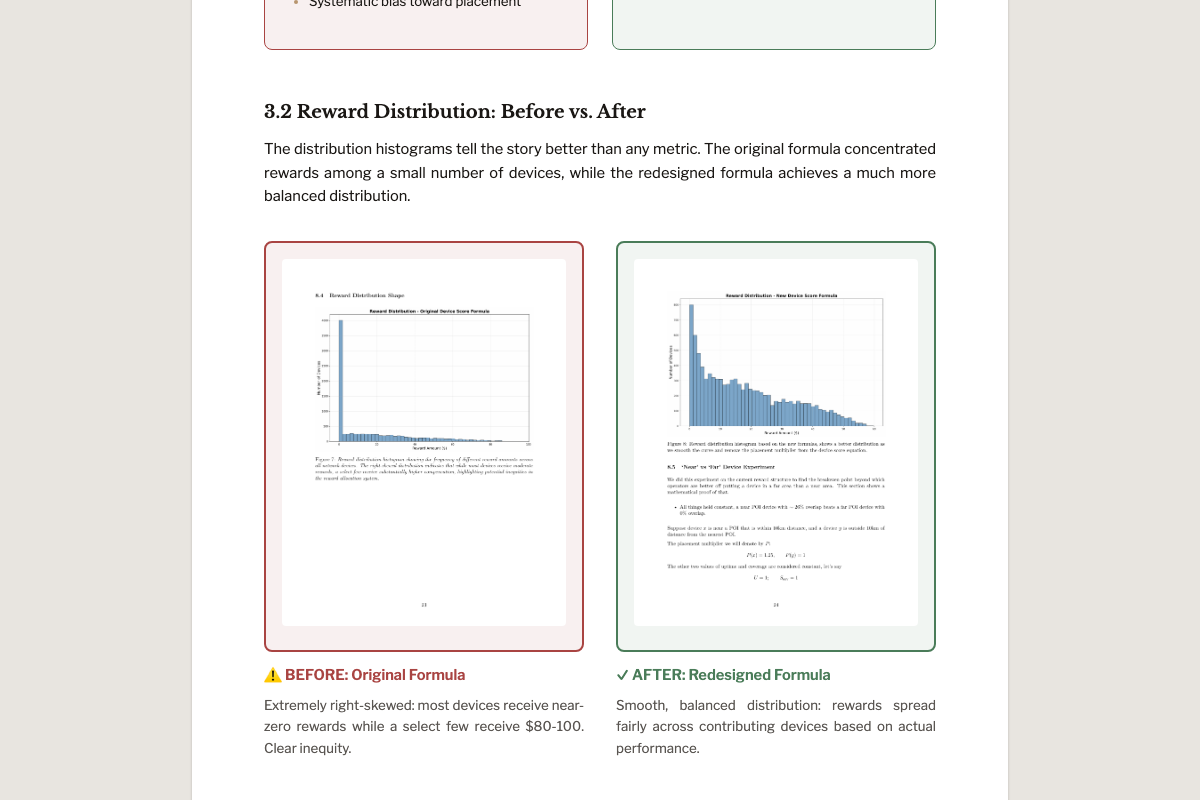
The distribution histograms tell the story better than any metric. The original formula concentrated rewards among a small number of devices, while the redesigned formula achieves a much more balanced distribution.
Reward distribution before vs. after
Design outcome: Balanced distribution with rewards that correlate to coverage and reliability.
The New Reward Formula
| Term | Description | Purpose |
|---|---|---|
| S_cov | Coverage score | Reward meaningful spatial contribution |
| R_u30 | 30-day uptime reliability | Incentivize consistent operators |
| O(r_eff) | Overlap penalty | Reduce redundant rewards |
Interpretation: Rewards scale with contribution and reliability, while overlap reduces waste.
Correlation Analysis
We validated that the redesigned formula properly correlates rewards with desired behaviors:
Correlation matrix validation
Result: Higher coverage and uptime now reliably map to higher rewards, as intended.
Deliverables
Simulation module architecture
| Deliverable | Description | Purpose |
|---|---|---|
| Simulation framework | Production-grade Python simulation engine for modeling network behavior at scale | Stress-test reward mechanisms across thousands of scenarios before deployment |
| 40-Page In-Depth Report | Comprehensive analysis covering all formulas, recalculations, simulation results, fairness checks, distribution charts, and statistical analytics | Single source of truth documenting the complete reward mechanism redesign with auditable math |
Ongoing Value: The simulation framework is designed for reuse. As Roark's network evolves, the team can modify parameters and rerun simulations to validate mechanism changes before deployment.
Impact & Outcomes
Strategic Value
- Investor confidence: Data-backed reward mechanism that can withstand scrutiny
- Community trust: Transparent, provably fair reward distribution
- Operational tooling: Ability to simulate and validate future mechanism changes
- Technical documentation: Clear formulas and rationale for network participants
Book a Free Discovery Call
Get a clear plan for incentives, demand capture, and long-term sustainability — and see exactly what working together looks like.