Tokenomics Compliance Documentation: Your Legal Foundation
Tokenomics compliance documentation protects your project from regulatory penalties, enables exchange listings, and builds investor confidence through proper legal structure.


Tokenomics compliance documentation exists because securities laws, KYC/AML standards, and jurisdictional regulations demand it. These documents—Token Purchase Agreements, Investment Memoranda, white papers, and Token Legal Opinions—detail token rights, risks, supply mechanics, and governance structures that protect investors and satisfy regulatory requirements. Without them, you can't list on reputable exchanges, you can't raise capital from institutional investors, and you expose yourself to enforcement actions that can shut down your project.
The regulatory environment isn't getting more lenient. Projects that treat compliance as an afterthought are setting themselves up for problems.
#Why Compliance Documentation Matters Now
The difference between projects that survive regulatory scrutiny and those that don't comes down to documentation. Not marketing materials. Not community hype. Documentation that holds up when regulators, exchanges, and institutional investors look under the hood.
Token classification under securities laws varies by jurisdiction. What passes in one market creates liability in another. Your documentation needs to address this complexity upfront, not after you've already distributed tokens.
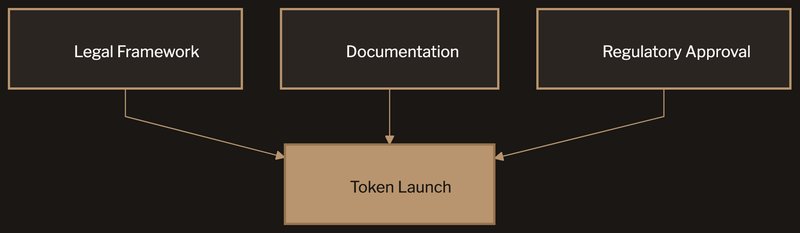
Proper compliance documentation includes Token Purchase Agreements that outline terms, conditions, risks, token sale roadmaps, disclaimers, allocation structures, and investor rights. These aren't optional. They're the legal foundation that determines whether your token launch succeeds or becomes a liability.
Exchange listings require proof. Reputable platforms won't list your token without a Token Legal Opinion that specifies the legal qualifications of your token functions and regulatory status. This document takes weeks to prepare properly because it requires analysis from qualified legal counsel familiar with securities law in your target jurisdictions.
"The regulatory landscape for digital assets is changing rapidly, and projects that proactively address compliance through proper documentation are positioning themselves for long-term success while others face increasing scrutiny." — Gary Gensler, Former Chair, U.S. Securities and Exchange Commission (SEC Statement on Crypto Assets)
Compliance isn't just about avoiding penalties. It's about building investor confidence. Institutional capital requires institutional-grade documentation. Retail investors deserve protection. Your legal team needs defensible positions. Your developers need clear implementation specs. Everyone's interests align when you get your house in order from the start.
According to Blockchain App Factory, the compliance hardening phase typically requires 31 to 90 days for proper execution before token launch. This timeline covers audit completion, policy documentation, and regulatory review. Projects that try to compress this timeline create vulnerabilities that surface later.
Additionally, tokenization legal kits emphasize that investor data provision must comply with data protection rules for compliance. GDPR and similar regulations affect how you collect, store, and use investor information, making proper documentation essential from day one.
#Core Documentation Requirements
Your tokenomics compliance documentation package consists of several interconnected documents. Each serves a specific legal function. Missing any of them creates gaps that regulators and sophisticated investors will identify immediately.
Token Purchase Agreement defines the contractual relationship between your project and token purchasers. This document must include comprehensive risk disclosures, token sale terms, allocation schedules, vesting structures, and investor rights. It establishes the legal framework for the entire token distribution.
Token Purchase Agreements outline terms, conditions, risks, token sale roadmap, disclaimers, allocation, and investor rights. These agreements create binding obligations that protect both parties and establish clear expectations about token functionality, distribution timelines, and holder rights.
Investment Memorandum provides detailed information about your token: ticker symbol, technical features, total supply, pricing structure, distribution plan, and risk factors. This document serves as the primary disclosure vehicle for investors conducting due diligence. Investment Memoranda must include token description, ticker, features, supply, price, rights, distribution plan, and risk disclosures comprehensive enough to satisfy securities law disclosure requirements while remaining accessible to non-technical investors.
White Paper with Regulatory Compliance goes beyond marketing. Your white paper needs sections addressing tokenomics mechanics, consensus mechanisms, governance structures, and explicit regulatory alignment. White papers must address tokenomics, consensus, governance, and comply with regulatory standards for ICOs and STOs, including risk disclosures that meet securities law requirements.
Token Legal Opinion confirms your token's legal classification and regulatory status. Token Legal Opinions specify legal qualifications of token functions and status, required for exchange listings. Legal opinions take time because they require analysis from qualified counsel who understand both blockchain technology and securities law across multiple jurisdictions.
Smart Contract Audit Reports provide technical verification that your token contracts function as documented. Audits must cover token logic, vesting mechanisms, staking contracts, treasury controls, and bridge implementations. Technical security and legal compliance intersect here—your contracts must do what your legal documents say they do.
KYC/AML Policies and Procedures document your processes for investor due diligence, identity verification, and background checks. These policies demonstrate your commitment to preventing money laundering and terrorist financing. Regulators expect documented procedures, not informal practices.
The compliance timeline matters. Rushing documentation creates legal vulnerabilities that can't be fixed retroactively. Your documentation needs to be complete before you distribute tokens, not after.
#The Revenue-First Documentation Approach
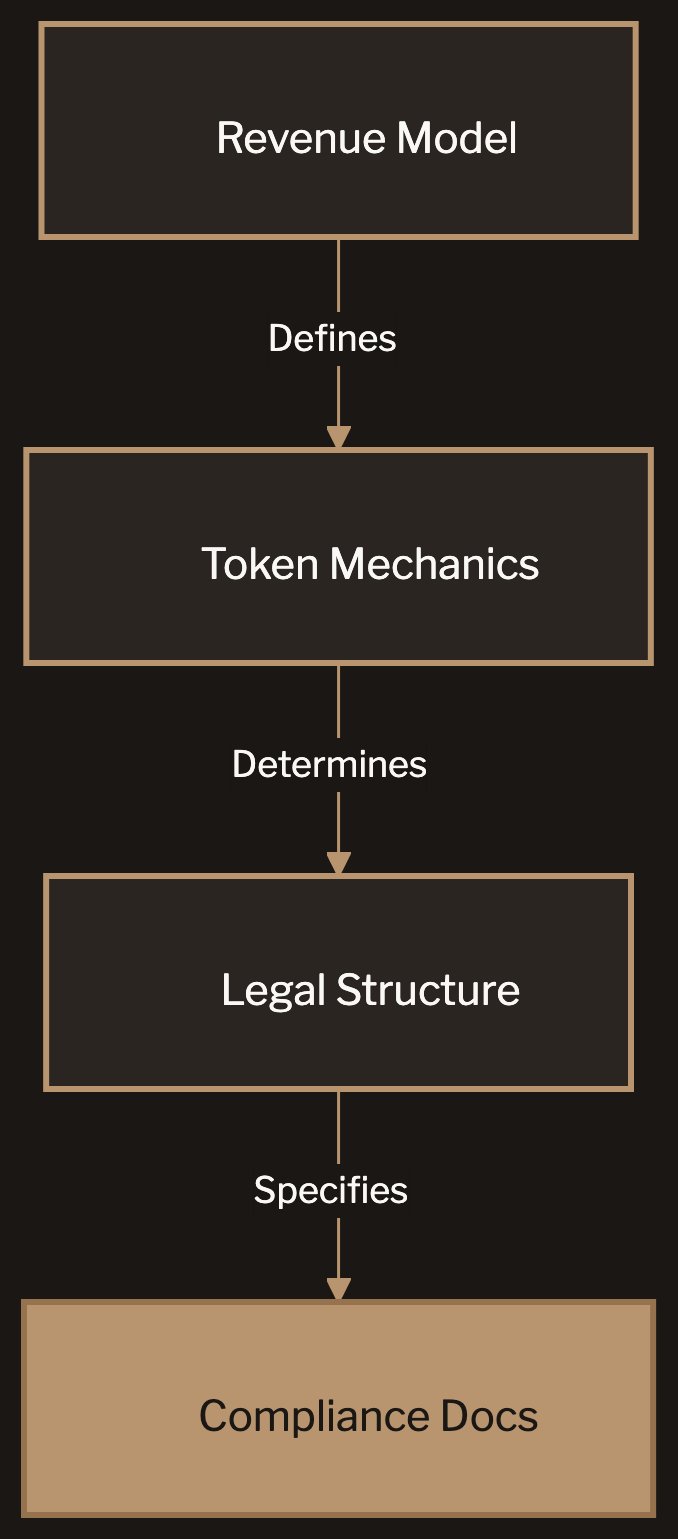
Documentation should follow your business model, not lead it. The Revenue-First Design methodology applies to compliance documentation just as it applies to tokenomics design. Your legal structure must support sustainable revenue generation, not just token distribution.
Start with how your business actually makes money. Document that first. Then build your token mechanics around it. Your compliance documentation should clearly articulate the revenue sources, cash flows, and value accrual mechanisms that make your token economically viable.
This approach creates alignment between your legal structure and your business reality. Investors can see how revenue flows through the system. Regulators can assess whether your token functions as a security. Your team can implement mechanisms that match the documented design.
Token classification depends on function, not intention. If your token provides profit-sharing, voting rights on business decisions, or returns based on others' efforts, securities laws likely apply. Your documentation needs to acknowledge this reality and structure accordingly.
Permissioned tokens assist compliance by identifying holders, controlling tokens, and enforcing KYC/AML. For security tokens and RWA projects, permissioned architectures provide the technical foundation for regulatory compliance. Your documentation should specify these technical controls and their legal purposes.
Revenue models determine token utility. If your token provides access to platform services, your documentation should emphasize functional utility. If your token provides ownership rights or profit participation, your documentation needs to address securities law implications.
The connection between revenue and compliance isn't optional. Your legal structure must support your business model. Misalignment between how you make money and how you document your token creates regulatory risk that compounds over time.
#Documentation for Different Token Types
Not all tokens require the same documentation. Your compliance package depends on your token's function and regulatory classification.
Utility tokens that provide access to platform services need documentation emphasizing functional utility over investment returns. Your white paper should detail how tokens enable specific platform features. Your purchase agreement should clarify that tokens are sold for use, not investment. Even utility tokens need proper documentation—the classification isn't automatic.
Security tokens require the full compliance package. Token Purchase Agreements must meet securities law standards. Investment Memoranda need comprehensive risk disclosures. You need legal opinions confirming securities status. You need broker-dealer licensing if you're involved in distribution. Security tokens face the highest documentation burden because they provide ownership rights, profit participation, or investment returns.
Governance tokens sit in a gray area. Pure governance rights may not trigger securities classification, but governance combined with profit-sharing or treasury access likely does. Your documentation needs to clearly delineate what governance rights your token provides and whether those rights create securities law implications.
RWA tokens that represent real-world assets require documentation connecting the token to the underlying asset. You need legal structures establishing ownership, custody arrangements, and redemption rights. Real estate tokenomics and other RWA projects need documentation that satisfies both securities laws and property laws. For more on RWA-specific compliance requirements, see our guide on RWA token compliance.
Stablecoins face unique regulatory scrutiny around reserve backing and redemption mechanisms. Your documentation must prove that reserves exist, specify custody arrangements, and detail redemption processes. Algorithmic stablecoins face additional scrutiny around mechanism stability and risk disclosures.
Token standards matter for compliance. ERC-3643 provides built-in compliance features for security tokens, including identity management and transfer restrictions. ERC-1400 offers similar functionality for regulated assets. Your choice of token standard affects your documentation requirements and compliance capabilities.
Each token type creates different legal obligations. Your documentation package needs to match your token's actual function, not what you wish it was. Misclassifying your token doesn't make securities laws go away—it just makes your documentation inadequate when scrutiny arrives.
#Building Your Compliance Documentation Package
Creating proper tokenomics compliance documentation isn't a linear process. It requires coordination between legal counsel, technical teams, and business leadership.
Start with legal counsel qualified in securities law and blockchain technology. Not all lawyers understand token mechanics. Not all blockchain lawyers understand securities law. You need both. Expect to pay for quality—legal opinions from qualified counsel aren't cheap, but they're cheaper than regulatory enforcement actions.
Your documentation timeline should align with your launch roadmap. Build compliance considerations into your project plan from the start, not as an afterthought when you're ready to launch.
Technical documentation must match legal documentation. Your smart contract audit reports should confirm that code implements what your legal documents promise. Discrepancies between technical implementation and legal documentation create liability. Use the same terminology across all documents.
Financial modeling supports your documentation by demonstrating economic viability. Monte Carlo simulation helps stress-test your token mechanics under various market conditions. When your legal documents make claims about token economics, your financial models should support those claims with data.
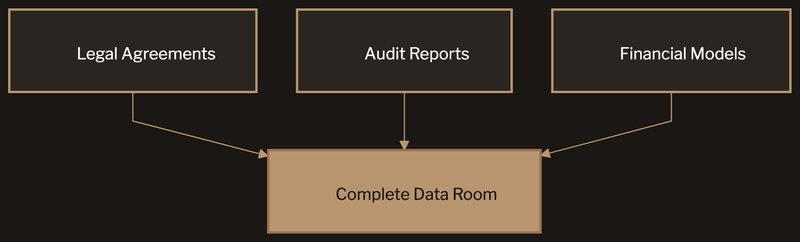
A complete tokenomics data room organizes all compliance documentation in one accessible location. This includes legal agreements, audit reports, financial models, technical specifications, and regulatory analyses. Investors expect organized documentation. Exchanges require it. Your legal team needs it for regulatory responses.
The tokenomics data room checklist provides a comprehensive framework for organizing compliance documentation. Every document should be current, internally consistent, and accessible to relevant stakeholders.
Documentation quality matters as much as documentation existence. Poorly drafted agreements create ambiguity. Incomplete risk disclosures create liability. Outdated technical specs create implementation problems. Invest in getting it right the first time.
#Jurisdictional Considerations
Token regulations vary significantly by jurisdiction. Your compliance documentation must address the specific requirements of every market where you plan to operate or distribute tokens.
United States securities laws apply the Howey Test to determine whether tokens are securities. Your documentation needs to address each prong of this test. If your token meets the definition of a security, you need registration or an exemption. Regulation D, Regulation S, and Regulation A+ provide different exemption frameworks with different documentation requirements.
European Union regulations under MiCA (Markets in Crypto-Assets) create new compliance obligations for crypto asset service providers. Your documentation must address MiCA requirements if you're operating in EU markets. These requirements affect white papers, investor disclosures, and operational procedures.
Asian markets each have distinct regulatory frameworks. Singapore, Hong Kong, Japan, and South Korea all regulate tokens differently. Your compliance package needs jurisdiction-specific documentation for each market you enter.
Licensing requirements vary by jurisdiction and by function. If you're operating as a broker-dealer, exchange, or trading platform, you need appropriate licenses. Your documentation should clearly specify what activities you're conducting and what licenses you hold.
Don't try to navigate this alone. Work with legal counsel who understand international securities law and have experience with token projects. The cost of proper legal guidance is a fraction of the cost of regulatory violations.
Cross-border token sales create complex compliance obligations. You need to understand securities laws in every jurisdiction where you're offering tokens. A token sale that's compliant in one market may violate securities laws in another. Your documentation needs to address these jurisdictional differences explicitly.
#Common Documentation Failures
Most compliance failures stem from documentation gaps that were avoidable. Here's what typically goes wrong.
Inconsistent terminology across documents. Your white paper calls it a "governance token," your purchase agreement calls it a "utility token," and your legal opinion calls it a "digital asset." Pick one term and use it consistently. Inconsistency creates ambiguity that regulators and plaintiffs exploit.
Insufficient risk disclosures. Generic risk language doesn't satisfy securities law requirements. Your risk disclosures need to be specific to your project, your token mechanics, and your market. If your token uses novel mechanisms, those risks need explicit disclosure.
Missing technical specifications. Legal documents that don't specify technical implementation create enforcement problems. How do vesting schedules work? What triggers token burns? How are governance votes counted? Technical specs belong in your documentation.
Outdated documentation. Your white paper from 18 months ago doesn't reflect your current token mechanics. Your purchase agreement references features you deprecated. Keep documentation current or it becomes a liability rather than protection.
No legal opinion. You assumed you didn't need one because you're calling your token a "utility token." Token classification isn't self-executing. Get a legal opinion from qualified counsel confirming your token's regulatory status.
Inadequate KYC/AML procedures. You have a KYC provider but no documented policies. Procedures need to be written, implemented, and auditable. Regulators want to see documented processes, not informal practices.
Misaligned financial projections. Your white paper projects 50% APY on staking rewards. Your financial models show this isn't sustainable beyond six months. Projections in marketing materials must align with financial reality. Overpromising creates securities fraud liability.
Documentation failures compound over time. A small gap at launch becomes a major liability when you're trying to list on exchanges or raise institutional capital. Fix documentation problems before they become regulatory problems.
#Maintaining Compliance Post-Launch
Compliance documentation isn't one-and-done. Your obligations continue after token launch.
Update documentation when token mechanics change. If you modify vesting schedules, update your purchase agreements. If you change governance structures, update your white paper. Material changes require disclosure to token holders.
Maintain audit trails for all compliance activities. Document KYC procedures, investor communications, and regulatory interactions. These records demonstrate good-faith compliance efforts if questions arise later.
Monitor regulatory developments in your operating jurisdictions. Securities laws evolve. New guidance emerges. Your compliance documentation needs to adapt to changing regulatory expectations.
Conduct periodic compliance reviews. Annual reviews at minimum, more frequently if you're operating in multiple jurisdictions or conducting ongoing token sales. Use these reviews to identify documentation gaps and update outdated materials.
Build relationships with qualified legal counsel who can respond quickly to regulatory inquiries. When regulators ask questions, you need answers fast. Having counsel who already understands your project and documentation makes response times manageable.
Investors are demanding tokenomics data rooms as standard due diligence. Your compliance documentation needs to be organized, current, and accessible. Projects that can't produce documentation quickly signal poor operational discipline.
Post-launch compliance requires ongoing attention. Your documentation package isn't static—it evolves with your project. Treat documentation maintenance as operational infrastructure, not a one-time legal expense.
#When to Engage Professional Help
Some projects can handle basic compliance documentation internally. Most can't. Here's when you need professional help.
If your token provides profit participation, voting rights on business decisions, or returns based on others' efforts, you need securities counsel. The stakes are too high to guess.
If you're conducting a token sale to U.S. investors, you need U.S. securities counsel familiar with exemptions and registration requirements. International token sales require counsel familiar with securities laws in each target jurisdiction.
If you're building on permissioned token standards like ERC-3643 or ERC-1400, you need technical documentation that matches your legal structure. This requires coordination between legal and technical teams.
If you're tokenizing real-world assets, you need counsel experienced in both securities law and the specific asset class. Real estate tokenomics requires different expertise than tokenizing commodities or intellectual property.
If you're planning exchange listings, you need documentation that meets exchange requirements. This typically includes legal opinions, audit reports, and comprehensive disclosure documents. Exchanges won't list tokens without proper documentation.
Professional tokenomics documentation services provide the complete package: legal agreements, technical specifications, financial models, audit coordination, and data room organization. Our tokenomics data room service delivers institutional-grade documentation that holds up under scrutiny.
The investment in proper documentation pays for itself by avoiding regulatory problems, enabling exchange listings, and building investor confidence. Projects that skip this step end up paying more later—in legal fees, lost opportunities, or enforcement penalties.
Professional help isn't about outsourcing responsibility. It's about accessing specialized expertise that most projects don't have in-house. Securities law is complex. Token mechanics are technical. The intersection requires professionals who understand both.
#Get Your Compliance Documentation Right
Tokenomics compliance documentation protects your project, your investors, and your team. It's not optional. It's not something to handle after launch. It's foundational infrastructure that determines whether your token project succeeds or becomes a cautionary tale.
The regulatory environment is getting more serious. Projects that treat compliance as an afterthought are setting themselves up for problems. Projects that invest in proper documentation from the start position themselves for sustainable growth.
Your house needs to be in order before you go to market. Comprehensive legal agreements. Technical audit reports. Financial models that support your claims. Risk disclosures that satisfy securities laws. Organized documentation that stakeholders can access and understand.
If you're building onchain and need tokenomics compliance documentation that holds up under scrutiny, book a discovery call. We'll assess your project and tell you whether we're the right fit. Sometimes we're not. We'll tell you that too.